

Merging Function and Form in Your Landscape
Retaining walls with stairs combine structural engineering with practical access, changing steep slopes into functional outdoor spaces. Here’s what you need to know about building them:
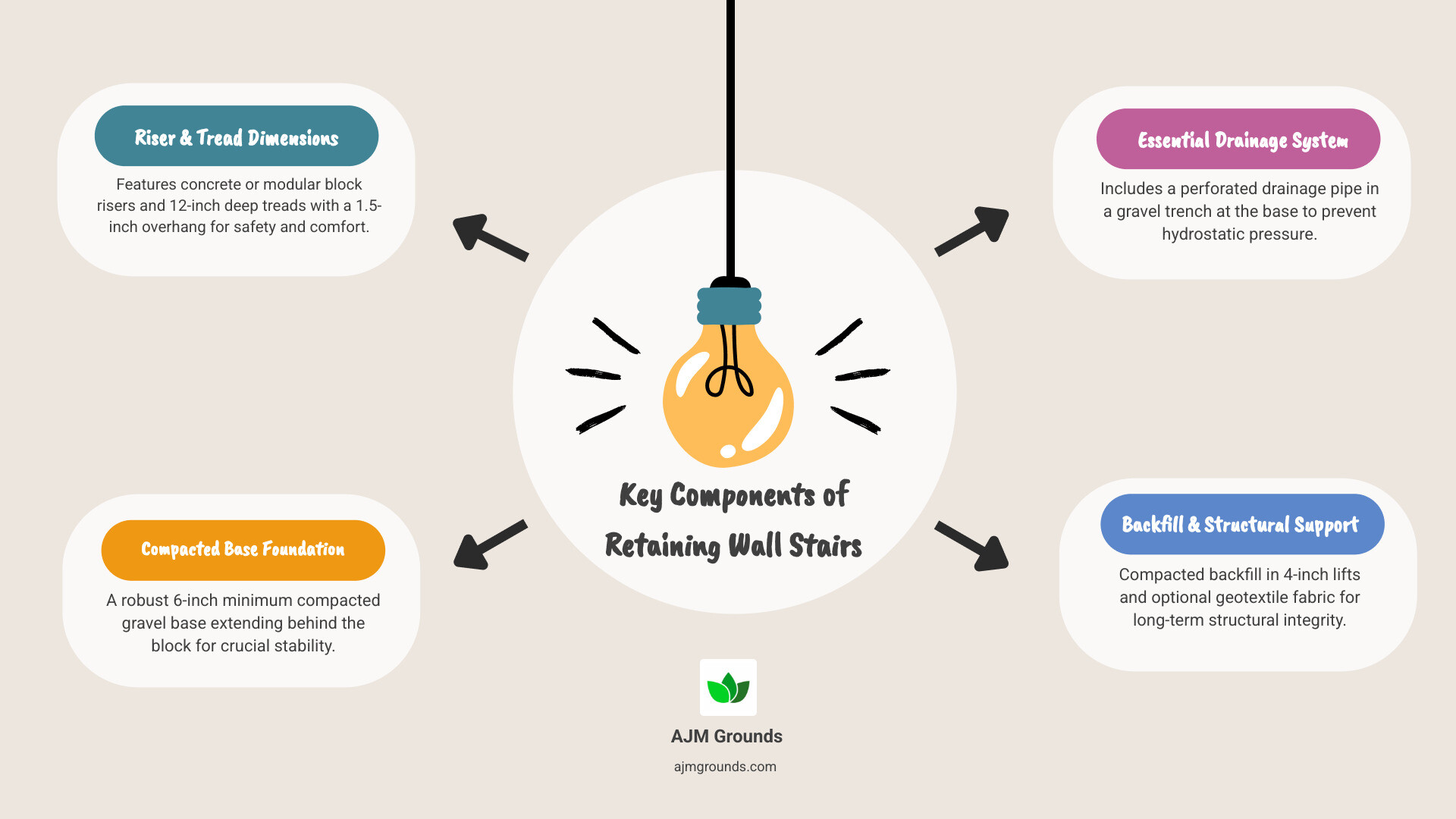
Key Components of Retaining Wall Stairs:
- Rise and Run: Standard 8-inch riser height with 12-inch tread depth
- Solid Base: Minimum 6 inches of compacted gravel under each riser
- Proper Drainage: Perforated pipe and gravel backfill to prevent water buildup
- Secure Treads: Capstones or pavers secured with masonry adhesive
- Structural Integration: Stairs built in sequence with wall courses for stability
Building stairs into a retaining wall isn’t just about connecting two elevations—it’s about creating safe passage while managing soil pressure, water drainage, and structural loads. The process requires careful planning, from calculating the number of steps based on your slope’s total rise (divide vertical inches by 8) to selecting materials that can withstand New England’s freeze-thaw cycles. Poor drainage or unstable footings can lead to settling, cracking, or complete failure of both the stairs and the wall.
I’m John Caplis, owner of AJM Grounds LLC, and over the years I’ve helped dozens of homeowners in Woburn transform challenging slopes into beautiful, accessible outdoor spaces with expertly built retaining walls with stairs. Every project teaches me that the difference between stairs that last decades and those that fail within years comes down to proper base preparation and drainage.
The sections ahead will walk you through the planning, material selection, and step-by-step construction process you need to understand—whether you’re working with a professional or simply want to know what goes into a quality installation.
Learn more about Retaining walls with stairs:
Key Planning and Design for Retaining Walls with Stairs
Before we ever break ground, the magic of a successful retaining wall with stairs project begins with meticulous planning and design. This stage is all about understanding your landscape, envisioning the final aesthetic, and making informed decisions that ensure safety, functionality, and longevity. It’s where we lay the intellectual groundwork for a structure that will serve you well for years to come.
Calculating Stair Dimensions and Layout
The first step in planning your retaining wall stairs is to accurately measure your site and calculate the dimensions for a comfortable and compliant staircase. This isn’t just about looking good; it’s about making sure every step feels natural and safe underfoot.
We start by measuring the total vertical rise of your slope. This is the entire elevation change from the bottom to the top of where your stairs will be. Once we have this number, we can determine the number of steps needed.
A widely accepted guideline for stair design, often cited in resources like The Spruce guide on retaining wall stairs, uses a maximum riser height of 8 inches and a minimum tread depth (run) of 12 inches. This 8:12 ratio is a sweet spot that feels comfortable and meets most residential building codes. For example, with modular block systems like Allan Block, you typically get an 8-inch rise and a 12-inch run.
To find the approximate number of steps needed, we use a simple step calculation formula: measure the total rise of your slope in inches and then divide that number by 8 inches (the approximate height of a typical retaining wall block). For instance, if your slope rises 40 inches, you’d need approximately 5 steps (40 inches / 8 inches per step).
We also focus on adapting to your slope grade. On steep slopes, we keep blocks tight together to maintain that optimal 8-inch rise and 12-inch run. For more gentle slopes, we might add pavers or other materials to increase the tread depth and run length, making the ascent even more gradual.
For longer stairways, incorporating landings is a smart move. These flat, intermediate platforms break up the climb, provide a natural resting spot, and can gracefully connect different sets of steps, making the overall design more inviting and less strenuous. Think of them as scenic overlooks on your journey up the garden!
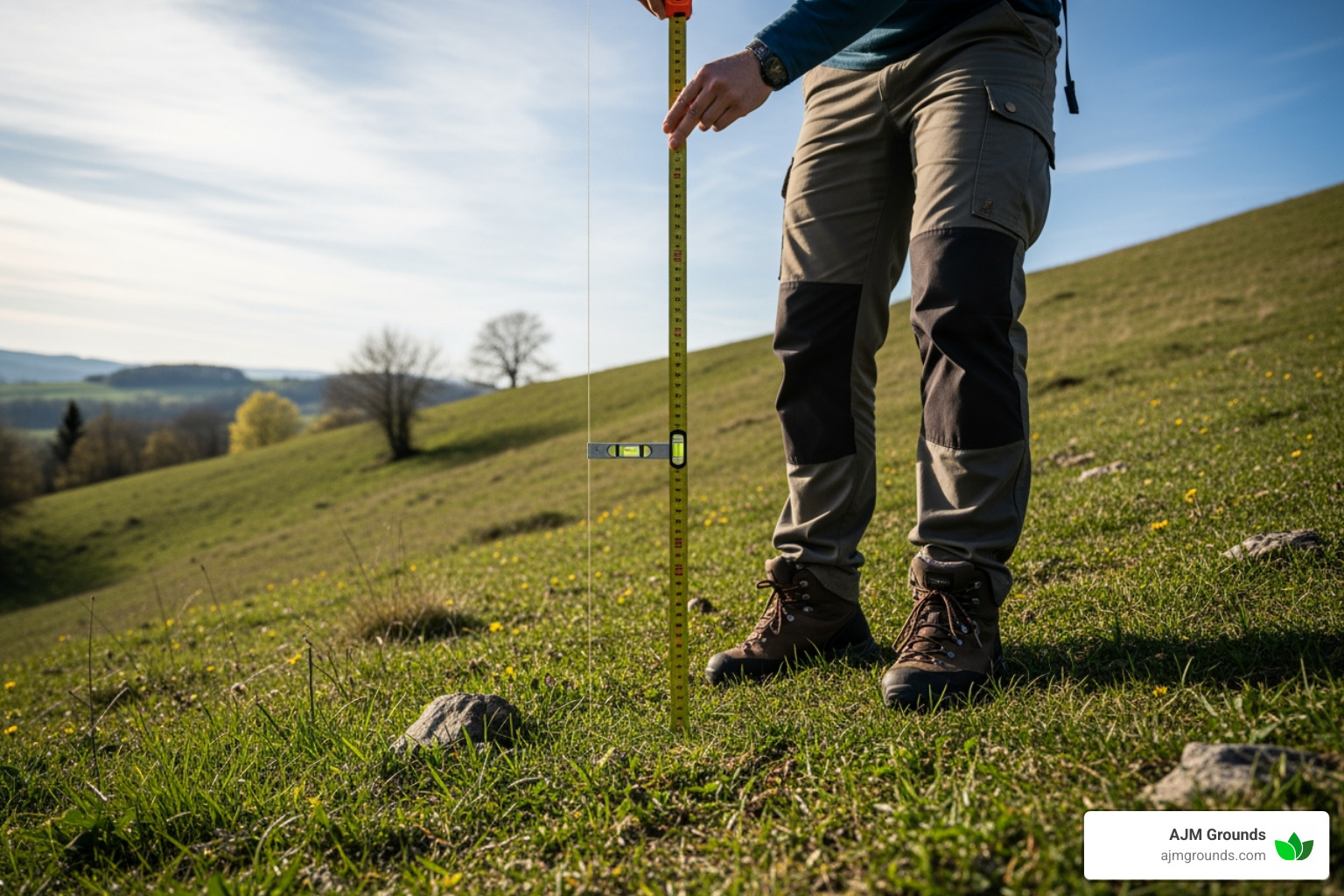
A well-planned layout considers not just the steps themselves, but how they integrate with your surrounding landscape and existing features. For more complex projects, we use our expertise in hardscape construction to ensure every element works in harmony.
Choosing the Right Materials for Risers and Treads
The materials you select for your retaining walls with stairs will dictate not only their appearance but also their durability, maintenance requirements, and overall cost. In New England, where we experience significant freeze-thaw cycles, material choice is paramount. We always recommend materials that can withstand our climate. Homedit’s guide on retaining wall steps provides some insights into various options.
Here’s a comparison of common materials we consider:
| Material Type | Durability | Aesthetic Versatility | Maintenance |
Our experience goes beyond these materials. For more info about stone retaining wall installation, check out our guide.
Critical Design Factors: Drainage, Soil, and Codes
Building retaining walls with stairs is a delicate dance between structural engineering and environmental factors. Ignoring critical design elements like proper drainage, soil conditions, and local building codes can lead to costly and even dangerous failures.
Water management is perhaps the most crucial aspect. A retaining wall, by its nature, holds back soil that often contains significant moisture. Without effective drainage, this water can accumulate, leading to hydrostatic pressure—an immense force that can push even the strongest walls outward.
Water can also soften the base of the wall and stairs, compromising their stability. We always install a perforated drain pipe at the foot of the wall, often with a slight slope (1-2%), surrounded by a clean, washed gravel backfill envelope. Wrapping this assembly in geotextile fabric adds another layer of protection, keeping fine particles out while allowing water to pass freely, as highlighted in guides like this one on attractive retaining wall steps.
Next, we rigorously assess soil conditions. Different soil types have varying load-bearing capacities. For instance, coarse sandy soils can support more weight than stiff clays, especially when wet. Understanding your specific soil type and its compaction standards is fundamental to designing robust footings that can withstand the lateral earth pressures exerted by the retained soil.
Skipping this step can lead to uneven risers, bulging walls, or expensive repairs down the line. We emphasize compacted base material and backfill in lifts (4-6 inches at a time) to prevent settling and ensure long-term stability, a practice detailed in comprehensive guides like this one on mastering retaining wall stairs design. For more on preparing the base, explore our insights on paver base for a retaining wall.
Finally, we must always adhere to local building codes and permit requirements. In Massachusetts, many jurisdictions require permits for retaining walls over a certain height (often around 4 feet). These codes also dictate minimum clear widths, maximum riser heights, minimum tread depths, and often, specific requirements for handrails.
For example, handrails are typically required if the stair rise exceeds 30 inches. According to InterNACHI guidelines, a handrail should resist a 200-pound load in any direction, be mounted between 34 and 38 inches high, and have a comfortable grip size (1¼- to 2-inch diameter). We ensure all our projects in Woburn, MA, and surrounding towns like Bedford, Burlington, and Lexington, meet or exceed these critical safety and structural standards.
The Construction Process: Building Your Stairs Step-by-Step
With thoughtful planning and design complete, we move to the exciting phase of bringing your retaining walls with stairs to life. This is where precision and proper technique are paramount, ensuring a structure that is not only beautiful but also incredibly strong and safe.
Preparing the Foundation for Your Retaining Walls with Stairs
Just like building a house, a strong foundation is non-negotiable for retaining walls with stairs. This initial preparation sets the stage for the entire project’s stability and longevity.
Our first task is site excavation. We carefully mark out the footprint of your stairs and retaining wall, then excavate the area to the necessary depth and width for each stair riser and the main wall. This includes removing any organic matter or unsuitable soils. The trench depth is crucial; it must accommodate the base material and the first course of blocks, ensuring the first riser is at the correct finished height.
Once excavated, we focus on compacting the base material. This is a step we never skimp on. We lay down a minimum of 6 inches of clean, crushed stone or gravel, and then compact it thoroughly using a plate compactor. For best results, we compact to 95% Standard Proctor, ensuring a rock-solid, non-settling foundation. Guides like those from Allan Block consistently emphasize the need for a minimum of 6 inches of base material under each stair riser, extending at least 6 inches behind the retaining wall block.
Next comes installing the first course of blocks. These blocks are often partially or fully buried, forming the true base of your stairs. We carefully place them, ensuring they are perfectly level side-to-side and front-to-back. This leveling and alignment of the first course is absolutely critical; any errors here will compound with every subsequent step, leading to an uneven and potentially unsafe staircase. We use string lines and spirit levels to verify every block’s position.
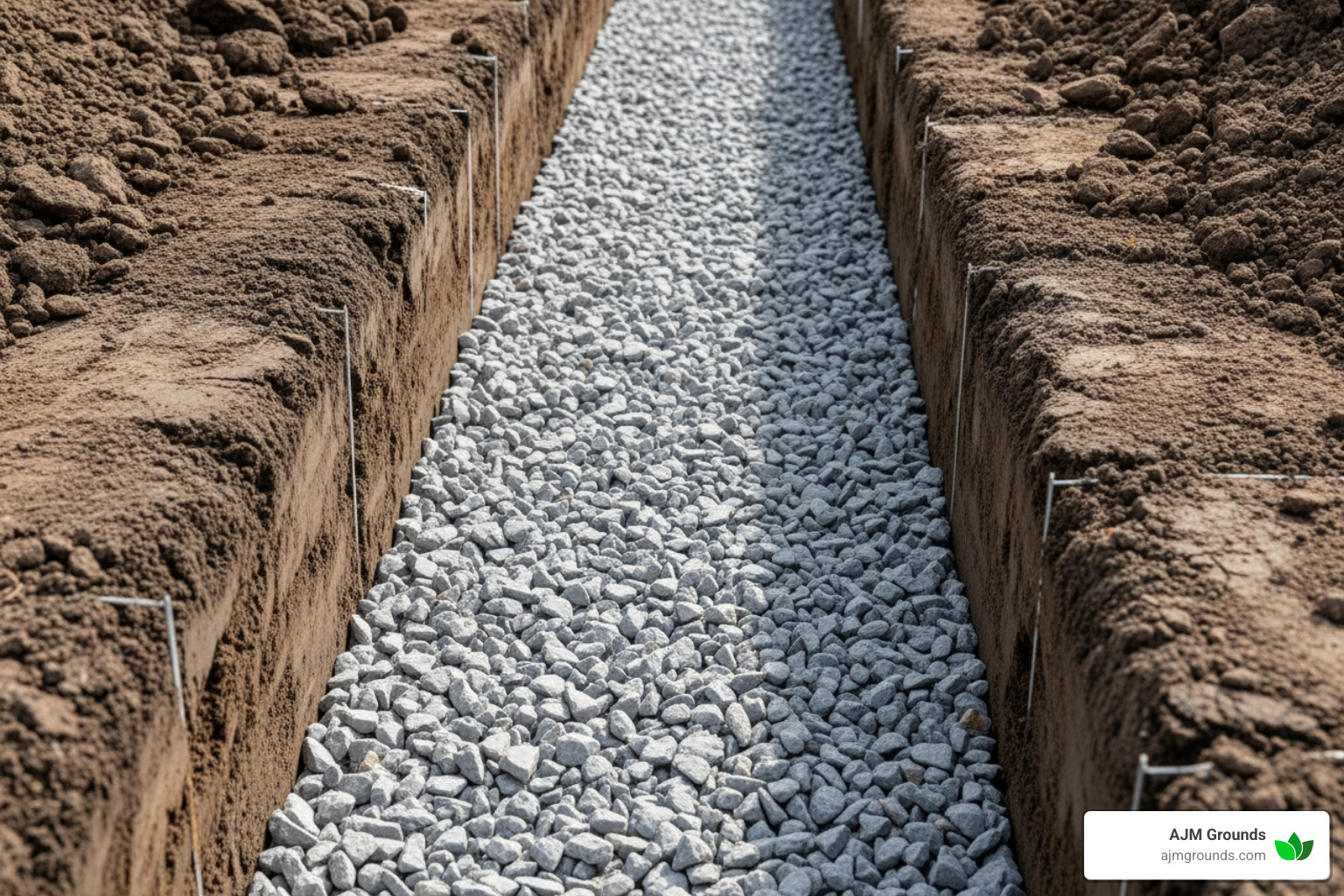
This foundation work is the backbone of your project. For more detailed insights into this crucial stage, you can explore our guide on how to install a block retaining wall.
Building Upward: Stacking Risers and Integrating with the Wall
Once the foundation is solid, we begin the vertical construction, carefully stacking successive courses to form the risers of your stairs and the height of your retaining wall. This phase demands precision and an understanding of how each component contributes to the overall strength.
A key technique we employ is staggering joints, also known as a half-bond pattern. This means that the vertical joints between blocks in one course are offset from the joints in the course below it. This creates a mechanical interlock, distributing weight evenly and significantly enhancing the structural integrity of both the stairs and the wall. Think of it like bricklaying – you wouldn’t stack bricks directly on top of each other with aligned joints, right? The same principle applies here.
As we build upward, we continuously focus on backfilling in lifts and compacting backfill. After each course of blocks is laid, we backfill the area behind the wall and within the stair structure with drainage-friendly material, typically crushed gravel. This backfill is placed in thin layers, or “lifts,” usually 4-6 inches deep, and then thoroughly compacted before the next course is laid. This process of layering and compacting is essential for preventing future settlement and ensuring the wall and stairs remain stable. We’ve seen our share of landscaping mishaps from improper compaction, and trust us, it’s not a pretty sight!
The secret to seamless integration is building each step in sequence with each course of the regular retaining wall units for the best interlock. This ensures that your stairs don’t just look like an afterthought but are truly part of the wall’s structure. Modular block systems like CornerStone 100 are designed with features like hollow cores and SecureLugs that simplify this integration, allowing for a strong, unified structure.
For a deeper dive into the structural considerations of modular block walls, you can refer to our article on block retaining wall design.
Finishing Touches for Your Retaining Walls with Stairs
The final steps in building your retaining walls with stairs are where we transform a functional structure into a polished and inviting landscape feature. These finishing touches are what make your stairs truly shine and integrate beautifully with your outdoor space.
Installing treads is the next crucial step. The treads are the flat surfaces you step on. We use various materials for treads, such as 12-inch deep cap units (designed to fit atop retaining wall blocks), pavers, patio slabs, or natural stone like bluestone or flagstone. When installing, we ensure a slight overhang, typically about 1.5 inches, beyond the riser below. This creates a clean look and helps shed water.
To secure these treads firmly in place, we use high-strength masonry adhesive. A bead of this adhesive between the tread and the riser blocks ensures that your steps won’t shift or wobble, providing a safe and durable surface for years to come. In colder climates like ours, we also advise against using salt for ice removal on blocks or capstones, as it can cause deterioration; sand is a much friendlier alternative.
Beyond the treads, we consider safety handrails. If your stair rise exceeds 30 inches, handrails are typically a code requirement. We install handrails according to strict safety standards, ensuring they are mounted at the correct height (between 34 and 38 inches from the tread nose), provide adequate clearance from walls, and can resist a significant load (e.g., 200 pounds). A comfortable grip size (1¼- to 2-inch diameter) is also key for usability.
Finally, we focus on overall landscape integration. This is where your retaining walls with stairs truly become part of your home’s aesthetic. We can integrate features like planters directly into the wall design, create gentle curved sidewalls for a softer, natural look, or incorporate landscape and step lighting for both safety and ambiance. Recessed riser lights or sidewall lights can transform your stairs into a stunning nighttime feature. To explore options for illuminating your outdoor steps, check out our guide on retaining wall lights installation.
For professional results that ensure safety and longevity, consider partnering with experienced hardscape specialists for your landscape retaining walls. We take pride in crafting custom retaining walls with stairs that not only solve elevation challenges but also improve the beauty and value of properties throughout Woburn, Bedford, Burlington, Lexington, Reading, Stoneham, Wilmington, and Winchester, MA.
