

Understanding Retaining Wall Basics
A retaining wall installation turns sloped properties into functional, beautiful spaces. The structure holds back soil to prevent erosion, creating level areas for gardens, patios, and walkways.
Key Steps for Retaining Wall Installation:
- Plan and design – Assess site conditions, choose materials, check local codes
- Excavate and prepare – Dig trench, compact soil, install gravel base
- Install first course – Level blocks, bury partially below grade
- Build up courses – Stack blocks with staggered joints, maintain level
- Backfill and drain – Add gravel behind wall, install drainage pipe
- Cap and finish – Secure cap stones, grade soil away from wall
The most common reasons retaining walls fail are poor drainage and inadequate foundation preparation. Water buildup behind the wall creates hydrostatic pressure that can cause it to lean, bulge, or collapse. For walls over 4 feet high, geogrid reinforcement is essential to resist soil pressure.
Material costs typically range from $50-250+ per linear foot, depending on the materials used. Labor adds another $50-150 per linear foot. These are average costs based on internet data and not actual costs for AJM Grounds.
As John Caplis, owner of AJM Grounds LLC, I’ve overseen countless retaining wall installation projects in Woburn, Massachusetts. My team understands the engineering and drainage techniques that ensure these structures last.
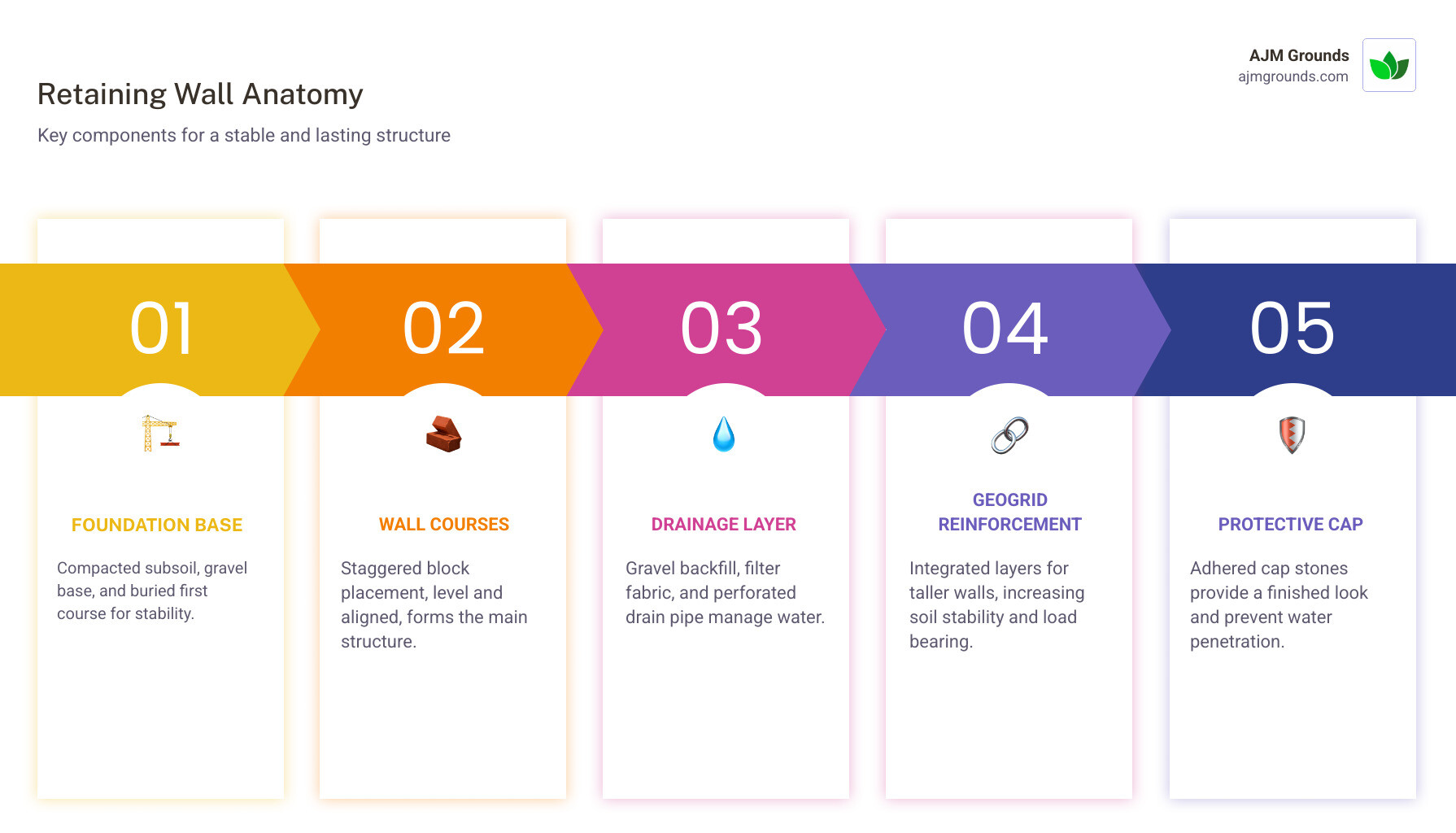
Basic retaining wall installation terms:
Planning Your Retaining Wall Project
Planning is the first step to a successful retaining wall installation. Skipping it can lead to an unstable wall that’s expensive to fix.
First, call 811, the free utility marking service. This simple step prevents dangerous accidents and costly repairs from hitting underground lines. Next, check local permits and building codes. In Woburn and surrounding towns like Reading and Lexington, walls over 3-4 feet typically need permits. These regulations exist to ensure your wall is safe.
Choosing the Right Materials
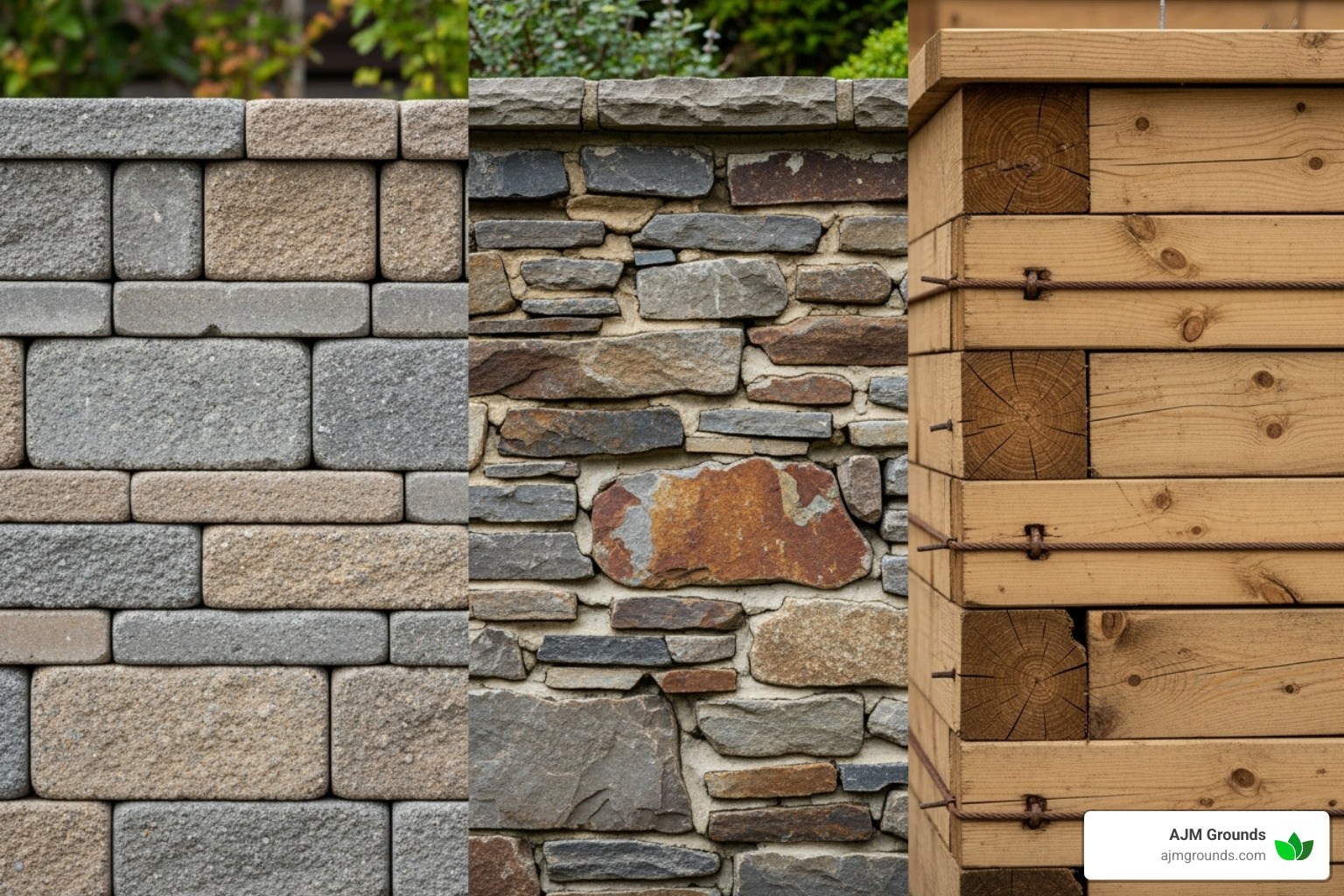
The material you choose affects your budget and project timeline. Each option has its own purpose.
| Material | Cost (per linear foot) | Durability | DIY-Friendliness |
|---|---|---|---|
| Interlocking Concrete Blocks | Medium | High | High |
| Natural Stone | High | Very High | Medium/Low |
| Treated Timber | Low | Medium | Medium |
Interlocking concrete blocks are a popular choice. They’re designed for straightforward installation, come in various styles, and can handle walls up to 3 feet without reinforcement. For taller walls, they work well with geogrid. Learn more on our Concrete Block Wall Installation page.
Natural stone offers timeless beauty. While these walls complement any landscape, they require more skill to install properly. Our Natural Stone Retaining Walls page shows the stunning results possible.
Treated timber is an affordable, rustic option for lower walls. It has limitations, requiring “dead men” anchors for stability and shouldn’t exceed 10 feet in height.
Poured concrete provides maximum strength and design flexibility, ideal for projects needing serious structural support. Boulders create dramatic, natural-looking walls but require heavy equipment for placement.
Understanding Soil, Slopes, and Design
Your soil type is critical. Clay soil holds water, creating pressure, while sandy soil drains well but can erode if not managed. Water is the biggest enemy of retaining walls, and poor drainage is the leading cause of failure.
Gravity walls use their own weight for stability. Cantilevered walls use a concrete footing as an anchor. For walls over 4 feet or those supporting heavy loads like driveways, geogrid reinforcement is essential. This synthetic grid extends into the soil, creating a reinforced mass to resist pressure.
Steep slopes often benefit from terracing with multiple shorter walls. This approach is structurally sound and looks more natural. The distance between walls should be at least twice the height of the lower wall.
For challenging terrain, check out our specialized Retaining Walls for Slopes page. The Oregon State University Extension also offers excellent guidance on Building a landscape retaining wall.
Estimating Your Project Costs
Retaining wall installation costs vary based on materials, labor, equipment rental, and debris disposal. Material costs typically range from $15-75 per square foot. Labor costs generally run $50-150 per linear foot, though complex projects can cost more.
Wall height dramatically affects cost, as taller walls require more materials, deeper excavation, and often reinforcement. Poor site accessibility also increases labor time and cost.
These are average costs based on internet data and not actual costs for AJM Grounds. Every project is unique, with costs ranging from $50 per linear foot for simple projects to $250+ per linear foot for complex installations. For detailed pricing, visit our Retaining Wall Construction Cost page.
Step-by-Step Guide to Retaining Wall Installation
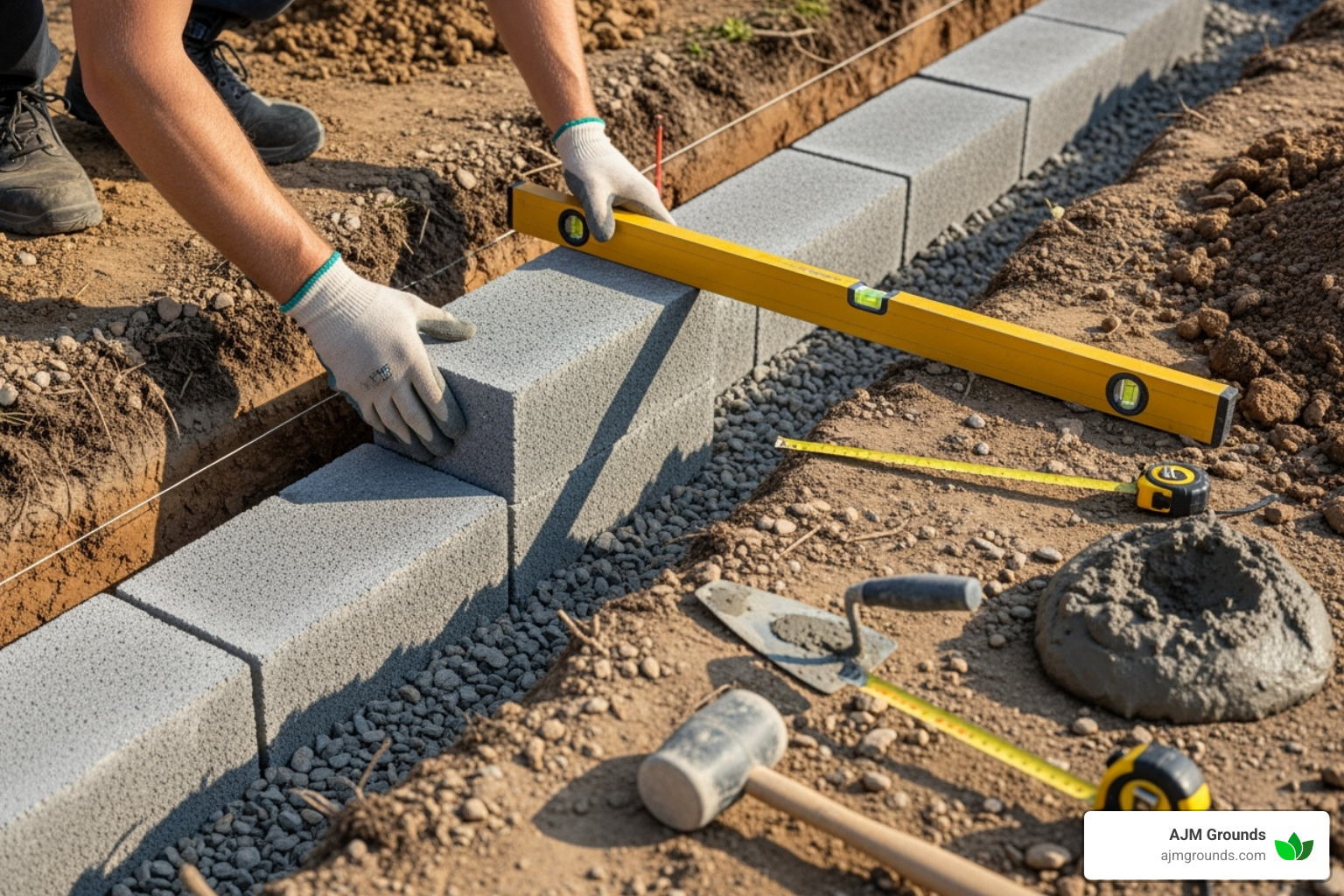
Building the wall requires the right tools, safety protocols, and a methodical approach. My experience with retaining wall installation in the Woburn area has proven this time and again.
Essential tools include: shovels, picks, a tape measure, stakes, and string line, a torpedo and 4-6 foot level, a rubber mallet, a wheelbarrow, and a masonry chisel or wet saw. A plate compactor is crucial. Always use safety gear like gloves, glasses, and dust masks.
Step 1: Excavation and Base Preparation
This foundation work is critical for the wall’s longevity. Mark the layout with stakes and string or a garden hose, and remember to call 811 before digging. The trench must be precise: dig deep enough to bury half the first course plus 4-6 inches for the gravel base. The width should be twice the block’s width to allow for drainage.
Remove all organic material like topsoil from the trench, as it will decompose and cause instability. Dig down to solid subsoil, replacing any soft spots with compacted granular fill. Next, compact the subsoil with a plate compactor until firm. This prevents settlement. Finally, spread and compact 4-6 inches of ¾-inch gravel for the gravel base layer. Use a long level to ensure the base is perfectly level. A rock-solid, level foundation is non-negotiable. For more details, see our guide on How to Install a Block Retaining Wall.
Step 2: Laying the Courses
Precision is key when laying the courses. Start laying blocks from the lowest point of the trench. The base course must be perfectly level side-to-side and front-to-back. Use a torpedo level for each block and a longer level across multiple blocks, as small deviations will be magnified as you build higher.
Burying the first course provides stability. At least half its height should be below the final grade—more for taller walls. This prevents the base from being pushed out by soil pressure. For subsequent courses, stagger the joints in a running bond pattern to distribute weight evenly. Use a rubber mallet for fine adjustments and continuously check for level and alignment. Our article on Installing Landscape Blocks has more tips.
Step 3: Backfilling and Compaction
Proper backfilling and compaction prevent hydrostatic pressure, the main cause of wall failure. After each course, backfill with clean, ¾-inch gravel for at least 12-14 inches behind the wall. Line the excavated area with filter fabric before adding gravel to prevent soil from clogging the drainage layer.
Compact in thin lifts of 6-8 inches to ensure stability. Compacting each layer of gravel and soil eliminates voids and reduces pressure. For walls over 4 feet tall, geogrid reinforcement is essential. Lay the grid horizontally between specified courses, extending it back into the compacted fill according to manufacturer specifications. Our guide on Retaining Wall Construction covers these elements.
Step 4: Finishing Your Wall
The final touches protect your investment. Install a perforated drainage pipe at the base of the wall within the gravel backfill. This pipe collects and directs water away, preventing the hydrostatic pressure that destroys walls.
Capping the wall provides a finished look and protects it. Apply construction adhesive and place capstones with a 1 to 1.5-inch overhang to create a drip edge that sheds water. For details, see our guide on Installing Cap Stone on Retaining Wall.
Final grading is also essential. Grade the topsoil with a 2-5% slope away from both sides of the wall to prevent water from pooling. Finally, landscaping integrates the wall into your yard. Strategic planting can help stabilize soil and soften the wall’s appearance.
Critical Factors for a Lasting Wall
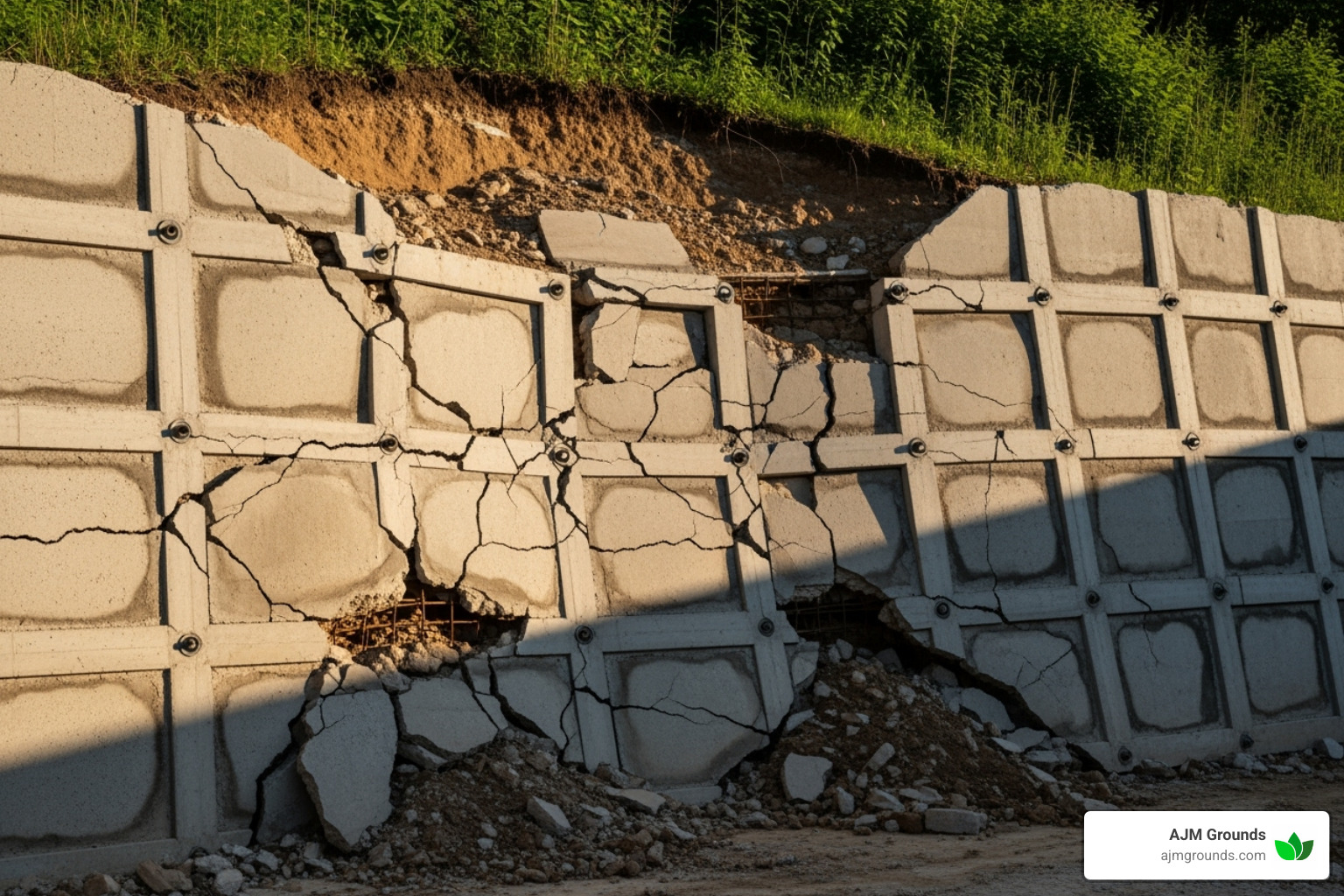
Building and repairing retaining walls in the Woburn area has taught me what makes them last. It’s not luck; it’s understanding the critical factors of a proper retaining wall installation. Most failures are due to poor drainage and inadequate foundation preparation. Water buildup creates hydrostatic pressure, which, combined with New England’s freeze-thaw cycles, is a recipe for disaster.
Frost heave (expanding frozen soil) can push a wall out of position. Surcharge loads from driveways or patios add extra weight. These factors can turn a landscape feature into a costly problem.
The Importance of a Solid Foundation
A retaining wall is only as strong as its foundation. In Massachusetts, the frost line is about 4 feet deep. Building the foundation below the frost line is essential to prevent shifting from frozen ground. I’ve repaired many walls that failed because the contractor cut corners on depth.
Using compacted gravel for the base is non-negotiable. It provides solid, draining support. We use 6 to 12 inches, depending on wall height. It must be compacted, as loose gravel will settle. A perfectly level base is also critical to prevent settlement and keep the wall straight.
Ensuring Proper Wall Drainage
My top advice for retaining walls is to respect water. Saturated soil is incredibly heavy and creates tremendous hydrostatic pressure that can buckle any wall. This is why multiple drainage strategies are essential.
Weep holes or a perforated drain pipe at the base give water an escape route. Our gravel backfill (¾-inch clear stone) creates a fast-draining zone, allowing water to reach the drainage pipe instead of saturating the soil. We also use an impermeable soil cap and grade the landscape away from the wall to shed surface water.
Signs Your Retaining Wall Needs Repair
Even well-built walls can develop issues. Catching problems early is key to avoiding catastrophic, expensive repairs.
- Leaning or bulging indicates excessive pressure, usually from water buildup or a failing foundation.
- Cracking or crumbling indicates structural stress. Horizontal cracks are especially concerning.
- Separation from adjoining walls means the wall is moving and needs to be addressed.
- Water pooling behind the wall is the most telling sign. It indicates a failed drainage system, and the trapped water is actively destroying your wall.
When you spot these signs, don’t wait. Our team at AJM Grounds specializes in Retaining Wall Repairs and can address problems before they become disasters.
DIY or Hire a Pro?
Homeowners often ask whether to DIY or hire a pro for a retaining wall installation. The answer depends on key factors that separate success from a costly disaster, including project complexity, wall height, required tools, and time commitment.
When to DIY a Retaining Wall
DIY retaining wall installation is great for low-risk, manageable projects.
- Small, decorative walls under 2-3 feet, like garden beds or simple borders, are perfect for DIY. They don’t hold back significant soil loads, so the risk is minimal.
- Simple, straight designs using interlocking blocks are also DIY-friendly, as the blocks are engineered for easy stacking.
- If your project is small and doesn’t require geogrid or permits, it’s a good candidate for DIY. For guidance, check our page on Installing a Small Retaining Wall.
When to Hire a Professional for Retaining Wall Installation
Some projects carry too much risk for DIY, threatening both your safety and your wallet. You should hire a professional for:
- Walls over 4 feet tall. The earth pressure is immense, requiring geogrid and engineering. A mistake can lead to catastrophic failure, property damage, or injury.
- Walls supporting critical structures like driveways, patios, or foundations. The cost of failure far exceeds any DIY savings.
- Complex slopes and difficult terrain. Unstable soil or poor access can create a nightmare. A failed DIY attempt often costs more to fix than professional installation.
- Projects requiring permits and engineering. Professionals understand local building codes and can manage the approval process.
At AJM Grounds, our experience in Woburn and surrounding communities like Lexington and Winchester means we understand local soil, codes, and proper techniques. Our Hardscape Installation Service provides professional expertise and peace of mind.
The bottom line? If you have any doubts, it’s worth getting a professional consultation.
Conclusion
A successful retaining wall installation respects the forces of water, soil, and gravity. The key principles—a solid foundation, proper drainage, and thorough compaction—are the difference between a lasting wall and a failing one. A bulging or cracking wall indicates one of these elements was overlooked.
A well-built retaining wall is an investment. It creates functional space, prevents erosion, and adds beauty and value to your home. It can become an integral part of your outdoor living area.
The decision between DIY and professional installation depends on your project’s complexity. Small decorative walls can be rewarding DIY projects, but taller or more complex walls deserve professional expertise.
In the Woburn area, a proper retaining wall installation can transform a landscape. The right engineering, materials, and drainage create a functional and beautiful feature for your property.
If you’re ready to tackle a sloped yard, our team at AJM Grounds can help. For professional retaining wall construction in the Woburn, MA area, contact our experts to discuss your project and get started.
