

Transform Your Lawn in Days: The Power of Sod
Residential sod installation is the fastest way to achieve a lush, green lawn without waiting months for grass seed to grow. If you’re looking for immediate results, here’s what you need to know:
| Residential Sod Installation Basics |
|---|
| Cost: $300-$900 per 1,000 sq ft (materials only); double that for professional installation |
| Timeline: Same-day change; roots establish in 6-8 weeks |
| Best Time: Spring through fall in most regions |
| DIY Difficulty: Moderate; two people can cover 1,000 sq ft in one day |
| Water Needs: Daily for first week, tapering off over 3-4 weeks |
Looking out at a patchy, brown lawn is frustrating. Whether you’ve just moved into a new home, completed a renovation, or simply want to refresh your outdoor space, residential sod installation offers an immediate solution that seed simply can’t match.
Unlike seeding, which takes months of careful nurturing, sod transforms your yard from bare soil to green lawn in a single day. It prevents soil erosion, creates uniform coverage, and keeps mud at bay—perfect for families with children and pets who can’t wait months to enjoy their outdoor space.
I’m John Caplis, owner of AJM Grounds LLC, and I’ve overseen hundreds of residential sod installation projects throughout Woburn, Massachusetts, helping homeowners achieve the lush, vibrant lawns they desire without the lengthy wait time of traditional seeding methods.
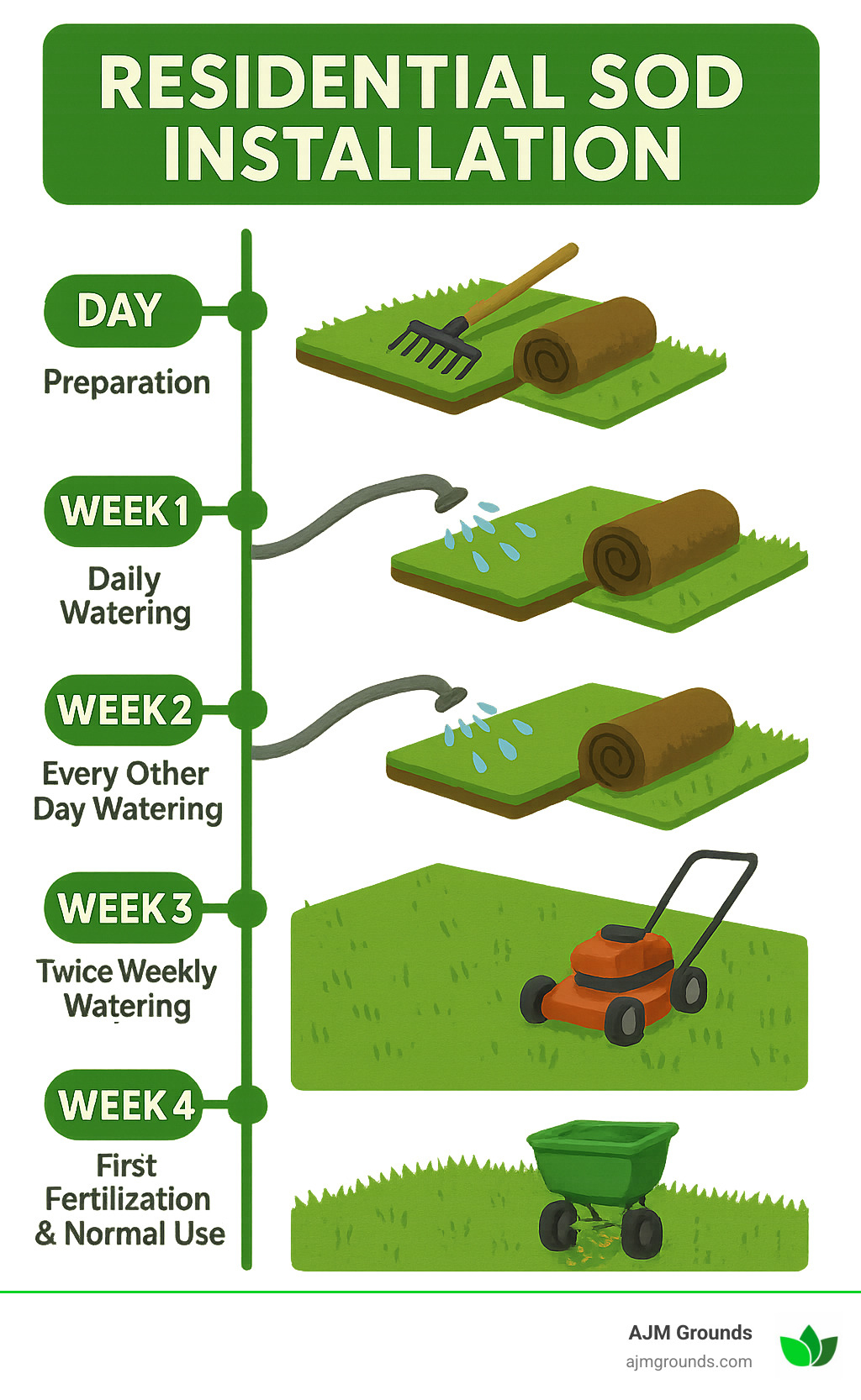
Residential sod installation terminology:
– best time to plant a new lawn
– Landscape Installations Woburn MA
– lawn installation services
Residential Sod Installation 101: Why Sod Beats Seed
When you’re staring at a bare yard or patchy lawn, you’ve got two main choices: seed or sod. While seeding has its place in lawn care, residential sod installation offers clear advantages that make it the go-to choice for many Massachusetts homeowners looking for quick results.
Sod is essentially your lawn, pre-grown and ready to roll out—a layer of mature grass with its root system intact, held together by a thin layer of soil. Professional turf farms nurture these living carpets for 14-18 months before harvesting and delivering them to your property, ready for immediate installation.
“Growing a lawn from seed is like raising a child—it takes patience, consistent care, and favorable conditions,” explains our team at AJM Grounds. “When you choose sod, it’s more like adoption—you skip the sleepless nights and get right to enjoying your beautiful new addition.”
According to latest research on post-installation watering, the most significant advantage of residential sod installation is immediacy—you’ll have a complete lawn the same day, rather than watching bare soil for weeks hoping seedlings will emerge.
What Is Sod & How It’s Grown
Sod is typically harvested within 24 hours of delivery to ensure freshness. Most turf farms cut sod during evening hours to maintain moisture and vitality until installation. This living product demands prompt attention—ideally being laid the same day it arrives at your property.
Professional sod farmers select specific grass varieties suited for different conditions, carefully tending the turf through regular mowing, fertilization, and pest management until it develops a dense, mature root system strong enough to hold together when harvested.
The cutting process employs specialized equipment that slices the grass into uniform rectangles or rolls, typically including about 3/4 inch of soil and roots—just enough to keep the grass alive during transition but thin enough to establish quickly in its new home.
Key Benefits for Homeowners
The advantages of choosing residential sod installation extend far beyond just saving time:
Instant curb appeal transforms your property’s appearance overnight, while superior erosion control prevents soil washout during heavy New England rains. The dense turf provides natural weed suppression by leaving little room for invaders to establish.
Uniform coverage eliminates the patchy appearance common with seeding, and mud reduction keeps your home cleaner—especially valuable for families with children and pets. Many sod varieties offer better shade performance than seed, thriving in areas where seed often struggles.
For those considering selling, a lush lawn can boost resale value by significantly improving first impressions. Plus, the play-ready surface means your family can enjoy the yard within weeks rather than months.
“One of our Woburn clients installed sod on a Friday and hosted a garden party the following weekend,” shares John from AJM Grounds. “You simply can’t do that with seed.”
Primary Drawbacks to Keep in Mind
While residential sod installation offers impressive benefits, it’s only fair to consider potential drawbacks:
The higher upfront cost is the most obvious consideration—expect to pay $300-$900 per 1,000 square feet for materials alone, potentially reaching $900-$2,700 for professional installation, depending on your location and site conditions.
The physical demands shouldn’t be underestimated—each pallet weight can exceed 1,500 pounds for an area covering about 640 square feet, making this a challenging DIY project without proper equipment or help.
You’re also limited to the limited varieties local suppliers offer, whereas seed comes in countless options. And timing matters—sod must be installed quickly after delivery (within 24-48 hours) before it begins to deteriorate.
Despite these considerations, most of our Massachusetts clients find the immediate change and reduced waiting time well worth the investment. As one Woburn homeowner put it, “I’ve tried seed three times over five years. I should have just started with sod and saved myself the headache.”
Plan & Measure Like a Pro
Successful residential sod installation begins with proper planning and precise measurements. Taking time to prepare adequately will save you money, prevent waste, and ensure a smooth installation process.

Choosing the Right Sod for Your Region
Here in Massachusetts, not all grass is created equal. The harsh New England winters and variable summers mean we need to be selective about what we plant.
For our local customers, we typically recommend cool-season grasses that can handle our distinctive four seasons. Kentucky Bluegrass shines in high-traffic areas like family backyards, with amazing self-healing properties when the kids and dogs run across it. If you’re concerned about drought, Tall Fescue develops deep roots that seek out water even during dry spells.
Many of our Woburn homeowners love Perennial Ryegrass for its quick establishment and durability, while those with shady yards find that Fine Fescue thrives where other varieties struggle.
“Your lifestyle should guide your grass choice,” I often tell my clients. If you’re hosting weekly backyard gatherings, you’ll need something different than someone who simply wants a beautiful view from their kitchen window. Consider your sun exposure (count those hours of direct sunlight), expected foot traffic, irrigation setup, and how much time you want to spend mowing and maintaining your new lawn.
At AJM Grounds, we walk properties with homeowners to identify these factors before recommending the perfect sod variety. For more details about our approach, check out our lawn installation services.
How Much Sod Do You Need?
Nothing derails a residential sod installation faster than running short on materials halfway through the job. I’ve seen the panic in homeowners’ eyes when they realize they’ll need to halt their project while waiting for another delivery.
For simple rectangular yards, the math is straightforward—multiply length by width. But most New England properties have irregular shapes, trees, garden beds, and other features that complicate measurements.
The pro approach is to divide your yard into geometric sections. Measure rectangles normally, calculate triangles by multiplying base by height and dividing by two, and determine circular areas using the formula π × radius². Then add everything together.
Always include a 5-10% buffer for trimming, waste, and those inevitable measurement errors. I’ve never met a homeowner who regretted ordering a little extra, but I’ve consoled many who came up short.
For a quick estimate on smaller areas, try the step-counting method. Walk the length and width, counting your steps, then multiply by your stride length (typically about 3 feet). It’s not perfect, but it works in a pinch.
Struggling with complex layouts? Try sketching your yard on graph paper or using one of the many online area calculators. Just remember—measure twice, order once!
Best Time of Year to Install
While we can lay sod whenever the ground isn’t frozen solid, timing dramatically affects how quickly your new lawn establishes itself.
In Massachusetts, spring installations (April-May) benefit from moderate temperatures and natural rainfall, giving roots time to establish before summer heat arrives. But our installation teams at AJM Grounds often find that early fall (September-October) provides ideal conditions—cooler temperatures reduce stress on the new grass while still allowing enough time for root development before winter dormancy.
Summer installations require significantly more attention to watering, especially during those hot July and August stretches. And while late fall installation is possible, cold soil temperatures slow down root growth considerably.
“Think of sod like any transplant,” I explain to customers. “It needs time to settle in before facing extreme conditions.” That’s why we recommend scheduling your residential sod installation during these optimal windows whenever possible. With proper timing and a two-person crew, most homeowners can transform their yards in a single weekend.
For more detailed information about the best times to establish new lawns in our region, visit our guide on the best time to plant a new lawn.
Soil Preparation: The Hidden Foundation
Think of residential sod installation like making a sandwich – the bread gets all the attention, but it’s the ingredients inside that make it delicious. Your soil is those critical ingredients that determine whether your new lawn thrives or struggles.
“I’ve seen beautiful sod fail within weeks when laid on poorly prepared soil,” explains John from our team. “On the flip side, I’ve watched properly prepped areas transform into lush lawns that last for decades. The difference is all in what happens before the first piece of sod ever touches the ground.”
Removing Existing Turf, Weeds & Debris
Before your beautiful new grass can make itself at home, you need to clear out the old residents. Start by deciding whether you’ll take the chemical or mechanical route.
If you’re comfortable using herbicides, apply a non-selective product like glyphosate about 10-14 days before your planned installation date. This gives the product time to work its way down to the roots. Be patient – rushing this step means dealing with persistent weeds later.
For those preferring a chemical-free approach, a sod cutter (available at local equipment rental shops for about $80-100 per day) will strip away old turf cleanly. It’s more work but gives immediate results and avoids chemical concerns.
Once the old grass is gone, grab a rake and remove all the rocks, sticks, and debris hiding in your soil. Even small stones can create air pockets under your new sod, preventing proper root contact. Take this opportunity to look for low spots where water pools after rain – these areas will need extra attention during grading.
Amend, Grade & Level
Now comes the real magic of soil preparation – turning mediocre dirt into a perfect growing environment for your new lawn.
Start with a soil test to understand what you’re working with. Most local extension offices offer affordable testing services, or you can pick up a DIY kit at garden centers. The test results will tell you two critical things: your soil’s pH and nutrient levels.
Most grass varieties thrive in soil with a pH between 6.0 and 7.5. If your soil is too acidic (lower pH), you’ll need to add lime to raise it. If it’s too alkaline (higher pH), sulfur will bring it down. Follow the application rates on the product packaging based on your test results.
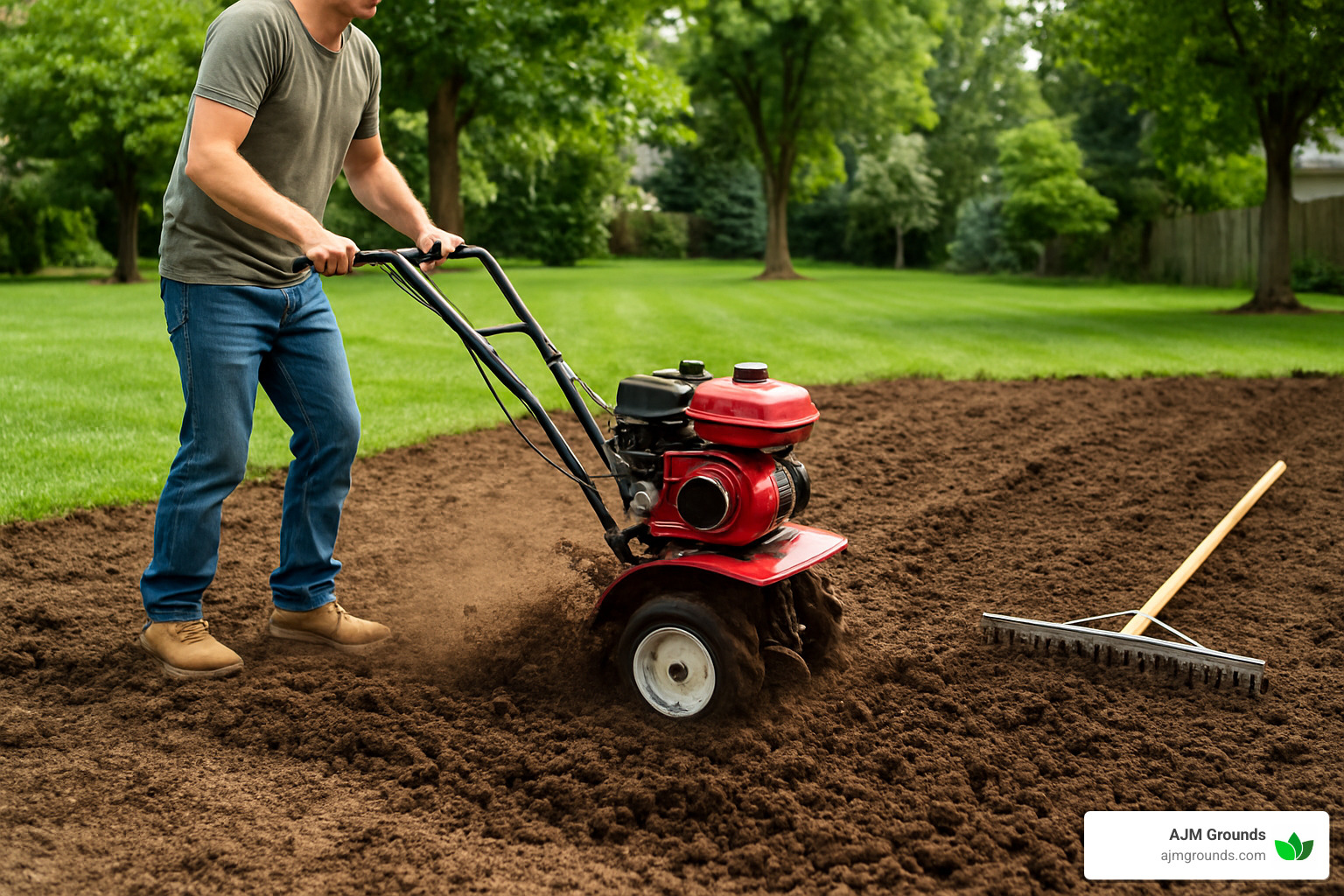
Next, spread a 2-inch layer of quality compost across your yard. This organic matter works wonders for both clay soils (improving drainage) and sandy soils (increasing water retention). Work it into the top 4-6 inches using a rototiller, creating a hospitable environment for new grass roots.
“The difference good compost makes is night and day,” shares our installation expert. “It’s like the difference between trying to grow plants in concrete versus garden soil.”
Before your final grading, apply a starter fertilizer high in phosphorus (the middle number on the bag). This nutrient specifically promotes root development – exactly what new sod needs to establish quickly.
Now for the critical grading step. Using a rake, create a gentle slope away from your home’s foundation (aim for about 1 inch of drop for every foot). This prevents water from pooling against your house during heavy rains. The final soil surface should sit approximately 1 inch below sidewalks, driveways and patios to accommodate the thickness of the sod.
Essential Tools & Materials
Getting your soil ready for residential sod installation requires the right equipment. Here’s what you’ll need:
A rototiller is essential for breaking up compacted soil and mixing in amendments. Unless you plan to make a hobby of soil preparation, renting one makes more sense than buying. Most equipment centers offer half-day rentals for $50-80.
You’ll also need a lawn roller (the water-filled kind) to ensure good soil-to-sod contact after installation. A steel rake handles the heavy work of initial grading, while a garden rake creates the smooth final surface. Don’t forget a sharp utility knife or dedicated sod knife for trimming pieces to fit.
For monitoring moisture after installation, invest in a simple soil probe that lets you check water penetration without disturbing your new lawn. And for slopes steeper than 15 degrees, pick up some sod staples to hold everything in place until roots establish.
The change begins underground, in soil most people never see. But taking time with this foundation step pays dividends for years to come – in reduced water bills, fewer pest problems, and a lawn that makes neighbors wonder what your secret is. At AJM Grounds, we consider soil preparation the most important service we provide, even if it’s the least visible.
How to Lay Sod Step-by-Step
With your soil properly prepared, it’s time for the main event: the actual residential sod installation. This process transforms your yard in hours, but attention to detail makes the difference between a struggling lawn and a thriving one.
Starting Point & Pattern Techniques
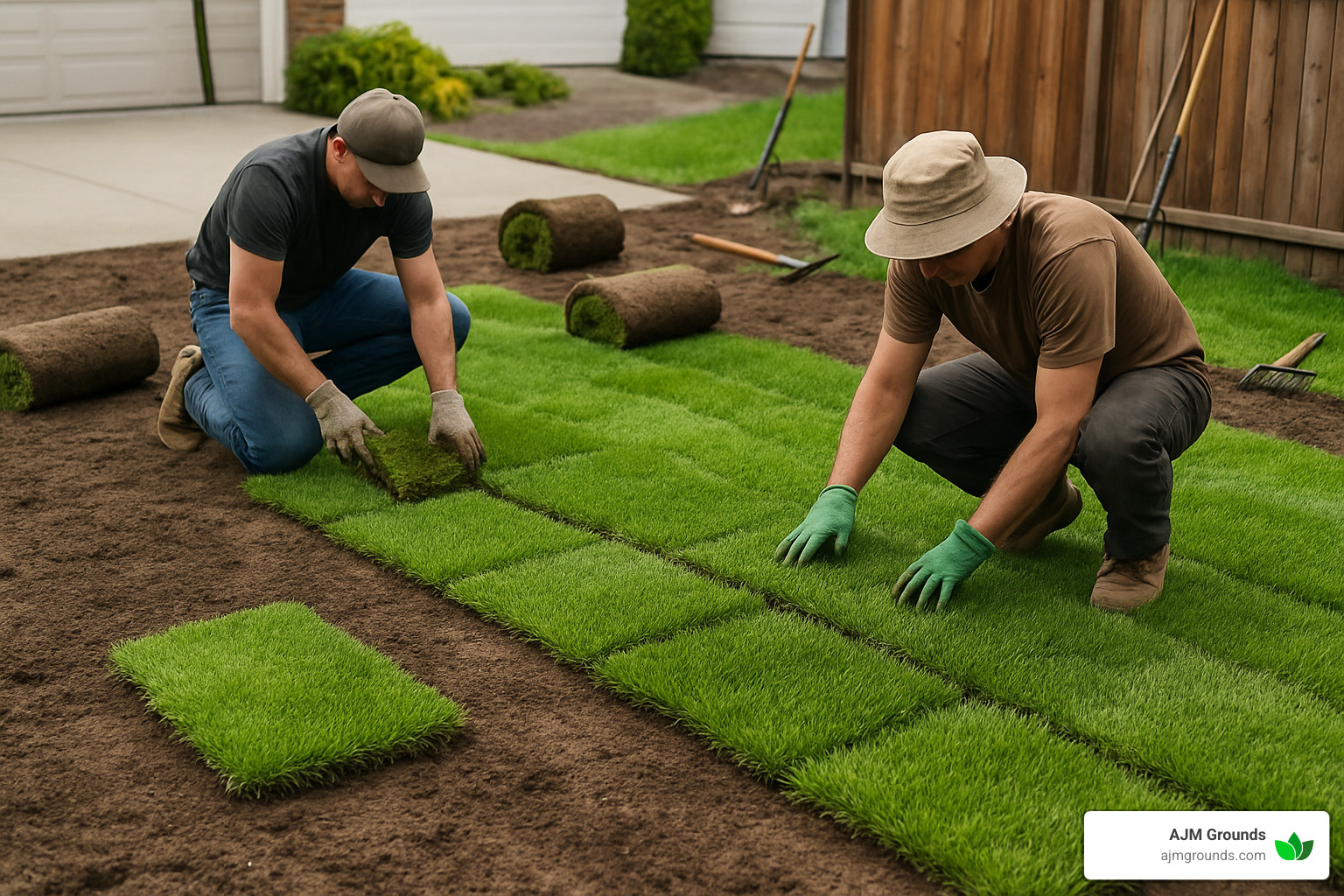
When I’m working with homeowners on their first residential sod installation, I always emphasize the importance of starting in the right place. Begin along your longest straight edge—typically a driveway, sidewalk, or fence line. This gives you a solid reference point for the rest of the installation.
Before laying the first piece, lightly dampen the soil. This provides immediate moisture for the roots and helps them make good contact with your prepared ground. Then, carefully unroll your first row of sod pieces along that straight edge, making sure they butt firmly against your hardscape.
“Think of it like subway tile,” I often tell my clients at AJM Grounds. “You want to create that brick pattern where no four corners ever meet at one point.”
This staggered approach is crucial—offset each subsequent row so seams don’t align. When seams line up, they create vulnerable lines where water evaporates quickly and weeds can easily establish. A brick-like pattern creates a more uniform lawn with fewer visible seams once established.
Avoid using small strips when possible, especially at the beginning of rows. These narrow pieces dry out much faster than full-width sections and often struggle to establish properly.
Ensuring Perfect Soil Contact
The secret to successful residential sod installation isn’t just about placing the pieces—it’s about ensuring they make perfect contact with the soil beneath. When I’m training new team members, I emphasize that good soil-to-sod contact is non-negotiable.
Gently place each piece of sod without pulling or stretching it, which can cause shrinkage later as it establishes. Press the edges together tightly without overlapping—gaps invite weeds, while overlaps create liftd ridges that can be damaged by mowing.
After laying all your sod, use a water-filled lawn roller to press the turf firmly against the soil. This crucial step eliminates air pockets that would otherwise cause roots to dry out and die back. Don’t have a roller? Lay a sheet of plywood over sections of your newly installed sod and walk on it to achieve similar results.
“I can always tell when someone skipped the rolling step,” our installation expert often notes. “The patches that struggle are usually where air pockets prevented proper root contact with the soil.”
Residential Sod Installation Tips for Curves & Obstacles
Most yards aren’t perfect rectangles, which is why handling curves and obstacles requires some special techniques during your residential sod installation.
For curved areas, use full-width pieces wherever possible. Make dart-like cuts (similar to how a tailor might adjust fabric) to allow the sod to conform to gentle curves without overlapping. These small V-shaped cuts let the edges spread slightly while maintaining good coverage.
When working around trees, utility boxes, and other obstacles, lay a piece of sod completely over the obstacle, then cut an X from corner to corner. Trim away the excess and press the remaining sod gently around the feature. This approach creates a much cleaner finish than trying to piece together small sections.
For landscape beds, I recommend laying sod slightly over the edge, then coming back with a sharp knife to cut a clean, flowing line once all pieces are in place. This creates a more natural transition than trying to match the curve perfectly with pre-cut pieces.
Perpendicular installation is vital on slopes—lay the sod across the slope, not up and down it. This prevents water from running down the seams and potentially washing out your new lawn before it establishes. For steeper slopes, consider using sod staples to hold everything in place until the roots take hold.
After-Care: Water, Mow, Feed, Repeat
The moment your residential sod installation is complete, the real work begins. Those first six weeks are make-or-break time for your new lawn, determining whether it becomes the envy of the neighborhood or a patchy disappointment.
“I’ve seen beautiful installations fail simply because homeowners didn’t understand the critical establishment period,” shares our maintenance specialist at AJM Grounds. “It’s like bringing home a new baby—those first weeks demand consistent attention and care.”
Your new sod needs a delicate balance of moisture—not too wet, not too dry—along with proper mowing and eventual fertilization to develop deep, healthy roots.
Residential Sod Installation Watering Schedule
Think of watering new sod as a gradual weaning process. You’ll start with frequent, light waterings and slowly transition to deeper, less frequent irrigation:
Week 1:
Water your new lawn immediately after installation—within 30 minutes is ideal. During this crucial first week, you’ll need to water 3-4 times daily for short 5-10 minute sessions. Your goal is to keep the sod and top few inches of soil consistently moist, but never soggy.
“The simplest way to check moisture is to lift a corner of sod and feel the soil underneath,” our irrigation expert explains. “It should feel like a wrung-out sponge—damp but not dripping.”
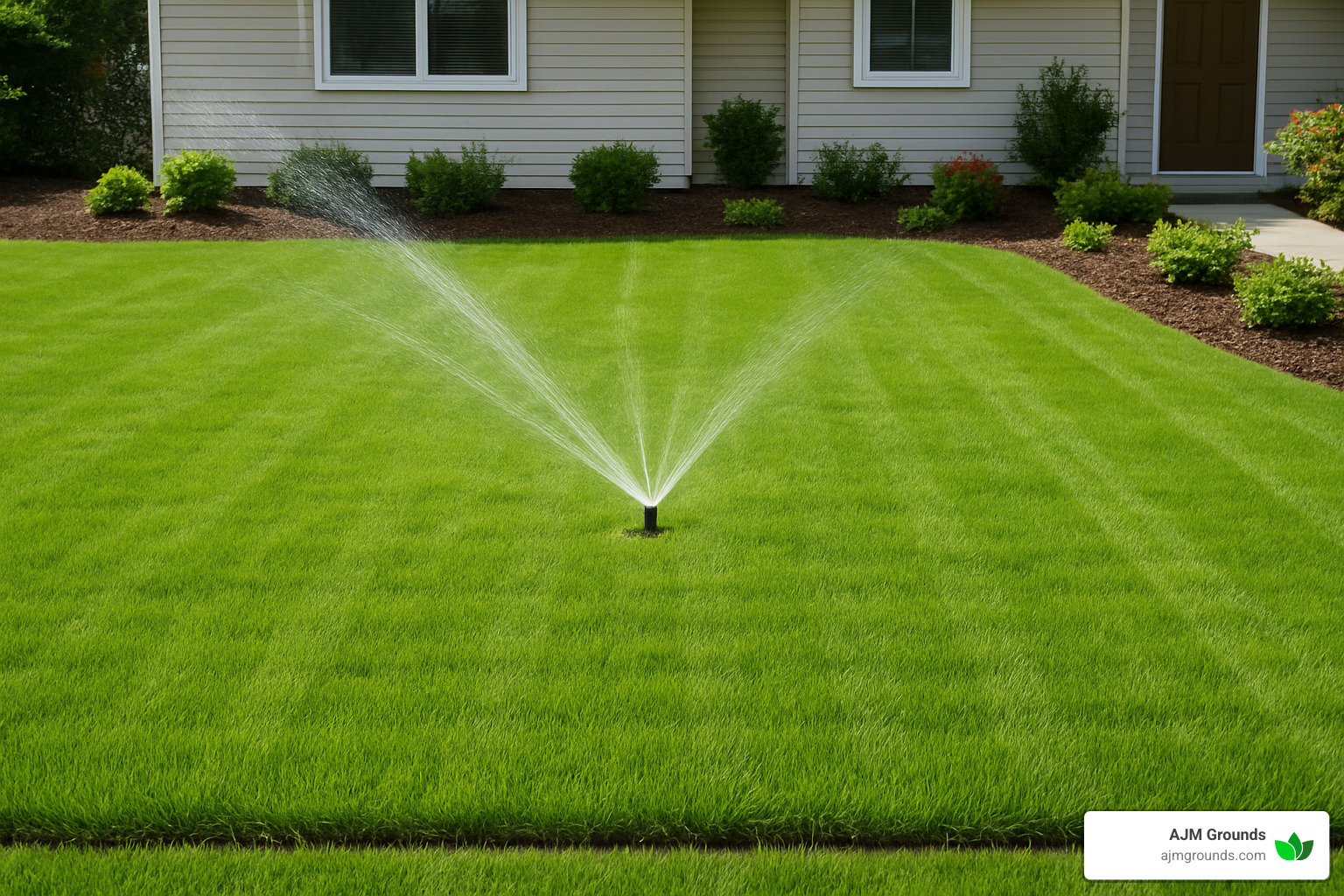
By week two, you’ll reduce to once daily watering for about 30 minutes, keeping an eye on the weather. Hot, windy days might require a second watering. Week three transitions to every-other-day watering, and by week four, you’ll be on a normal 1-2 times weekly schedule with deeper watering sessions.
“Morning watering is always best,” notes our team. “Evening irrigation leaves moisture sitting overnight, which can invite fungal problems that are much harder to fix than preventing in the first place.”
When to Mow & Fertilize
That first mowing is a milestone moment, but patience is key. Wait until your new grass reaches about 3 inches tall, which typically happens 2-3 weeks after installation. Before mowing, gently tug on the grass in a few spots—if it resists, the roots have begun establishing.
Set your mower deck high for that first cut, removing only about one-third of the blade length. A sharp blade is non-negotiable—dull blades tear grass rather than cutting it cleanly, creating entry points for disease.
“I always tell homeowners to avoid the temptation to fertilize too soon,” says our lawn care specialist. “Your new sod already contains nutrients to sustain it through the initial rooting period. Additional fertilizer won’t speed establishment and might actually cause harm.”
The right time for that first post-installation feeding is around week 4, once roots have established. Choose a balanced fertilizer based on your soil test results, and apply according to package directions—more is definitely not better when it comes to feeding your lawn.
Troubleshooting Yellowing, Non-Rooting, Patchiness
Even with careful installation and attentive aftercare, problems can arise. Knowing how to identify and address common issues can save your investment:
Yellowing grass is usually a water issue—either too much or too little. Check soil moisture by inserting a screwdriver into the soil. If it enters easily, you likely have sufficient moisture. If the soil feels soggy, reduce watering frequency but increase duration to encourage deeper rooting.
Brown edges are extremely common because seams dry out faster than the centers of sod pieces. These areas may need targeted hand-watering until the lawn is established. Pay special attention to areas along driveways and sidewalks, which heat up and accelerate moisture loss.
Failure to root properly often stems from poor soil contact. If you notice sections that feel spongy underfoot after a couple of weeks, they may need additional rolling to establish soil contact. In extreme cases, lifting and reinstalling poorly rooted sections may be necessary.
“The most common mistake I see is inconsistent watering,” observes our maintenance team leader. “An automatic irrigation system with proper coverage makes establishment so much easier, but if you’re hand-watering, commit to a consistent schedule and stick to it religiously.”
For homeowners who choose our Professional Sod Installation services, we provide detailed aftercare instructions and follow-up visits to ensure your new lawn develops properly. After all, the true measure of a successful residential sod installation isn’t how it looks on day one—it’s how it thrives for years to come.
Cost & DIY vs. Hiring a Pro
When considering residential sod installation, cost is often the first thing on homeowners’ minds. Understanding what you’re getting into financially helps you make the right choice between rolling up your sleeves or calling in the professionals.
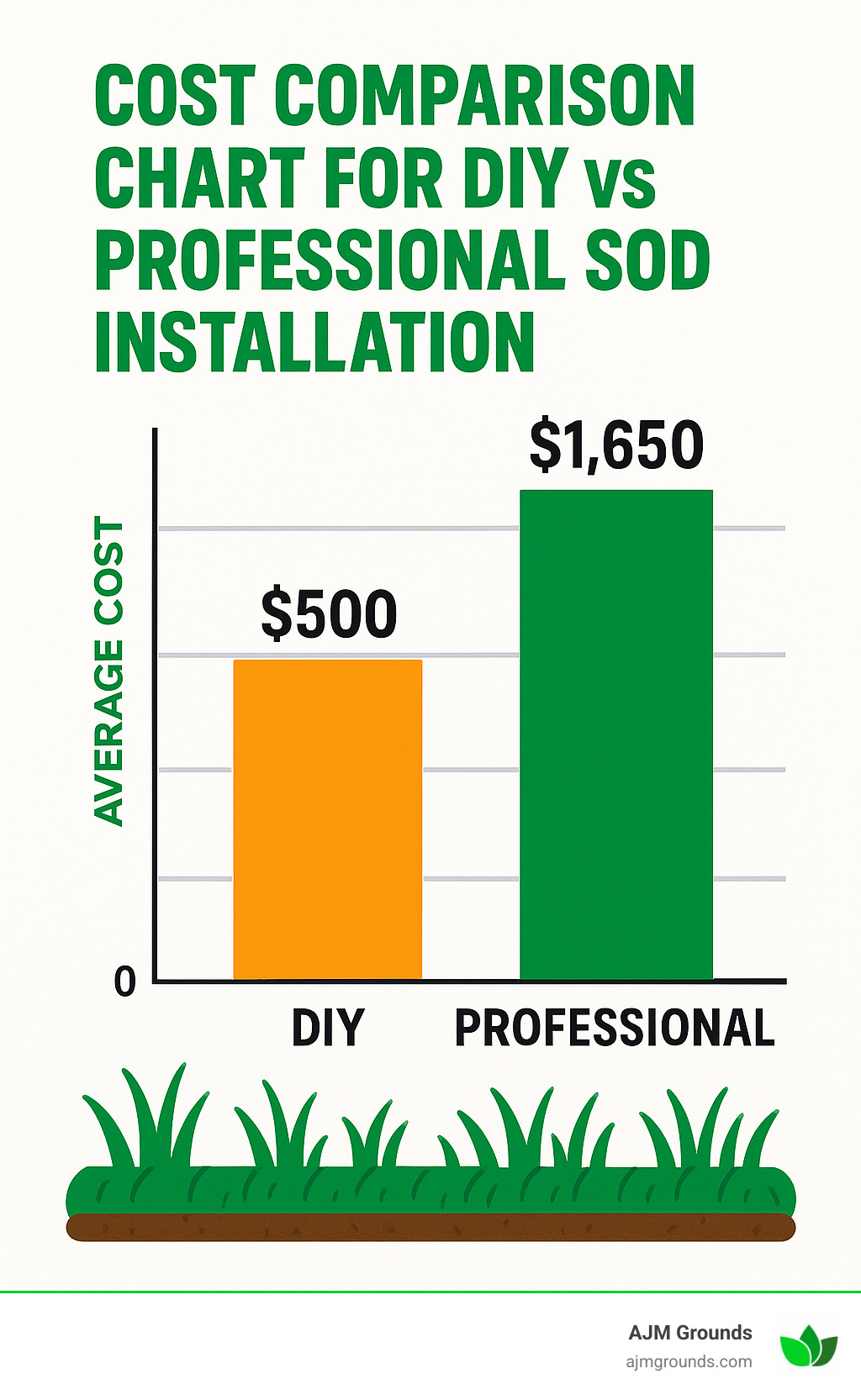
Average Costs
The materials for residential sod installation typically run between $300-$900 per 1,000 square feet of lawn area. If you’re thinking “that’s quite a range,” you’re right! The price varies widely based on grass type, your location, and current market conditions. When you add professional installation services, that figure usually doubles, with total costs ranging from $600-$2,700 per 1,000 square feet.
It’s worth noting that these figures represent national averages based on internet data and not actual costs for AJM Grounds. Your specific project might fall outside these ranges depending on several key factors.
“The biggest price surprise for most homeowners isn’t the sod itself,” explains our team leader, “it’s the preparation work needed to ensure success. Poor soil preparation saves money upfront but costs much more in the long run.”
What drives these costs? Premium grass varieties naturally command higher prices than basic options. Your site’s condition matters too—if extensive grading or soil amendment is needed, costs rise accordingly. Hard-to-reach backyards might require manual transport of heavy sod pallets, adding labor costs. And like most landscaping services, prices tend to peak during high-demand seasons.
For DIY enthusiasts tackling a modest 1,000 square foot area, you’re looking at $300-$900 for the sod itself, plus $50-$150 for soil amendments, $30-$60 for starter fertilizer, and $100-$300 for equipment rentals. That brings your DIY total to roughly $480-$1,410.
Professional installation adds expert labor ($300-$900) and includes expertise and warranty protection (worth $100-$300), bringing the professional route to approximately $880-$2,610 for the same area.
Pros & Cons of DIY Residential Sod Installation
Taking the DIY approach to residential sod installation can be rewarding, but it’s not for everyone.
The biggest advantage is obviously cost savings. By providing your own labor, you can potentially save hundreds of dollars. There’s also something deeply satisfying about changing your own yard with your two hands. Many homeowners appreciate the flexibility to work at their own pace and the control over every detail of the installation process.
“Two people can install about 1,000 square feet of sod in a day,” notes our landscaping expert. “But that’s assuming the soil is already properly prepared, which is usually another full day of work.”
The disadvantages? Sod is heavy—really heavy. A single pallet covering about 640 square feet can weigh over 1,500 pounds. The work is physically demanding, especially in summer heat. There’s also a learning curve for proper techniques like staggered seams and proper cutting. Equipment rental costs can add up quickly, and perhaps most importantly, if something goes wrong, there’s no warranty to fall back on.
Pros & Cons of Professional Services
Professional residential sod installation services like those we offer at AJM Grounds bring expertise that only comes from years of experience.
Our professional advantage begins with proper soil preparation—the foundation of lawn success that DIYers often underestimate. We bring professional-grade equipment that most homeowners don’t have access to, and our experienced crews can typically complete in 1-2 days what might take a homeowner an entire weekend or more.
Perhaps most valuable is the warranty protection that comes with professional installation. If problems arise during the establishment period, you’re not on your own. We also provide customized advice for after-care specific to your property’s unique conditions.
“We often see DIYers struggle with proper grading and seam alignment,” shares our installation manager with a knowing smile. “These might seem like small details, but they make a huge difference in how the lawn establishes and performs long-term.”
The main drawback to professional installation is, of course, the higher upfront cost. You’ll also need to work around our schedule rather than your own, though we always strive to accommodate our clients’ timing needs.
For homeowners in Bedford, Billerica, Burlington, Lexington, Reading, Stoneham, Wilmington, Winchester, and Woburn, MA, our team at AJM Grounds brings attention to detail that ensures your new lawn thrives from day one. We understand that a beautiful lawn is more than just curb appeal—it’s the canvas for family memories and outdoor enjoyment for years to come.
You can find more information about our Professional Sod Installation services on our website, or use this helpful Cost calculator reference to get a general idea of what your project might cost.
Frequently Asked Questions about Residential Sod Installation
How long before I can walk or play on new sod?
That beautiful new lawn is tempting to walk on, but patience pays off! For light foot traffic, you’ll need to wait at least 7-10 days after your residential sod installation. By this point, the roots should be establishing themselves—you can test by gently tugging on a corner of the sod. If it resists, you’re on the right track.
For more demanding activities, you’ll need extra patience. Children playing and pets should stay off for about 3-4 weeks, while sports and high-impact activities require the full establishment period of 6-8 weeks.
“We tell our clients to think of new sod like a surgical patient,” explains our lawn care specialist with a smile. “It needs time to heal and establish before resuming normal activity.”
When is it safe to mow the first time?
Your new lawn will need some time before its first haircut! Wait until your grass reaches about 3 inches in height, which typically happens about 2-3 weeks after installation. Before mowing, make sure the sod is firmly rooted by giving it a gentle tug test.
When that exciting first mow day arrives, be gentle with your new lawn. Use a sharp blade (dull blades tear grass rather than cut it cleanly) and set your mower to a higher setting of about 2-2.5 inches. The golden rule of mowing applies: never remove more than one-third of the grass height in a single pass. This reduces stress on your new lawn and helps it continue establishing a strong root system.
Why are the edges of my new sod turning brown?
Brown edges are a common concern with new sod installations, and they usually point to one thing: those edges are drying out. Think about it—the edges and seams between sod pieces are exposed on multiple sides, making them especially vulnerable to moisture loss.
This typically happens for three main reasons: insufficient watering (edges dry faster than the centers), poor soil contact (edges not firmly pressed into the soil), or installation delays (sod started drying out before or during installation).
The solution? Give those edges extra attention! Increase your overall watering frequency and consider hand-watering the edges and seams until everything is fully established. If the problem persists despite diligent watering, check whether the edges have good soil contact—you might need to roll the lawn again to press everything firmly into place.
How much should I water new sod?
Watering is perhaps the most critical aspect of residential sod installation aftercare. Your new lawn needs consistent moisture to establish roots without becoming waterlogged.
For the first week, water 3-4 times daily for short 5-10 minute sessions. This keeps the sod and soil consistently moist without creating puddles. During week two, transition to once daily watering for about 30 minutes. By week three, you can water every other day, and by week four and beyond, settle into a routine of deep watering 1-2 times weekly (about 1 inch each time).
A simple test: stick a screwdriver into the soil—it should slide in easily to a depth of 3-4 inches, indicating proper moisture penetration. If it’s difficult to push in, your soil is too dry. If it goes in too easily and feels muddy, you might be overwatering.
Can I install sod myself, or should I hire a professional?
This is perhaps the most common question we hear, and honestly, both approaches can work well depending on your situation.
DIY installation might be right for you if you have the physical stamina for heavy lifting (those sod pallets are no joke!), a relatively small and flat yard, enough time for proper preparation, basic landscaping knowledge, and budget constraints.
Professional installation makes more sense if your property has tricky grading or drainage challenges, you have a large area to cover, you’re short on time, you want warranty protection, or you’d benefit from expert guidance on grass selection and aftercare.
Many of our clients initially considered the DIY route but ultimately chose our professional services after realizing the complexity involved in proper soil preparation and the physical demands of moving heavy sod pallets.
At AJM Grounds, we provide landscape installations for homeowners throughout Woburn and surrounding Massachusetts communities who want professional results without the backbreaking work of DIY installation. Our team brings the expertise, equipment, and efficiency that turns your lawn dreams into reality—often in just a day or two.
Conclusion
There’s something magical about watching a bare patch of dirt transform into a lush, green oasis in a single day. Residential sod installation delivers that change, giving you the immediate gratification that seeding simply can’t match. Yes, it costs more upfront, but for many homeowners, the instant curb appeal and reduced waiting time make every penny worthwhile.
I’ve seen countless homeowners stand back with pride after we’ve completed their lawn installation, amazed at how their property has been completely transformed in hours rather than months. That moment of joy makes all the careful planning and preparation worth it.
Though, that beautiful grass above ground depends entirely on what happens below the surface. Think of soil preparation as building the foundation of your home—cut corners there, and you’ll pay for it later. Take the time to test your soil, amend it properly, and create the ideal growing environment for your new lawn.
Whether you decide to tackle the project yourself or bring in our team at AJM Grounds, your success hinges on three things: thorough planning, meticulous installation, and consistent aftercare. The first few weeks after installation are critical—stay vigilant with your watering schedule, and you’ll be rewarded with a lawn that establishes quickly and thrives for years.
For our neighbors throughout Woburn, Bedford, Billerica, Burlington, Lexington, Reading, Stoneham, Wilmington, and Winchester, we understand the unique challenges that Massachusetts weather and soil conditions present. Our team brings local expertise to every residential sod installation project, ensuring your new lawn is perfectly suited to New England’s climate.
The real beauty of sod isn’t just the instant gratification—it’s watching your outdoor space become the backdrop for family barbecues, children playing, and peaceful evenings enjoying your yard. A beautiful lawn creates the canvas for all your outdoor memories.
Ready to transform your property with a lush new lawn? Our team at AJM Grounds is here to help make your vision a reality. From selecting the perfect grass variety to providing detailed aftercare instructions, we’ll partner with you to create an outdoor space you’ll love coming home to. Contact us today to discuss your landscape installation project and find how we can help bring your dream yard to life.
