

Why Large Pavers Transform Your Outdoor Space
Installing large pavers can dramatically transform your outdoor living area. Here’s a quick overview:
Quick Installation Overview:
- Excavate 4-6 inches for patios/walkways or 12 inches for driveways
- Create a base with 6-8 inches of compacted gravel
- Add bedding layer of 1 inch screeded sand
- Lay pavers using the click-and-drop method (never drag)
- Install edge restraints to prevent movement
- Fill joints with polymeric sand and compact
Key Equipment Needed:
- Paver lifter tool (SlabGrabber or vacuum lifter)
- Plate compactor with protective pad
- Safety gear (gloves, safety glasses, steel-toed boots)
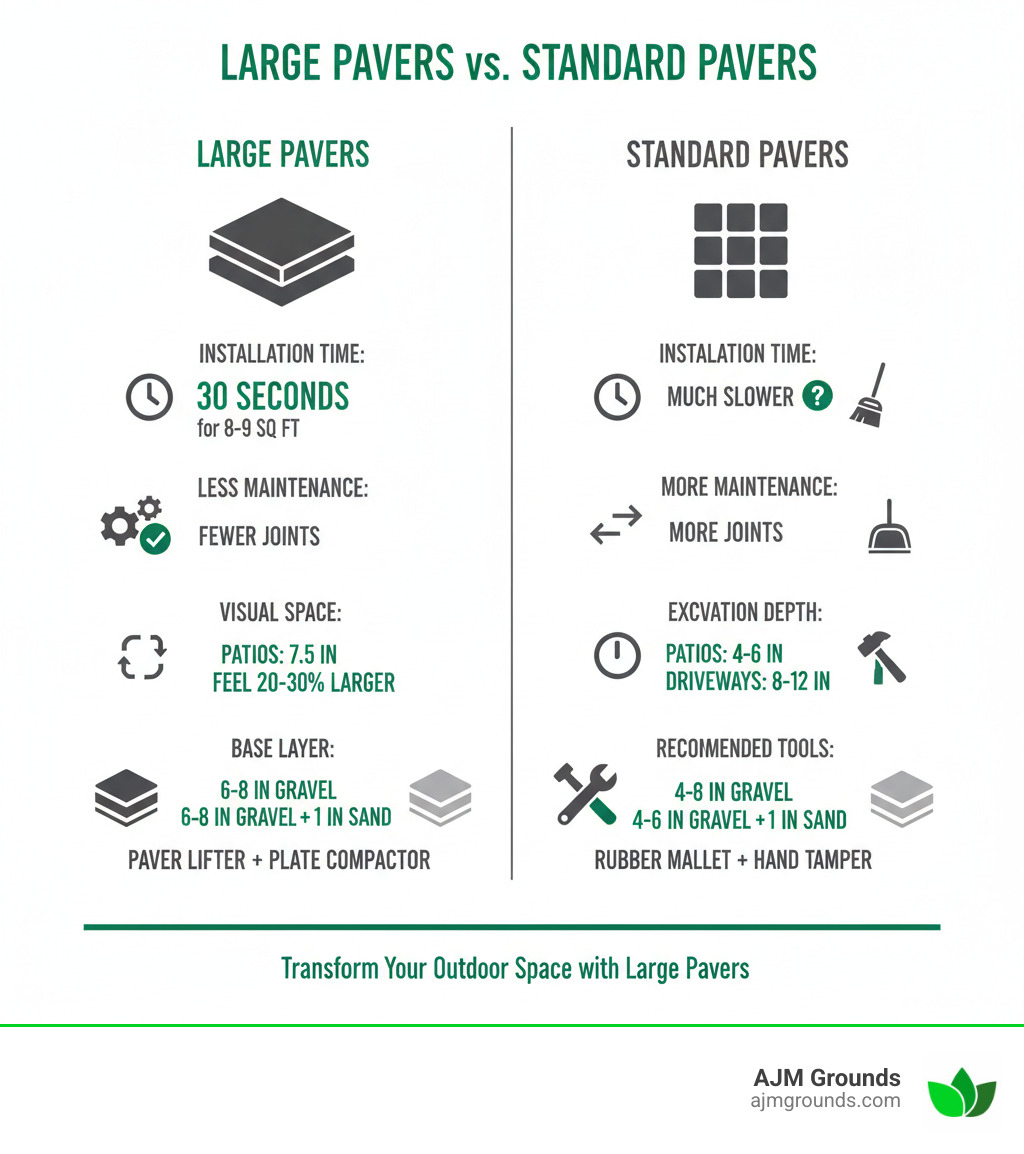
Beyond their bold look, large pavers create an expansive style, making small areas feel larger. Fewer joint lines mean a cleaner, modern aesthetic and faster installation—you can cover up to nine square feet in just 30 seconds.
Perfect for patios, pool decks, outdoor kitchens, and walkways, their size means fewer joints, less maintenance, and quicker installation. A well-planned DIY project can often be completed in a weekend.
The biggest challenge is their weight and handling. Large format pavers are heavy, making specialized tools like paver lifters essential. Many homeowners choose to work with a helper or hire professionals for larger projects.
As John Caplis, owner of AJM Grounds LLC, I’ve spent years installing large pavers across the Woburn area. My team knows that proper base preparation and the right handling tools are what turn a weekend project into a lasting investment.
Installing large pavers terms made easy:
The Complete Guide to Installing Large Pavers
The secret to a durable paver patio is the foundation. When installing large pavers, proper base preparation is crucial to avoid future problems and ensure a long-lasting result.
Preparing the Foundation: Base, Drainage, and Materials
Your excavation depth depends on the project’s use. For walkways and patios, dig down 4 to 6 inches. For a driveway supporting vehicles, excavate about 12 inches. Some installers prefer an 8 to 10-inch depth for all large paver projects for added stability.

First, outline your project area with marking paint and clear the site of all grass, topsoil, and debris. Proper drainage is critical in Massachusetts to prevent damage from freeze-thaw cycles. Ensure the area slopes away from your house by about 1 inch for every 8 feet, using string lines and a level to set the grade.
For the base, spread a 6 to 8-inch layer of gravel (thicker for driveways). Materials like 1/4″-10 crushed rock or 3/4″ minus gravel are ideal. Apply the gravel in 2 to 4-inch layers, moistening and compacting each layer with a plate compactor for a dense, stable foundation.
Consider laying geotextile fabric over the excavated soil to prevent it from mixing with your base. The final step is a 1 to 1.5-inch bedding layer of coarse sand (like C-33) or ASTM No. 8 stone. Do not compact this layer. To level it, use a technique called screeding: lay 1-inch PVC pipes as guides, pour sand between them, and drag a straight 2×4 board across the pipes to create a perfectly flat surface. Remove the pipes and carefully fill the voids.
More info about proper drainage solutions.
Laying the Slabs: A Guide to Installing Large Pavers Evenly
Now it’s time to lay the pavers, where the right tools are essential for safety and a professional finish.
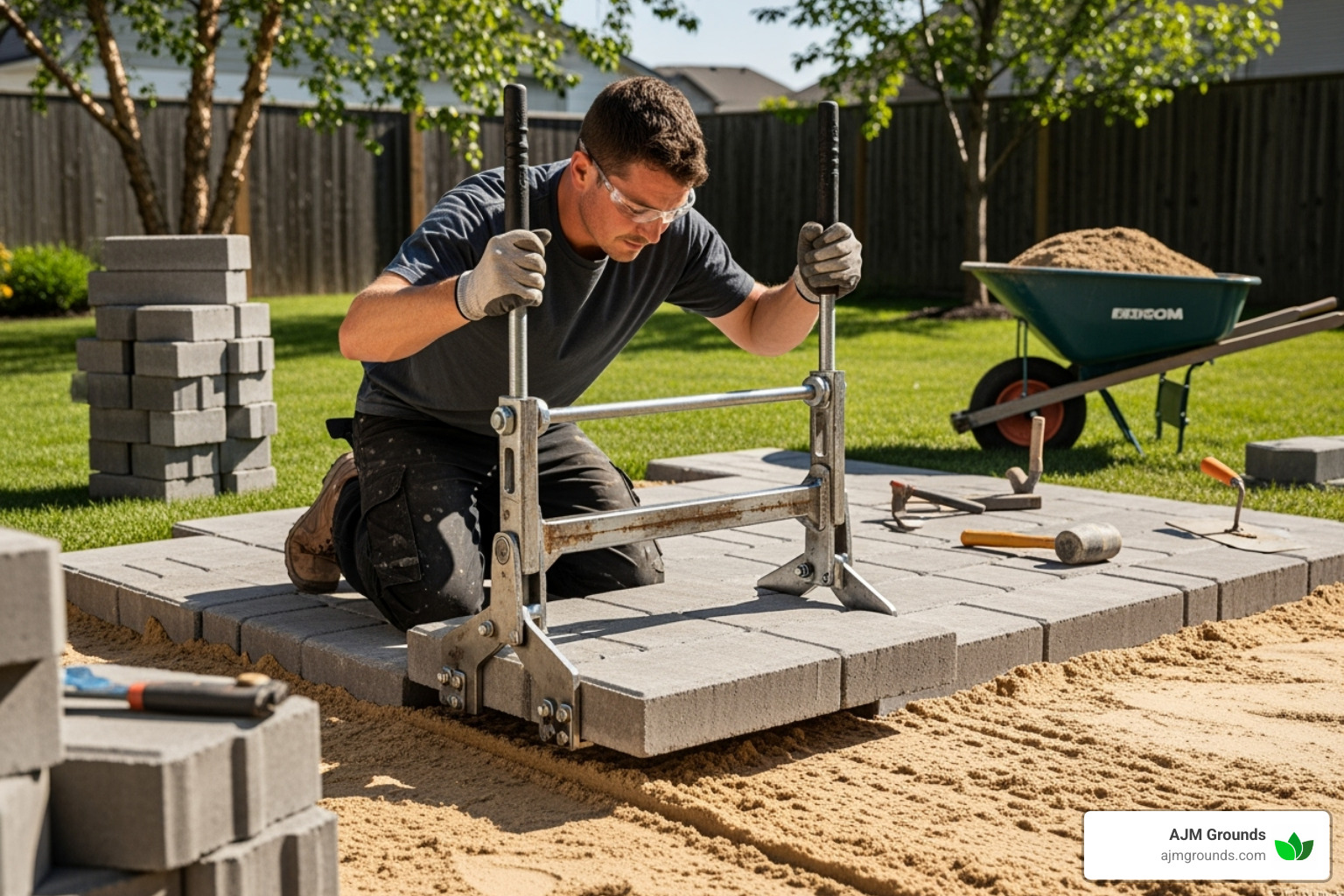
Large pavers are extremely heavy, making specialized handling tools like a SlabGrabber or a vacuum lifter (e.g., Grabo tool) essential. For a single project, renting these tools, along with a Plate Compactor, is a cost-effective choice.
The golden rule is to click-and-drop: touch the edge of the new paver to the one already in place, then lower it straight down. Never drag pavers, as this will ruin the level sand bed.
Start from a 90-degree corner, using the 3-4-5 triangle method for freestanding patios to ensure it’s square. Use string lines to maintain straight rows. Check each paver with a level, using a rubber mallet to tap down high spots or lifting to add sand underneath for low spots. A screwdriver can help nudge pavers for perfect alignment without chipping them.
Maintain consistent joint spacing of about 3mm (1/8 inch). Many large pavers have built-in spacer bars to simplify this. After laying a section, run a plate compactor over the pavers to vibrate them into the sand. Always use a protective pad on the compactor to prevent scuffing the paver surface.
Step-by-Step Laying Pavers guide.
Handling and Cutting Large Pavers Safely
Working with heavy materials requires proper safety measures. Always team lift heavy pavers to prevent injury. Personal Protective Equipment (PPE) is non-negotiable when installing large pavers.
Always wear:
- Heavy-duty gloves
- Safety glasses
- Steel-toed boots
- Long sleeves and pants
- Hearing protection and a respirator (when cutting)
For cutting large pavers, a wet saw with a diamond blade is necessary for clean, precise cuts. Mark your paver, then make several shallow passes with the saw until you cut through. For curved cuts, score the line and make a series of straight relief cuts inside the curve, then carefully chip away the excess material with a hammer and chisel.
The Art of Hardscaping: Incorporating Stone and Pavers into Your Massachusetts Landscape.
Securing Your Work: Edge Restraints and Joint Filling
These final steps lock in your hard work and ensure your project lasts for decades.
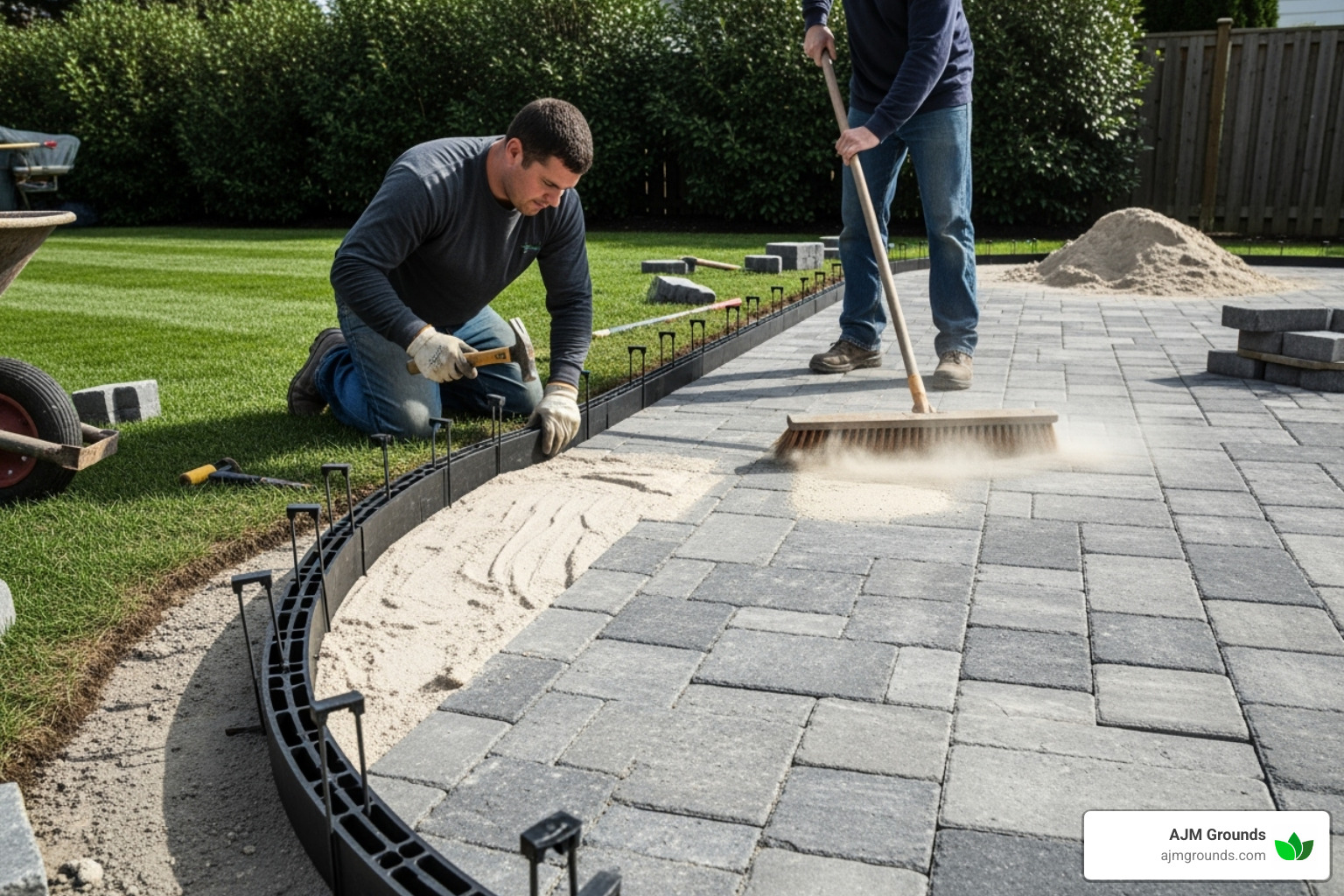
Edge restraints are non-negotiable. They prevent pavers from shifting and creating gaps. Common types include plastic edging secured with spikes, permanent concrete haunching, or invisible edge systems for flexible designs.
Joint filling locks the pavers, prevents weeds, and adds stability. Polymeric sand is the best choice; it contains additives that harden with water to create a durable, flexible bond. To apply it, ensure the pavers are completely dry. Sweep the sand into the joints until they are full. Crucially, use a leaf blower to remove all excess sand from the paver surfaces to prevent a permanent haze from forming. Lightly mist the area with water to activate the polymers and let it cure for at least 24 hours before use.
More about hardscape construction.
Common Mistakes and When to Call a Professional
Even with careful planning, installing large pavers can be challenging. Avoiding common pitfalls is key to success, as is knowing when a project is better left to the professionals at AJM Grounds.
Common Mistakes to Avoid When Installing Large Pavers
- Improper Base Preparation: An uncompacted or too-thin base will lead to uneven settling and tripping hazards, requiring a complete redo.
- Insufficient Compaction: The ground, each gravel layer, and the final pavers all need to be compacted. Skipping any step creates an unstable foundation.
- Incorrect Slope: Forgetting to slope the patio away from your house (1-inch drop per 8 feet) can cause water damage and ice heaving in Massachusetts winters.
- Dragging Pavers: Sliding pavers into place ruins the carefully leveled sand bed, resulting in an uneven surface that’s impossible to fix later.
- Ignoring Edge Restraints: Without restraints, pavers will creep outward, creating gaps and compromising the entire installation’s integrity.
- Incorrect Joint Filling: Leaving excess polymeric sand on the surface will create a permanent white haze, while not filling joints deeply enough allows for weeds and washout.
- Forgetting Safety: These slabs are heavy and awkward. Lifting improperly can lead to serious back injuries or crushed hands and feet.
Is DIY Right for You? Knowing When to Hire a Pro
Is this a manageable DIY project? Consider these factors before you start.
- Project Scale and Complexity: A small, flat patio may be a good DIY project. However, large, multi-level, or sloped designs require professional grading and equipment.
- Physical Demands: This is strenuous work involving hours of bending and heavy lifting. Be realistic about your physical condition and the project size.
- Time Commitment: A DIY project often takes longer than anticipated due to weather, equipment rentals, and learning curves. Ensure you have the time and patience to see it through.
Hiring a professional like AJM Grounds offers significant advantages: expertise in local soil and drainage conditions, access to commercial-grade equipment for superior results, and guaranteed quality that lasts. We handle the complex grading, heavy lifting, and precision work efficiently, saving you from costly mistakes and physical strain.
At AJM Grounds, we’ve been providing exceptional Hardscaping Services throughout Woburn, MA, and surrounding communities like Bedford, Billerica, Burlington, Lexington, Reading, Stoneham, Wilmington, and Winchester. Our attention to detail and personalized service ensure your project gets the care it deserves.
If you’re considering installing large pavers and want the confidence that comes with professional craftsmanship, let’s talk. Request a professional patio installation estimate today, and we’ll help you create an outdoor living space that exceeds your expectations and stands the test of time.
