

Transform Your Yard with a Stone Path
Ever looked at your yard and thought it needed something special? Installing a stepping stone walkway might be just the weekend project you’re looking for. I’ve seen countless homeowners transform their outdoor spaces with this simple addition that packs a serious visual punch.
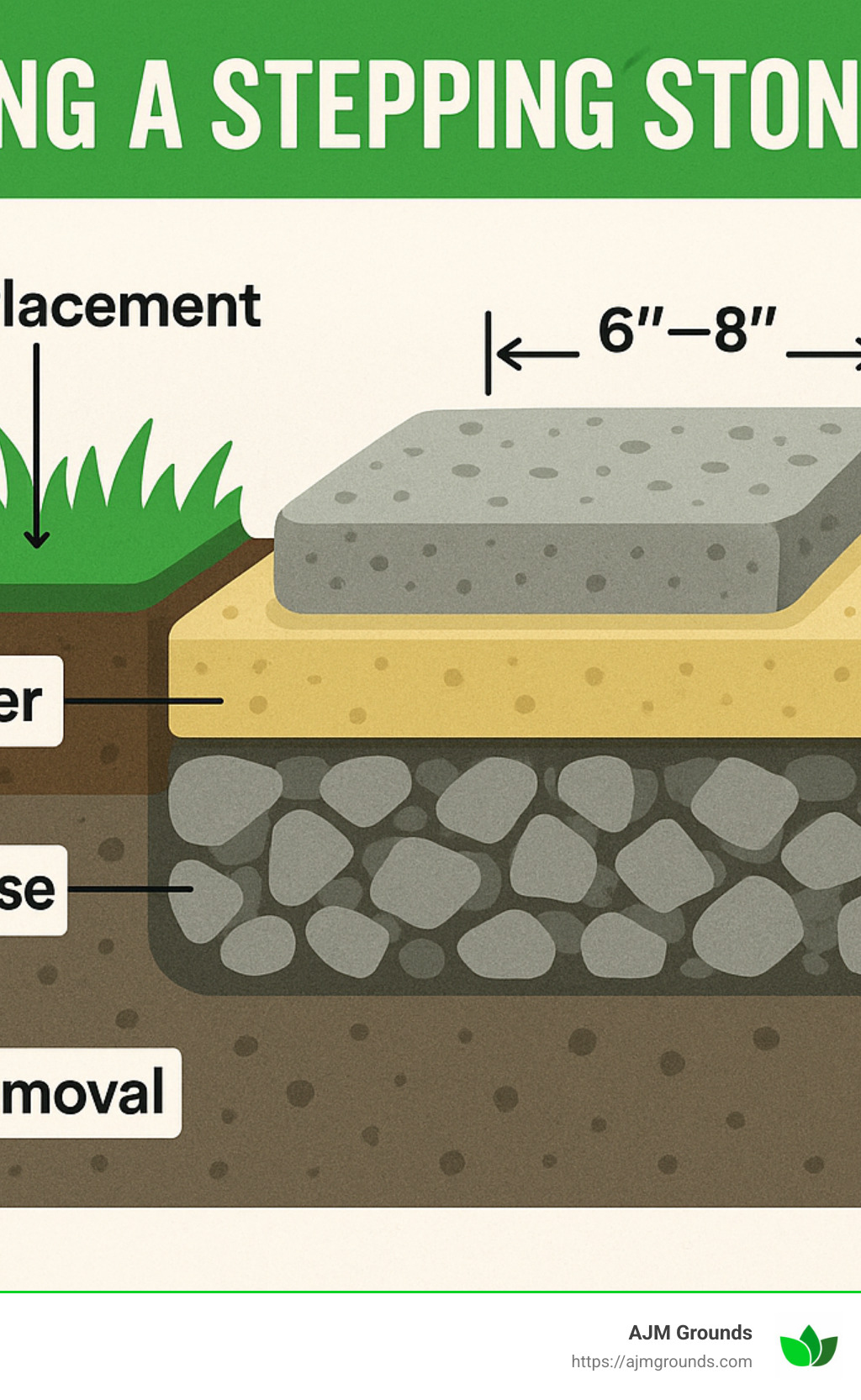
The process is surprisingly straightforward. Start by planning your path – lay out your stones exactly where you want them and mark their positions. Then dig down about 3-4 inches below grade for each stone placement. Next comes the foundation – add about 2 inches of gravel followed by a quarter inch of sand to create a stable base. When setting each stone, take time to ensure they’re level and stable (nobody likes a wobbly walkway!). Finally, fill in the gaps with your choice of soil, decorative gravel, or even ground cover plants for a finished look.
What I love about stepping stone paths is how they solve multiple problems at once. They guide foot traffic through your yard while protecting your lawn from wear and tear. Those muddy patches after rain? Gone! Plus, they add instant character to even the plainest landscape. Whether you’re creating a straight shot from driveway to front door or a meandering path through your garden beds, stepping stones offer that perfect blend of function and charm.
The best part? These pathways are incredibly low-maintenance once installed. A quick sweep occasionally is usually all they need, and they’ll last for years to come. With some basic tools and a free weekend, most homeowners can tackle this project themselves.
I’m John Caplis, owner of AJM Grounds LLC, and I’ve installed countless stepping stone walkways throughout Woburn, Massachusetts over the years. There’s something deeply satisfying about creating pathways that not only look beautiful but also make properties more functional and welcoming.
Want to learn more about installing a stepping stone walkway or similar projects? We’ve got you covered:
– installing a garden path
– patio installation company
– brick sidewalk repair near me
Why Choose a Stepping Stone Walkway?
There’s something magical about a stepping stone path that transforms an ordinary yard into something special. It’s not just a practical way to get from here to there – it’s a design element that adds character while solving several common yard problems at once.
“Natural stone paths look good in almost any landscape. They never go out of style like so many man-made paver materials,” says Steve Boehme, a landscape design expert. This timeless quality makes installing a stepping stone walkway a smart investment that will look just as good years from now as it does the day you finish it.
For homeowners across Bedford, Billerica, Burlington and throughout Massachusetts, these charming pathways offer tremendous benefits. Your lawn stays protected from foot traffic that would otherwise create worn, muddy trails. During our notorious New England spring thaws and autumn rains, you’ll appreciate having solid footing instead of soggy shoes. The visual appeal can’t be overstated – a thoughtfully designed stone path naturally draws the eye through your landscape, creating interest and flow.
Unlike solid concrete walkways, stepping stones allow rainwater to percolate into the soil between them, reducing runoff and helping with drainage issues. If you have a smaller yard (common in Winchester or Lexington), a stepping stone path creates an illusion of more space by establishing a sense of journey through your garden. And let’s not forget the practical benefits – increased property value, better traction in wet conditions, and a feature that complements virtually any home style.
More info about Landscape Design & Installation
Big Benefits in a Small Footprint
What makes installing a stepping stone walkway particularly appealing is how it delivers maximum impact with minimal disruption to your existing landscape.
“A stepping-stone path in a lawn can become a feature in its own right, preventing bare patches from heavy foot traffic,” notes a gardening expert from BBC Gardeners’ World. This perfect balance of beauty and function works wonderfully in established neighborhoods like Woburn and Winchester, where mature landscapes benefit from thoughtful additions rather than complete overhauls.
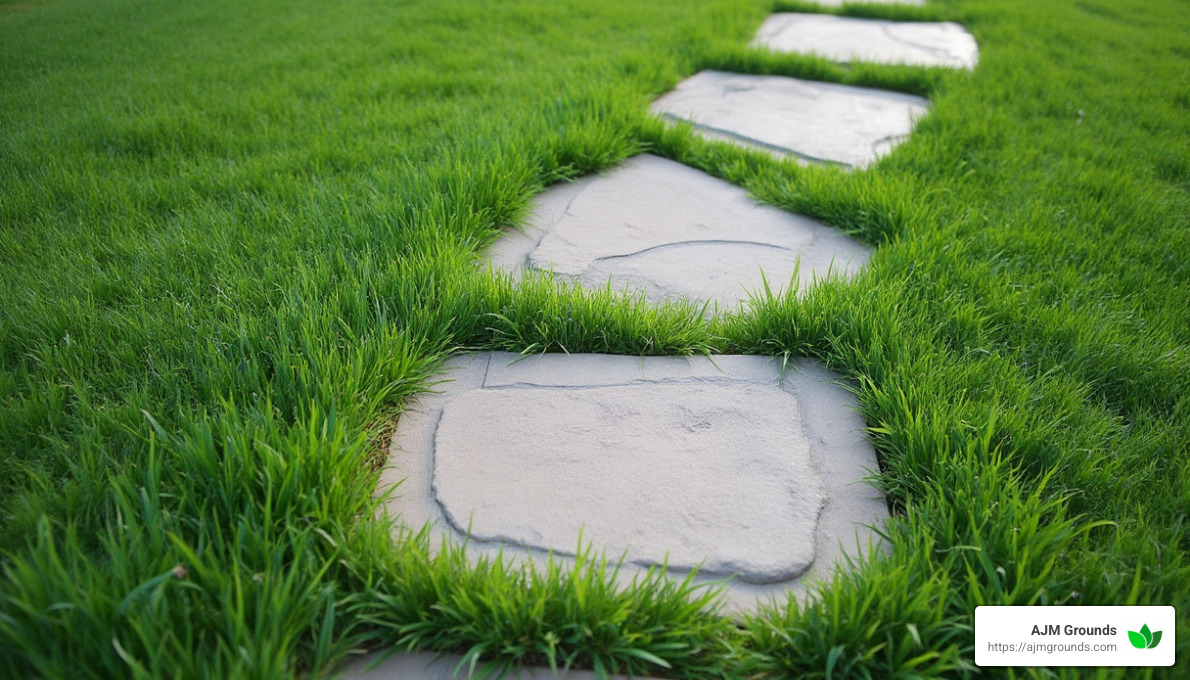
The spaces between your stones offer endless creative possibilities. You might keep it simple with grass growing between stones for a seamless look, plant creeping thyme for a fragrant experience when walked upon, or use decorative pea gravel for a more defined appearance. This versatility lets you tailor the path to complement your home’s character – whether you’ve got a historic property in Lexington or a modern home in Burlington.
The drainage benefits are substantial too. With proper installation and a slight slope (about ¼ inch per foot), these pathways help direct water away from your foundation while allowing much of it to naturally absorb into the ground. In our New England climate where spring thaws and summer thunderstorms can create water management challenges, this natural permeability is a significant advantage.
Common Mistakes to Avoid Early
After years of creating stepping stone pathways throughout Stoneham, Reading, and neighboring Massachusetts communities, we’ve seen the same mistakes trip up DIYers time and again. A little knowledge now can save you significant headaches later.
Choosing porous stone is perhaps the most costly mistake in our New England climate. “Porous stones like ‘creek rock’ absorb moisture and will crumble under freeze-thaw,” warns one hardscaping expert. Those beautiful limestone pieces might look perfect in the store, but after a few winters of our freeze-thaw cycles, they could crack and deteriorate. Always select dense, non-porous stones like granite or solid bluestone that can withstand our harsh winters.
Ignoring stride length leads to paths that feel awkward and unnatural to walk on. We always recommend measuring the stride of the shortest person in your household when determining stone spacing. Nothing ruins a beautiful path faster than having to take uncomfortably long or awkwardly short steps between stones.
Skipping base layers is the mistake we see most frequently. Placing stones directly on soil without proper preparation virtually guarantees future problems. Without a compacted gravel base, your stones will shift, sink, and become uneven over time, creating tripping hazards and a disheveled appearance.
Insufficient depth when excavating is another common error. Digging only deep enough for the stone itself means there’s no room for the crucial base materials. Always excavate 3-4 inches below your desired finished height to accommodate proper base materials that provide drainage and stability.
Neglecting drainage considerations can lead to water pooling on or around your stones. Without a slight slope for runoff, you’ll end up with slippery moss growth and potentially dangerous conditions during freeze-thaw cycles.
By avoiding these common pitfalls from the start, your stepping stone pathway will remain beautiful, functional, and safe for many years to come – a charming addition to your outdoor space that serves your family well through all our Massachusetts seasons.
More info about Landscape Design & Installation
Picking the Right Stones, Tools & Base Materials
When you’re planning on installing a stepping stone walkway, choosing the right materials makes all the difference between a path that lasts for years and one that starts shifting after the first frost. Through our experiences creating beautiful pathways throughout Woburn, Winchester, and nearby Massachusetts communities, we’ve learned what works best in our sometimes challenging New England weather.
Stone Selection
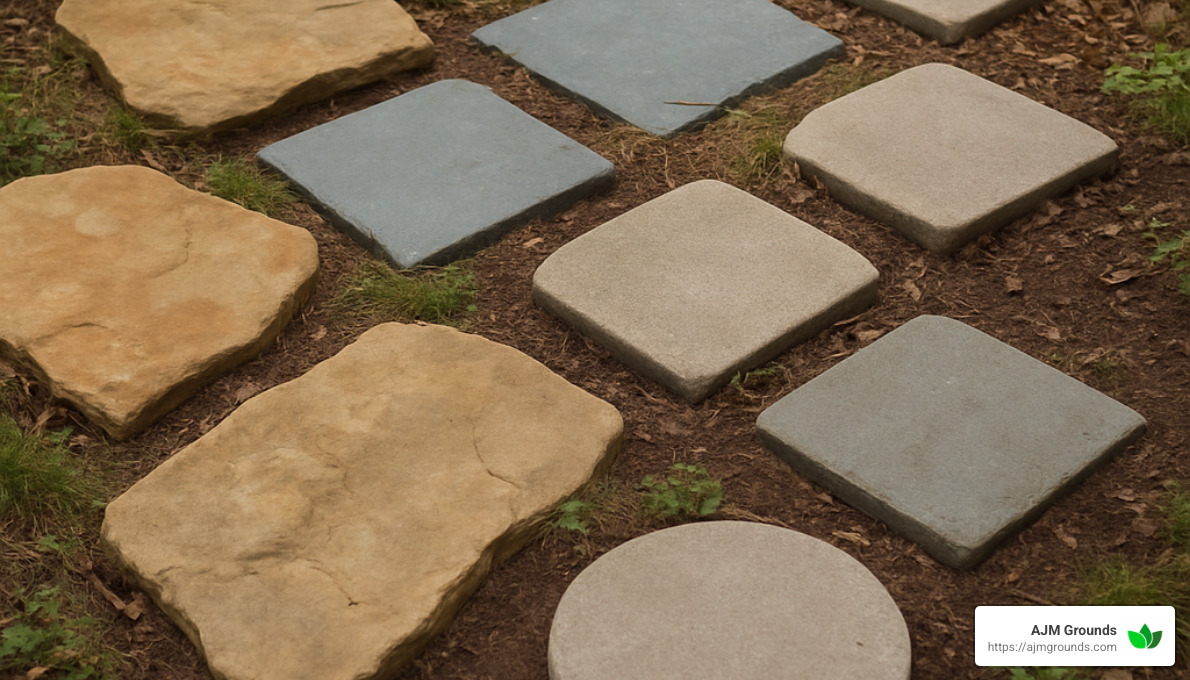
The stones you select will define the character of your pathway. Natural flagstone creates a timeless, organic feel that blends beautifully with garden settings. Its irregular shapes and earthy tones make each path unique – no two installations ever look exactly alike. Prices typically range from $5-$15 per square foot, depending on the variety and thickness.
Slate, a specific type of flagstone, offers that distinctive layered look with its often bluish-gray coloration. It’s incredibly durable and gives paths a slightly more formal appearance that complements both traditional and contemporary homes throughout Stoneham and Reading.
If you’re working with a tighter budget, concrete pavers provide consistency in size, color, and texture. They’re generally more affordable than natural stone and come in countless styles – some even mimicking the look of natural stone with remarkably convincing results.
For woodland gardens or more rustic properties, treated wood rounds create charming, whimsical paths. While they won’t last as long as stone, they bring unique character and warmth to natural settings.
Base Materials
What lies beneath your stepping stones matters just as much as the stones themselves. Think of it as building a house – without a solid foundation, even the most beautiful structure will eventually fail.
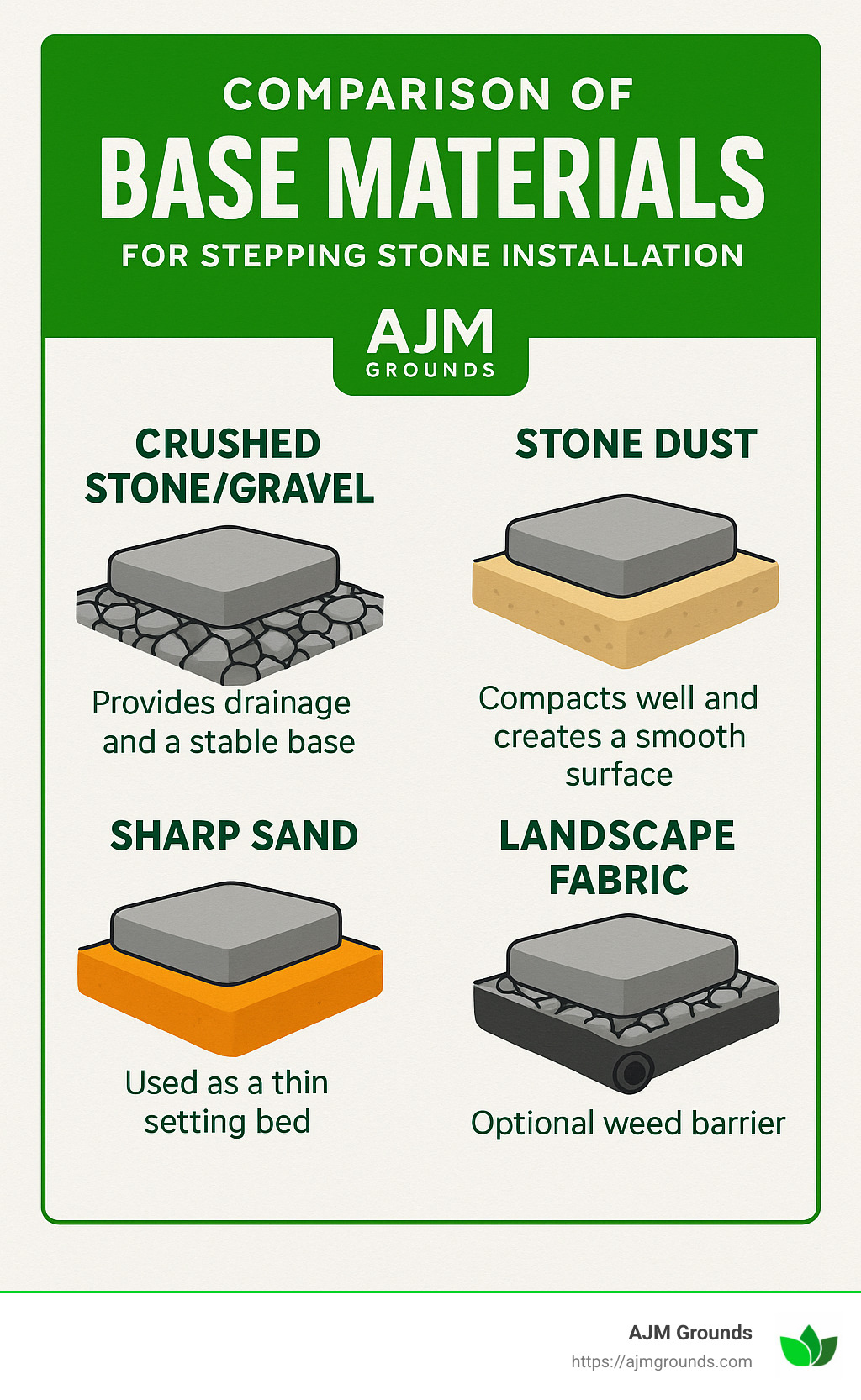
The bottom layer should be crushed stone or gravel (about 2 inches deep), which provides excellent drainage and stability. Above that, a layer of stone dust creates a smooth, compactable surface that helps you precisely position each stone. Stone dust typically costs around $50 per cubic yard, though prices vary depending on your location and quantity needed.
For fine adjustments to height and level, a thin layer of sharp sand (sometimes called builder’s or mason’s sand) works wonders. Unlike play sand, sharp sand has angular particles that lock together when compacted.
Many of our clients in Burlington and Lexington ask about weed prevention. While not essential, landscape fabric placed beneath the gravel layer can significantly reduce weed growth between stones, saving you maintenance headaches down the road.
Sizing & Spacing Essentials
Getting the proportions right makes the difference between a path that feels natural to walk on versus one that forces an awkward stride. For main walkways, stones should be at least 24 inches wide to provide comfortable footing. Anything smaller might look charming but could become a balancing act, especially when carrying groceries or during winter months.
Thickness matters too – aim for stones at least 1.5 inches thick to prevent cracking under weight. For primary pathways that see regular use, 2-3 inches is even better.
When it comes to spacing, I always recommend measuring the stride length of the shortest person in your household. There’s nothing more frustrating than a beautifully installed path that forces everyone to take unnatural steps! Generally, leaving about 6 inches between stone edges works well for most people.
If you’re creating a main entrance path, consider width carefully. A standard 36-inch width works for most residential applications, but 48 inches allows two people to comfortably walk side by side – something worth considering for front entrance paths.
Tool Checklist You’ll Actually Use
You don’t need specialized equipment for installing a stepping stone walkway, but having the right basic tools makes the job much easier. A good spade or shovel is essential for excavation, while a half-moon edger helps create clean cuts around existing turf.
For compacting base materials, a hand tamper works for smaller projects, but renting a plate compactor is worth every penny for larger pathways. Trust me, your back will thank you! A 4-foot level is non-negotiable – it ensures your stones sit properly and have the slight slope needed for proper drainage.
A sturdy wheelbarrow saves countless trips when moving materials, and a rubber mallet is perfect for tapping stones into place without damaging them. For layout, simple stakes and string help maintain straight lines or gentle curves, while utility marking paint or chalk helps visualize stone placement before you start digging.
One piece of advice from years of kneeling on Massachusetts soil – invest in good knee pads! They might not seem essential at the store, but halfway through setting stones, they’ll feel like the best purchase you’ve ever made.
With the right materials and tools in hand, you’re ready to transform your outdoor space with a beautiful, functional pathway that will improve your property for years to come. And if gathering all these materials seems overwhelming, at AJM Grounds, we’re just a phone call away, ready to handle every aspect of your pathway installation.
Installing a Stepping Stone Walkway: Step-by-Step
Now that you understand the materials and tools needed, let’s walk through the process of installing a stepping stone walkway. At AJM Grounds, we’ve refined this process through hundreds of installations across Woburn, Winchester, Lexington, and beyond.
Planning & Marking the Path for Installing a Stepping Stone Walkway
The first step in installing a stepping stone walkway is creating a thoughtful plan. Start by considering your path’s purpose – is this a main route from your driveway to the front door, or a leisurely garden path? This will influence everything from stone size to spacing.
For straight paths, a simple string line between stakes works wonders. If you’re dreaming of gentle curves (which often look more natural in garden settings), grab your garden hose – it’s perfect for laying out flowing curves that you can adjust until they look just right.
“Walk before you mark,” as I often tell my clients in Bedford and Burlington. Take a stroll along your proposed route to make sure it feels natural. Pay attention to how your feet naturally fall – this will guide your stone spacing.
Once you’re happy with the layout, place your actual stepping stones along the path in their approximate positions. This visual preview helps catch any awkward transitions before you start digging. Step from stone to stone to confirm the spacing feels comfortable for your stride.
With stones positioned, trace around each one using spray paint or chalk. This creates your digging template. And please – don’t skip calling 811 before you dig! This free utility-marking service isn’t just a good idea – it’s required by law and could save you from hitting gas or water lines.
Ground Prep & Base Layers for Installing a Stepping Stone Walkway
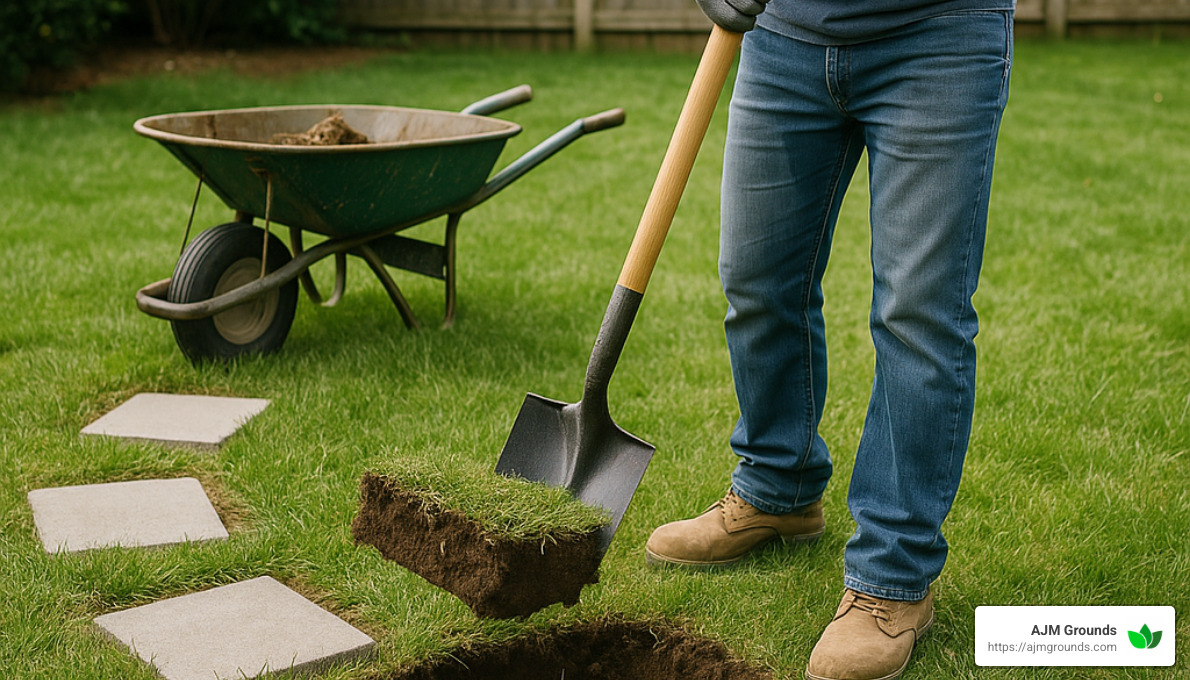
The secret to stepping stones that stay level for years isn’t in the stones themselves – it’s what goes underneath them. Start by cutting cleanly around your marked outlines with a spade or half-moon edger, then remove the sod and soil to a depth of about 3-4 inches below your desired finished height.
If you’re working in an established lawn in Winchester or Lexington, consider saving the removed sod on a tarp – you might reuse it to fill gaps between stones later.
Once excavated, compact the soil at the bottom of each hole using a hand tamper or plate compactor. This creates a solid foundation and prevents future settling. In weed-prone areas of your Woburn or Stoneham property, consider laying landscape fabric at this stage – your future self will thank you for not having to pull weeds between stones.
Next comes the most crucial layer – about 2 inches of crushed stone or gravel in each hole. Compact this thoroughly with your tamper. This drainage layer prevents water from pooling beneath your stones, which is especially important through our New England freeze-thaw cycles.
Finally, spread approximately 1/4 inch of sharp sand over the gravel. I like to mix stone dust with just enough water to create a cake-batter consistency – this creates a perfectly malleable bed for fine-tuning stone placement. This thin layer allows you to make small adjustments to get each stone perfectly level.
Setting, Leveling & Locking Each Stone when Installing a Stepping Stone Walkway
This is where your pathway starts to come alive! Place each stone in its prepared bed, positioning it according to your original layout. The 4-foot level becomes your best friend here – check that each stone is level from side to side, with a slight slope (about 1/4 inch per foot) away from buildings to ensure proper drainage.
“A slight pitch prevents puddles and discourages moss growth,” I often remind our clients in Reading and Burlington. In our New England climate, proper drainage isn’t just about aesthetics – it prevents ice formation in winter.
Add or remove sand beneath the stone to achieve the perfect position. You’ll want to wiggle each stone slightly to help it settle into the sand. Then use your rubber mallet to tap the stone firmly into place, helping it make full contact with the base materials.
The “wobble test” is essential – step on each corner of the stone to ensure it doesn’t rock. A wobbly stepping stone is not just annoying – it’s a tripping hazard. If you find any movement, simply lift the stone, adjust the sand beneath, and reset.
Installing a stepping stone walkway requires attention to height as well. Stones should sit slightly above grade if surrounded by lawn (making mowing easier) or flush with grade in garden beds. Working with a partner makes this process much smoother, especially when handling larger stones.
Filling Gaps & Finishing Touches
The spaces between your stepping stones offer a chance to add personality to your pathway. You might choose sifted topsoil and grass seed for a lawn-integrated look that’s popular in Winchester neighborhoods. Or consider decorative pea stone for a more defined path with excellent drainage, which works well in Billerica’s varied terrain.
For a truly stunning effect, plant ground cover like creeping thyme or moss between stones. Not only beautiful, these living fillers release wonderful fragrance when walked upon – a delightful sensory experience we’ve created for many clients throughout Massachusetts.
Whatever filler you choose, apply it to just below the stone surface. If using soil and seed or plants, water thoroughly to settle the material and encourage growth. The change from raw stones to integrated pathway happens surprisingly quickly.
Consider adding solar lighting along your new path for both safety and ambiance during evening hours. Low-voltage landscape lighting is another beautiful option we often install for clients in Woburn and surrounding communities.
For more detailed visual guidance on installing a stepping stone walkway, check out Setting Stepping Stones – visual guide, which provides excellent step-by-step photos of the process.
Finishing, Drainage & Ongoing Maintenance
Your stepping stone walkway isn’t quite “set it and forget it” – but the maintenance is refreshingly simple compared to many other landscape features. With a little seasonal attention, your path will continue to improve your property for years to come.
Drainage & Sloped-Site Tricks
Water is both friend and foe to any hardscape element. Here in Massachusetts, where we experience everything from spring downpours to winter freeze-thaw cycles, proper drainage isn’t optional – it’s essential.
The golden rule when installing a stepping stone walkway is maintaining that subtle ¼-inch per foot slope away from your home or other structures. This almost imperceptible grade prevents water from pooling around your foundation while keeping your pathway dry and safe.
For properties with persistent drainage issues like some we’ve worked with in low-lying areas of Woburn and Winchester, consider adding a French drain alongside your path. This underground channel captures and redirects water before it becomes problematic.
If your property has natural slopes, work with them rather than against them. A simple trench on the uphill side of your path can intercept water flow and channel it away from your carefully installed stones. This small preventative measure can save you significant headaches down the road.
“I always remind clients that the spaces between stones aren’t just decorative – they’re functional,” says John from AJM Grounds. “Keeping those joints slightly recessed creates mini-reservoirs that allow water to percolate naturally into the soil rather than rushing across the surface.”
Seasonal Care Schedule
New England’s distinct seasons each bring their own maintenance considerations for your stepping stone pathway:
Spring is inspection time. Once the snow melts, take a careful walk along your path to identify any stones that may have shifted during winter’s freeze-thaw cycles. This is also the perfect time to clean your stones with a stiff brush and mild detergent if they’ve accumulated winter grime. Any filler material between stones that washed away can be replaced now, and if you used polymeric sand in the joints, check if it needs reapplication.
Summer brings growth – sometimes where you don’t want it. Keep any ground cover plants between stones neatly trimmed, and stay vigilant about weeding. An occasional gentle washing of your stones will prevent dirt buildup and discourage algae growth, especially in shaded areas common in properties throughout Reading and Stoneham.
Fall brings beautiful colors – and falling leaves that can create slippery conditions on your pathway. Regular leaf removal not only keeps your path safe but prevents organic material from decomposing between stones. This is also a good time to top up any areas between stones that may have settled and to ensure all stones remain securely in place before winter arrives.
Winter requires special care. When de-icing becomes necessary, opt for calcium chloride-based products rather than rock salt, which can damage stone surfaces over time. When clearing snow, use plastic shovels rather than metal ones to avoid scratching or chipping your stones. As one landscaping expert wisely cautions, “Respect rocks. They can hurt you badly in a careless moment.”
For properties in Burlington or Lexington that receive significant snowfall, consider marking the edges of your path with reflective markers before the first snow. This simple step can prevent accidental damage during snow removal.
Properly cared for, your stepping stone walkway will continue to provide safe passage and visual appeal through all four seasons. And remember, if maintenance ever becomes overwhelming or you notice significant issues, professional help is just a call away.
More info about Walkway Installation
Budget, Timeline & When to Call in the Pros
Let’s talk dollars and sense when it comes to installing a stepping stone walkway. Whether you’re a weekend warrior ready to tackle this project yourself or considering professional help, understanding the investment of both money and time will help you plan effectively.
Budget Considerations
Creating a beautiful stone path doesn’t have to break the bank, but costs can vary widely depending on your choices. Based on internet data (not actual costs for AJM Grounds), here’s what homeowners typically spend:
For the DIY route, expect to invest between $500-$3,000 for a standard residential pathway. Natural stone like bluestone or granite will push you toward the higher end, while concrete pavers keep costs lower. The beautiful flagstone paths we install throughout Winchester and Lexington typically fall somewhere in the middle of this range.
Your biggest expenses will be the stones themselves (ranging from $5-$45 per square foot) and base materials like stone dust (about $50-$150 per cubic yard). Don’t forget to factor in tool costs if you don’t already own them – that plate compactor rental runs about $60-$100 per day, and it’s absolutely worth it for proper compaction.
Professional installation ranges more widely, from $600 to $10,500 based on internet averages, with the high end being at least 3x average pricing. This significant range reflects differences in stone quality, path complexity, and regional labor costs. In our experience serving communities like Woburn and Reading, most residential paths fall in the middle of this range.
As one customer in Stoneham told us after completing their own pathway: “I saved money doing it myself, but I definitely underestimated how much stone dust I’d need – had to make three more trips to the supplier!”
Timeline Expectations
Time is another important consideration when installing a stepping stone walkway. For a typical 20-30 foot residential path:
DIY enthusiasts should set aside one to four days for completion. If you’re working alone with limited experience, plan for the longer timeframe. Factors like stone weight, weather conditions, and path complexity all affect your timeline. That beautiful curving path through your garden will take longer than a straight shot from driveway to door.
Professional installation through AJM Grounds typically takes just one to two days, even for intricate designs. Our team has installed countless pathways throughout Bedford, Billerica, and nearby communities, and our experience shows in our efficiency.
I remember one client in Burlington who had spent two weekends on their pathway project before calling us to finish the job. “I had no idea how physically demanding moving those stones would be,” she admitted. “What would have taken me another two weekends, your team completed in hours.”

Signs You Should Hire Instead of DIY
While many homeowners successfully install their own stepping stone walkways, there are situations where professional help makes sense. Consider calling AJM Grounds if your project involves:
Steep slopes that exceed a 20% grade. These require specialized techniques to prevent erosion and ensure long-term stability. Many properties in Winchester and Lexington have challenging grades that benefit from professional expertise.
Heavy stone logistics can be daunting. Natural stones often weigh 50+ pounds each, and moving them safely requires proper equipment and techniques. Your back will thank you for calling in help!
Time constraints matter too. If you need your pathway completed quickly for a graduation party or home sale, our team can complete in days what might take you weeks of weekend work.
Accessibility requirements demand precision. If your path needs to meet specific codes or accommodate mobility challenges, professional installation ensures compliance and safety.
Complex designs with intricate patterns or integration with other landscape features benefit from our years of experience creating cohesive outdoor spaces throughout Woburn and surrounding areas.
As one hardscaping expert puts it, “Safety is number one when installing any outdoor surface.” We couldn’t agree more – it’s the foundation of every project we undertake.
How to Lay a Stepping-Stone Path – cost breakdown
Added Value of Professional Hardscaping
When you choose AJM Grounds for installing a stepping stone walkway, you’re not just paying for labor – you’re investing in expertise and peace of mind.
Our professional installation includes warranty protection that DIY projects simply can’t offer. When winter frost heaves come calling (as they inevitably do in New England), you’ll appreciate having our guarantee behind your pathway.
Our design expertise helps you make choices that complement your home’s architecture and existing landscape. We’ve created pathways for everything from historic colonials in Lexington to contemporary homes in Burlington, and we understand how to make your path feel like it’s always belonged there.
Proper equipment makes a tremendous difference in installation quality. Our professional-grade plate compactors ensure proper base preparation – a critical step that many DIYers struggle to achieve with hand tampers.
Material knowledge gained from years in the field helps us recommend stones that will stand up to New England’s freeze-thaw cycles. That beautiful limestone might look stunning in a catalog, but we might suggest more durable granite for your high-traffic areas.
Perhaps most valuable is efficiency. What might take a homeowner several weekends of sore muscles and YouTube tutorials, our team can often complete in a single day, with professional results that will last for years.
As landscape designer Steve Boehme notes, “Stone construction is one of the most satisfying home improvement projects you can do.” Whether you choose to tackle it yourself or bring in our professional team, a well-executed stepping stone walkway adds lasting beauty, function, and value to your property.
Frequently Asked Questions about Stepping Stone Walkways
How deep should I dig under each stone?
When installing a stepping stone walkway, proper excavation depth is crucial for long-term stability. Dig approximately 3-4 inches below your desired finished grade. This allows for a 2-inch layer of compacted gravel, a thin 1/4 to 1/2 inch of sand for leveling, plus the thickness of your stone.
For example, if you’ve chosen stepping stones that are 2 inches thick and you want them to sit flush with your lawn, you’ll need to dig down about 4-4.5 inches total. This might seem like overkill, but trust me – this extra depth pays off in the long run!
“Dig a trench an inch or two deeper than the thickest stone and pack one-inch crusher-run limestone into it,” recommends one stonework expert. This proper base preparation ensures good drainage and prevents that annoying sinking that happens when stones are placed too shallowly.
Think of it as building the foundation for a small house – you wouldn’t skimp on the foundation, and neither should you skimp on the base for your stepping stones. Your future self (and ankles) will thank you!
What is the ideal distance between stepping stones for comfortable walking?
Finding the right spacing between stones is a bit like Goldilocks – not too close, not too far apart, but just right for a natural stride. The standard edge-to-edge spacing is about 6 inches between stone edges, which typically translates to around 24 inches from the center of one stone to the center of the next.
This 24-inch center-to-center measurement generally matches an average adult stride, but here’s a pro tip: measure the stride of the shortest person who’ll regularly use the path. There’s nothing more awkward than a beautifully installed path that forces everyone to walk like they’re in a three-legged race!
Different spacing creates distinctly different walking experiences. Closer spacing (4-6 inches) encourages a slower, more contemplative stroll – perfect for garden paths where you want people to notice your plants. Wider spacing (8-10 inches) allows for a more natural, flowing stride ideal for frequently used paths. Very tight spacing (1-2 inches) works well if you need to accommodate garden carts or wheelbarrows.
As one expert notes, “The ideal distance between stepping stones is about 6 inches between the edges, or 24 inches from the center of one stone to the center of the next, matching the average stride.” But remember – your path, your stride, your choice!
Can I place stones directly on grass without a base?
I know it’s tempting to simply lay your beautiful new stepping stones directly on the grass and call it a day. It’s quicker, easier, and honestly, looks pretty good… for about a week. While technically possible, this approach is something I strongly advise against, especially in our New England climate.
Stones placed directly on grass quickly become unstable. They rock, shift, and create that annoying wobble when you step on them. Without proper support underneath, they’ll gradually sink into the soil, especially after a good rain. This is particularly problematic in our region, where freeze-thaw cycles cause stones to heave up in winter and sink in spring.
Beyond the annoyance factor, there are practical concerns too. Stones sitting proud above the grass create obstacles for your lawn mower and can damage equipment. Even worse, unstable or protruding stones become trip hazards – not something you want to explain to guests who take a tumble on your property!
One expert puts it plainly: “Although possible, stones laid on grass often shift or slide over time; digging and proper base installation are recommended for a long-lasting result.”
I understand the appeal of a quick solution, but when installing a stepping stone walkway, the extra time spent on proper excavation and base preparation pays dividends in longevity, safety, and appearance. A well-installed stone path can last decades with minimal maintenance – that’s worth a few extra hours of work upfront, don’t you think?
Conclusion
Installing a stepping stone walkway is one of those magical home improvement projects that delivers both practical value and visual charm. It’s the kind of upgrade that transforms how you experience your outdoor space while also catching the eye of every visitor who approaches your home.
Throughout this guide, we’ve walked through the entire process of creating a pathway that will stand the test of time – even through our challenging New England winters. The beauty of stepping stones lies in their versatility. Whether you’re looking to create a formal entrance to your front door or a whimsical garden path that meanders through your backyard, stepping stones provide a solution that’s both functional and full of character.
The key to success? It’s all in the preparation. As tempting as it might be to simply lay stones on the ground and call it a day, taking the time to properly excavate, create a solid foundation, and carefully position each stone will make the difference between a pathway that lasts decades and one that becomes a wobbly mess after the first frost.
Remember to choose dense, non-porous stones that can handle our freeze-thaw cycles without cracking or crumbling. That sturdy base of compacted gravel isn’t just busywork – it’s what will keep your stones stable through seasons of rain, snow, and temperature swings. And don’t forget about natural walking patterns! A path that fights against your natural stride will never feel quite right, no matter how beautiful it looks.
A properly installed stepping stone walkway does more than just keep your shoes mud-free (though that’s certainly a nice benefit!). It directs the eye through your landscape, reduces wear and tear on your lawn, and adds a timeless element to your property that improves its value and appeal. With some simple seasonal maintenance – clearing leaves in fall, checking for shifting in spring – your pathway will continue to delight for years to come.
Whether you decide to tackle this project yourself over a weekend or two, or call in our experienced team at AJM Grounds to handle the heavy lifting, a stepping stone walkway is an investment that pays dividends in both practicality and curb appeal. Our years of installing pathways throughout Woburn, Winchester, Lexington and surrounding communities have shown us that these seemingly simple additions often become favorite features of our clients’ landscapes.
For a personalized consultation on how a stepping stone walkway might improve your specific property, or to discuss any other landscaping needs, we’re always just a phone call away. Our commitment to craftsmanship and attention to detail has made AJM Grounds a trusted name throughout the communities we serve.
More info about our Walkway Installation services
