

Why Small Retaining Walls Transform Your Property
Installing a small retaining wall is one of the most impactful DIY projects you can tackle to solve drainage issues and create usable outdoor space. These structures, typically under 4 feet high, hold back soil while adding both function and beauty to your landscape.
Quick Overview: Installing a Small Retaining Wall
- Plan and measure your layout, checking local codes
- Dig a trench 4-6 inches deep, twice the block width
- Add and compact 2-6 inches of paver base
- Lay the first course perfectly level (most critical step)
- Stack subsequent courses with staggered joints
- Install drainage with gravel and perforated pipe
- Backfill and compact soil in 6-inch layers
- Add capstones with construction adhesive
A small retaining wall prevents soil erosion, creates level planting areas on slopes, and defines outdoor spaces like patios or garden beds. The project typically takes 6-10 hours and costs $150-$500 in materials for a basic wall.
The most common cause of retaining wall failure is poor drainage. Water buildup behind the wall creates enormous pressure that can cause bulging, leaning, or complete collapse.
As John Caplis, owner of AJM Grounds LLC, I’ve helped countless Woburn homeowners transform their sloped yards through professional retaining wall installations. My years of experience installing a small retaining wall have taught me that proper foundation preparation and drainage are the keys to a wall that lasts decades.
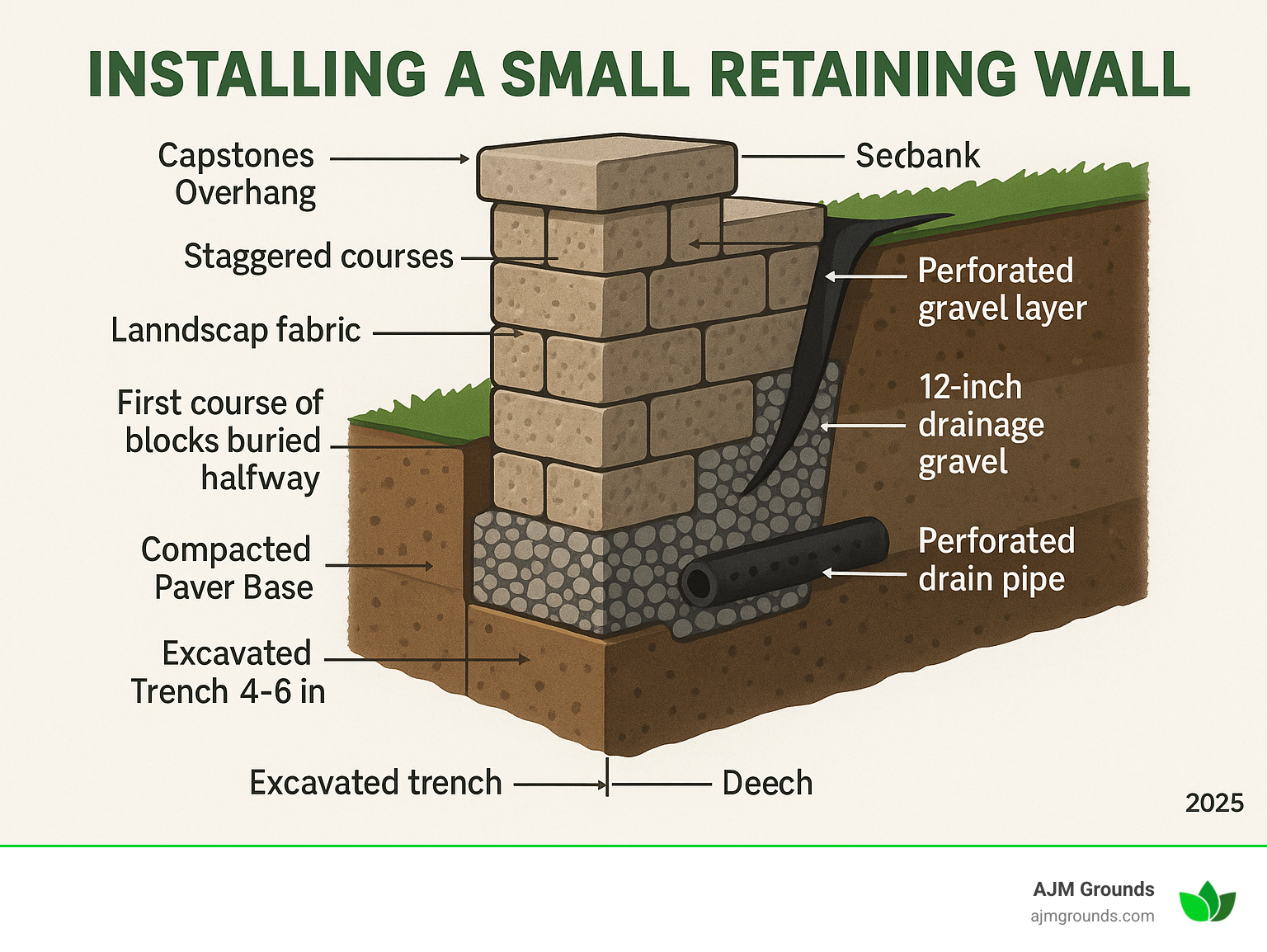
Know your installing a small retaining wall terms:
Planning Your Project: Tools, Materials, and Regulations
This section covers the essential preparation needed before you break ground. Proper planning prevents costly mistakes and ensures a long-lasting wall. Key considerations include design, material estimation, and legal requirements.
What You’ll Need: Tools and Materials
Before you start installing a small retaining wall, take time to gather all your tools and materials. Trust me, there’s nothing more frustrating than being knee-deep in your project only to realize you’re missing something essential.
The good news? You probably already own many of the tools you’ll need. A shovel for excavation and a tape measure for accurate layout are obvious must-haves. You’ll also want both a 4-foot level and a torpedo level for precise alignment – the 4-foot level works great for longer sections, while the torpedo level is perfect for individual blocks.
A rubber mallet becomes your best friend for adjusting blocks without damaging them, and a hand tamper is crucial for compacting soil and base materials. Don’t forget a wheelbarrow for hauling materials around your yard, plus safety glasses and work gloves to protect yourself during the work.
For materials, interlocking concrete blocks form the backbone of your wall, with capstones creating that finished, professional look on top. Your foundation needs paver base or crushed gravel, while drainage gravel (river rock works perfectly) handles water management behind the wall.
Landscape fabric prevents soil from clogging your drainage system, and perforated drain pipe channels water away from the wall’s base. Finally, grab some construction adhesive to secure those capstones in place.
Here’s a pro tip that’ll save you headaches later: purchase 10% more blocks than your calculations show. This accounts for cutting mistakes, unexpected breakage, and future repairs. As one experienced DIYer shared, “I thought it was going to be hard. But it was doable by myself in one afternoon for only about $150!”
How to Plan and Design Your Layout
Successful Landscape Retaining Walls start with thoughtful planning. Your design should balance both function and aesthetics to create something that truly improves your property.
Marking your layout is easier than you might think. For curved, flowing lines, grab a garden hose and lay it out where you want your wall – this lets you visualize the shape and make adjustments before committing. For straight, formal walls, simple stakes and string create clean, precise lines. Once you’re happy with the layout, mark it with spray paint so you don’t lose track during construction.
Calculating materials requires measuring your wall’s total length and desired height. Most standard interlocking blocks are 12 inches long, so a 20-foot wall needs approximately 20 blocks per course. Multiply that by your total number of rows to get your block count. For more detailed planning guidance, check out our Block Retaining Wall Design resource.
Think carefully about your wall’s purpose during the planning phase. Are you creating a raised garden bed for better drainage? Terracing a slope to prevent erosion? Defining a patio or outdoor living space? Maybe you’re managing water runoff from downspouts?
The wall’s purpose directly affects its design. A decorative garden border might only need 2 feet of height, while a slope stabilization project could require the full 4-foot maximum for DIY construction. Understanding your “why” helps you make better decisions about height, materials, and positioning.
Checking Local Codes and Calling 811
Before installing a small retaining wall, you’ll need to verify local requirements. This step might seem tedious, but it prevents costly mistakes and keeps everyone safe.
Permit requirements vary by location, but most communities require permits for walls over 3-4 feet in height. Some areas are even stricter – walls over 2 feet might need approval. If you’re in Bedford, Billerica, Burlington, Lexington, Reading, Stoneham, Wilmington, Winchester, or Woburn, check with your local building department first.
Don’t forget about HOA regulations if you live in a planned community. Review your homeowner’s association guidelines for material restrictions (some HOAs require natural stone over concrete blocks), height limitations that might be stricter than municipal codes, and setback requirements from property lines.
Here’s the most important safety step: Call 8-1-1 before you dig. This free service locates underground utilities including gas lines, electrical cables, and water pipes. As one contractor emphasized, “The change in pressure created by a retaining wall could damage utility lines,” making this call essential for safety.
The 811 service is completely free and typically takes 2-3 business days to mark your property. It’s a small delay that could prevent dangerous accidents and expensive utility repairs. Plus, it’s often required by law – so make the call before you break ground.
The Complete Guide to Installing a Small Retaining Wall
This step-by-step guide walks you through the physical process of building your wall. The foundation and first course are the most critical steps for stability. Proper drainage is the secret to a wall that won’t bulge or fail.
Step 1: Prepare the Foundation and Dig the Trench

Your foundation is like the roots of a tree – if it’s weak, everything above it will eventually fail. Don’t rush this step, even if you’re eager to see your wall taking shape.
Excavation starts with digging a trench twice the width of your block. For standard 12-inch blocks, that means a 24-inch wide trench. The depth calculation is where many DIYers stumble: you need 4-6 inches deep plus half the height of the first block. If your blocks are 6 inches tall, dig down 7-9 inches total.
Why so deep? You’re going to bury half that first block below ground level. This anchoring prevents soil from pushing your wall forward over time.
Compaction transforms loose soil into a solid foundation. Use your hand tamper to pound the trench bottom until it feels firm underfoot. Check for level frequently with your 4-foot level – any high or low spots will haunt you later.
Add paver base in a 2-6 inch layer, depending on your wall height. Taller walls need deeper bases for stability. Rake it smooth, then compact again. If the base material looks dusty, lightly mist it with water – this helps it compact better and reduces dust clouds.
One experienced builder shared this wisdom: “Getting the first course perfectly level is critical. Irregularities in the base course become larger as the wall stacks up.”
Step 2: Lay and Level the Critical First Course
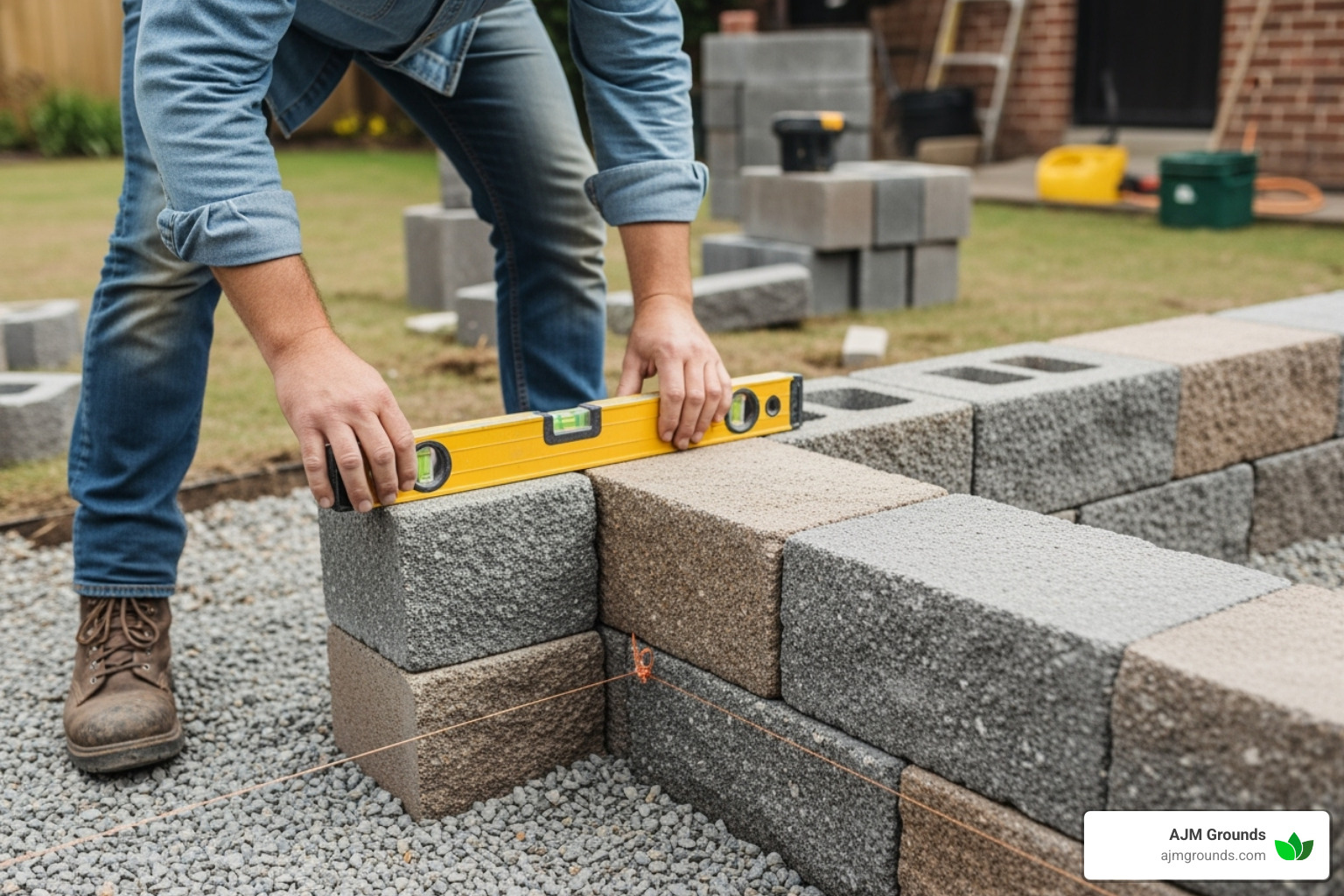
This is where installing a small retaining wall gets serious. The first course determines whether your wall will stand strong for decades or start leaning next spring.
Start at the lowest point of your wall’s path. Water always flows downhill, so beginning at the low end ensures proper drainage throughout the structure. Place your first block on the prepared base and take a deep breath – you’re about to do the most important work of the entire project.
Leveling requires patience and precision. Use your torpedo level to check each block front-to-back and side-to-side. Then check level across adjacent blocks. Make adjustments by tapping with a rubber mallet, adding or removing paver base beneath the block, or using up to 0.5 inches of coarse sand for fine-tuning.
Check level across adjacent blocks to ensure your wall runs straight and true. A gap you can slide a business card through is acceptable, but anything larger needs correction.
Installing Landscape Blocks teaches you that burying the first course properly is non-negotiable. At least half of your first block should sit below ground level. For walls over 3 feet, bury the entire first course. This anchoring prevents the soil from pushing the bottom of your wall outward under pressure.
Step 3: Build Subsequent Courses and Stagger Joints
Now that your foundation is rock-solid, the rest of your wall builds much faster. But don’t let speed compromise quality.
Sweep each course clean before adding the next layer. Even small pebbles or dirt clumps can prevent proper block seating and create weak points that lead to failure years later.
Staggering creates the interlocking pattern that gives your wall its strength. Start the second row with a half-block to offset the vertical joints from the first course. This prevents continuous vertical seams that would weaken the structure. Continue this staggered pattern throughout your wall’s height.
Block Wall Installation becomes almost rhythmic once you understand the pattern. Each block should overlap the joint below by at least 6 inches for maximum strength.
Setback happens automatically with most interlocking blocks. They feature a lip that creates an automatic step back when you pull each block forward until it contacts the course below. This lean into the hillside uses gravity to strengthen your wall – the weight of the soil actually helps hold everything together.
Step 4: Install Drainage and Backfill
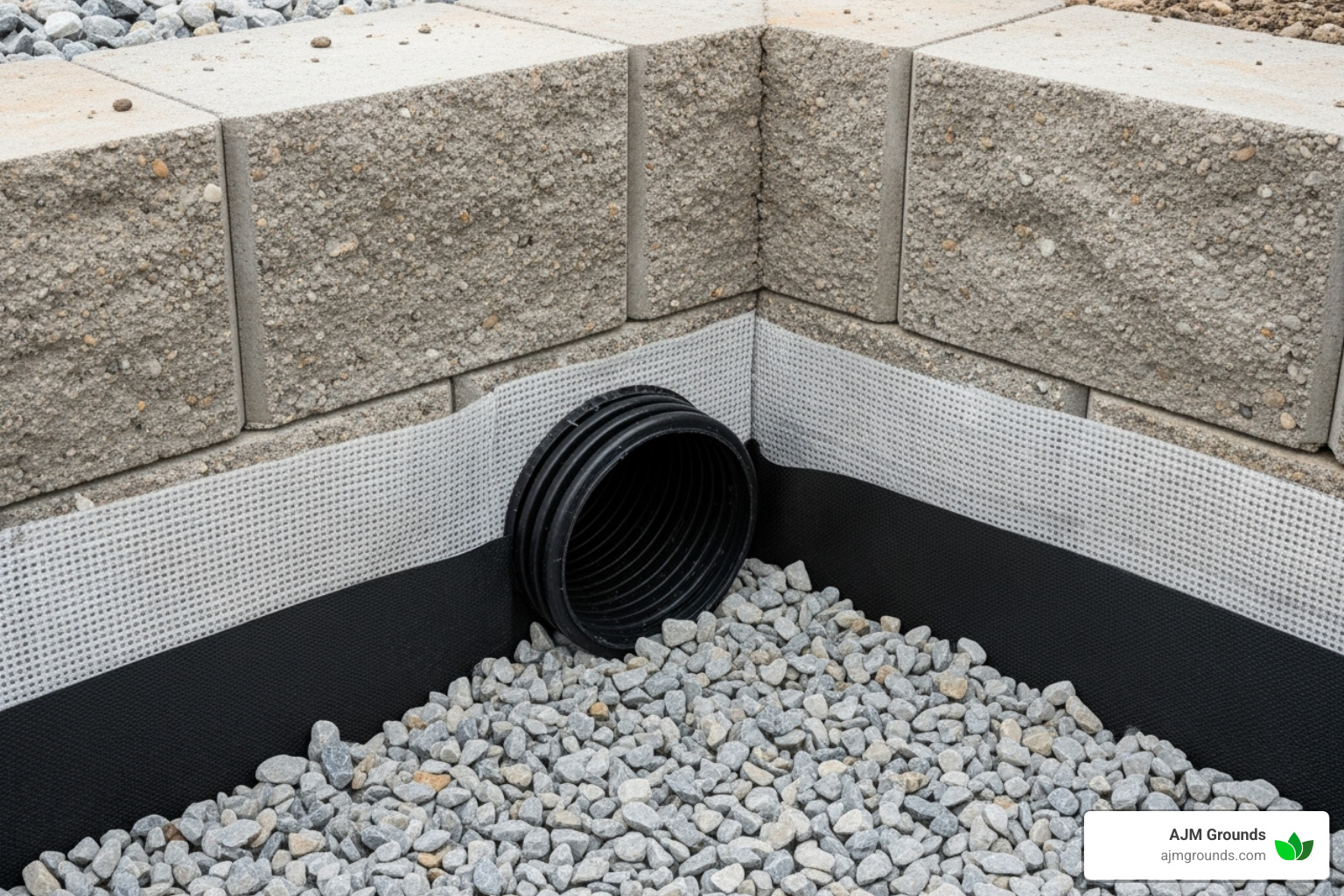
Here’s where you prevent the number one cause of retaining wall failure. Water-saturated soil weighs over 100 pounds per cubic foot and creates enormous pressure against your wall.
Lay landscape fabric against the back of your wall, extending it up and over the entire wall area. This fabric prevents soil from migrating into your drainage gravel while allowing water to pass through freely. Think of it as a coffee filter for your wall.
Drainage stone needs to be at least 12 inches thick behind your wall. River rock works perfectly because its rounded edges don’t lock together, allowing water to flow freely. Some experts recommend 18 inches for better long-term performance, especially in areas with heavy rainfall.
Perforated drain pipe becomes essential for walls over 2 feet or in wet areas. Install a 4-inch perforated pipe at the base of your wall, wrapped in filter fabric to prevent clogging. Make sure it has an outlet where water can flow away from the wall – a pipe that ends in a dead end is useless.
Backfill in layers of 6 inches, compacting each layer thoroughly. Use sandy or gravelly soil that drains well. Never backfill with topsoil or clay, which hold water and increase pressure. As one expert emphasized, “Good compaction means adding 3 or 4 inches of material at a time and compacting it properly.”
Step 5: Add Finishing Touches and Capstones
You’re in the home stretch now. These final steps transform your functional wall into a polished landscape feature.
Finishing the top starts with cleaning the final course thoroughly. Remove all loose material because any debris will prevent proper adhesive bonding. More info about Concrete Block Wall Installation includes detailed techniques for professional results.
Apply construction adhesive to the top course of blocks following the manufacturer’s instructions. Don’t skip this step – it’s what keeps your capstones from shifting or falling off.
Secure capstones carefully, ensuring they’re level and properly aligned. Capstones should overhang the wall by 1 to 1.5 inches for a professional look. This overhang also helps shed water away from the wall face.
Final landscaping completes your project beautifully. Add quality topsoil behind the wall and plant appropriate vegetation. The plants will help stabilize the soil while creating an attractive finished project that improves your property value.
Your installing a small retaining wall project is now complete – step back and admire your handiwork!
Common Mistakes and Creative Ideas
Knowing what to avoid is as important as knowing what to do. A small retaining wall can be more than just functional—it can be a creative centerpiece of your landscape design.
Pitfalls to Avoid When Building Your Wall
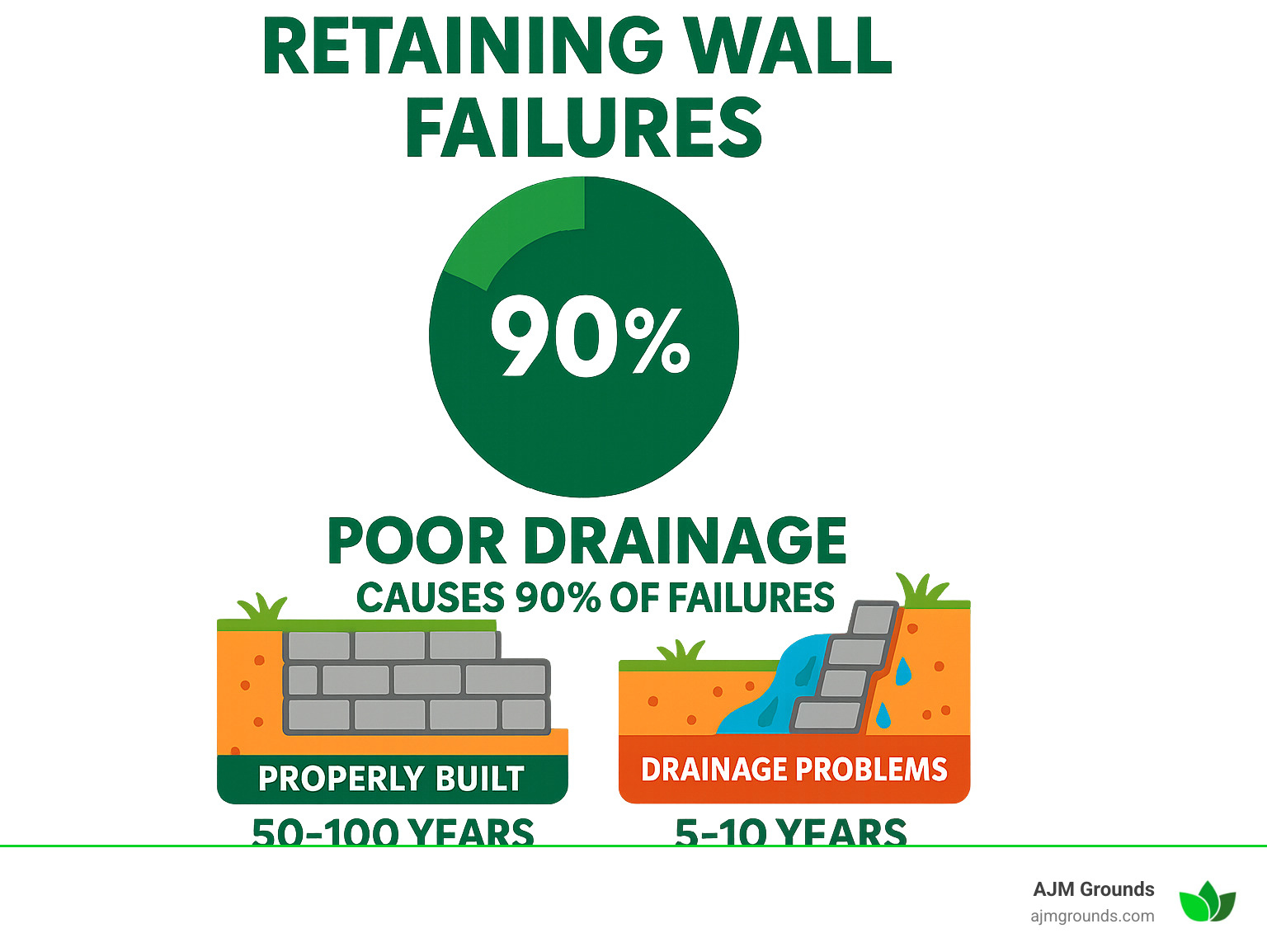
Poor drainage stands as the absolute #1 killer of retaining walls, causing roughly 90% of all failures. When water can’t escape from behind your wall, it builds tremendous pressure that will eventually push your beautiful structure outward. You’ll know you have drainage problems when you see the wall bulging or leaning, cracks appearing in blocks, water stains on the wall face, or constantly soggy soil behind the wall.
Think of water-saturated soil as a sleeping giant. Dry soil might weigh 100 pounds per cubic foot, but add water and that same soil can weigh over 130 pounds per cubic foot. That’s enormous pressure pushing against your wall 24/7.
Foundation problems create a domino effect that gets worse over time. An unlevel or poorly compacted base might seem like a small issue, but even tiny imperfections in your first course become magnified as the wall rises. It’s like building a house on a crooked foundation – everything above it will be crooked too.
Joint alignment errors turn your strong interlocking system into a weak stack of blocks. When you forget to stagger joints, you create vertical lines of weakness running through your wall. These weak spots can cause entire sections to separate or fail under pressure.
Wrong backfill materials doom your wall from the start. Using clay soil or regular topsoil behind your wall is like creating a water reservoir that never drains. These materials hold water like a sponge, creating exactly the hydrostatic pressure that destroys walls. Always stick with free-draining materials like sand or gravel.
Creative Uses for Your Retaining Wall
Installing a small retaining wall opens up exciting possibilities beyond basic soil retention. Your wall can become a stunning focal point that combines beauty with function.
Terraced gardens transform steep, unusable slopes into productive garden paradise. Instead of fighting erosion on a hillside, you can create multiple planting levels, each with improved drainage and easier access for maintenance. Retaining Walls for Gardens turn challenging terrain into your landscape’s crown jewel.
Built-in seating serves double duty by solving your soil retention needs while creating comfortable outdoor seating. Design your wall at bench height – approximately 18 to 24 inches – and you’ve got the perfect spot to enjoy your garden. Add some outdoor cushions and you’ve created an inviting gathering space.
Water features find their perfect foundation in retaining walls. The raised structure provides ideal conditions for creating a pond, waterfall, or fountain that becomes your landscape’s centerpiece. The sound of flowing water adds tranquility while the visual appeal increases your property value.
Space definition becomes effortless with thoughtfully placed walls. Use low retaining walls to separate your patio from lawn areas, create borders around flower beds, or outline walkways. Retaining Wall with Paver Patio combinations create stunning outdoor living spaces that feel like outdoor rooms.
Creative homeowners have finded countless other uses: fire pit surrounds using retaining wall blocks create cozy gathering spots, raised vegetable gardens provide better drainage and easier maintenance, mailbox surrounds add curb appeal, and multi-level terracing transforms hillside properties into stunning landscape features. You can even integrate outdoor lighting systems into your wall design for evening ambiance.
The key is thinking beyond the wall’s basic function. With a little creativity, your retaining wall becomes an integral part of your outdoor living space rather than just a practical necessity.
Frequently Asked Questions about Installing a Small Retaining Wall
Is installing a small retaining wall a good DIY project?
Installing a small retaining wall under 3-4 feet is absolutely a fantastic DIY project for homeowners who don’t mind rolling up their sleeves and getting their hands dirty. You don’t need to be a construction expert – just someone willing to follow directions carefully and pay attention to the details.
The project requires careful planning and a methodical approach, especially when preparing the foundation and leveling that crucial first course. But here’s the encouraging news: most small walls can be tackled by one person over a weekend, typically taking 6-10 hours total.
One enthusiastic DIYer perfectly captured the experience: “I thought it was going to be hard. But it was doable by myself in one afternoon for only about $150!” That’s the beauty of these smaller projects – they’re manageable in scope but deliver impressive results.
However, you should definitely consider calling professionals if your wall will exceed 4 feet in height, if you’re building near existing structures or utility lines, or if you’re dealing with challenging soil conditions like heavy clay or poor drainage. Some projects simply benefit from professional expertise and equipment.
What is the estimated cost for a small retaining wall?
The beauty of installing a small retaining wall yourself is the significant cost savings. Material costs for basic DIY projects typically range from $150-$500, making this an affordable way to transform your landscape.
Of course, total project costs vary dramatically based on your wall’s size, the materials you choose, and site complexity. Professional installation costs vary widely based on internet research – you might see quotes ranging from $1,600 to over $9,000, with some complex projects reaching $15,000 or more. These are internet-based averages and not quotes from our company.
Several factors influence your final cost. Wall dimensions obviously matter – a 20-foot wall costs more than a 10-foot one. Block selection makes a big difference too; basic concrete blocks cost far less than decorative stone options. Site conditions can add complexity and cost, especially if access is difficult or soil conditions are challenging.
Smart DIYers save money by doing their own site preparation, choosing standard concrete blocks over premium materials, and purchasing materials during off-season sales. You might also save by bundling your retaining wall project with other landscaping improvements.
What is the most common mistake to avoid?
Without question, inadequate drainage is the biggest mistake when installing a small retaining wall. This single error accounts for roughly 90% of all retaining wall failures – and it’s completely preventable with proper planning.
Here’s what happens when drainage fails: saturated soil becomes incredibly heavy, weighing over 100 pounds per cubic foot. This creates hydrostatic pressure that can exert thousands of pounds of force against your wall. Even a perfectly built wall will eventually buckle under this relentless pressure.
Warning signs of drainage problems include walls that lean or bulge outward, cracks developing in the blocks, water pooling behind the wall, or white mineral deposits (called efflorescence) appearing on block faces. If you notice any of these signs, address drainage issues immediately.
Prevention is straightforward but critical. Install landscape fabric to separate soil from drainage gravel. Use at least 12 inches of drainage stone behind your wall – some experts recommend 18 inches for even better performance. Include perforated drain pipes for walls over 2 feet tall. Grade the surrounding soil to direct surface water away from your wall.
Most importantly, never use clay or organic soil for backfill. These materials hold water like a sponge, creating exactly the pressure buildup that destroys walls. Stick with sandy or gravelly soil that drains freely.
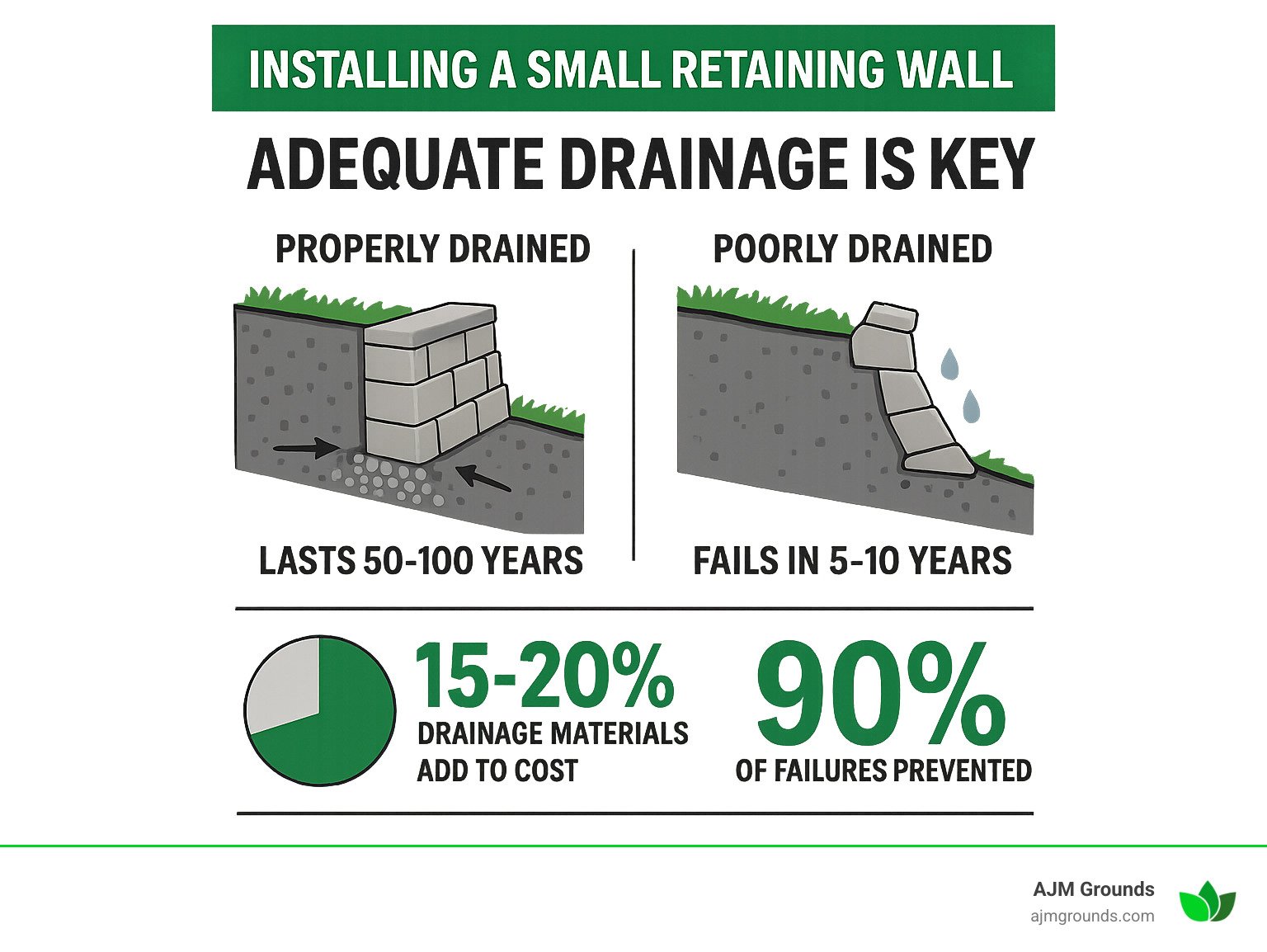
The irony is that proper drainage materials add only 15-20% to your project cost but prevent 90% of potential failures. It’s the best insurance you can buy for your retaining wall investment.
Conclusion: A Strong and Stylish Addition to Your Yard
Installing a small retaining wall is one of those weekend projects that delivers lasting satisfaction every time you look at your transformed landscape. You’ve taken a problematic slope or undefined space and created something both functional and beautiful that will serve your property for decades.
The journey from planning to completion might seem daunting at first, but breaking it down into manageable steps makes it entirely achievable. The foundation preparation teaches you patience, the first course leveling builds your confidence, and watching each subsequent course come together gives you that satisfying sense of accomplishment that only comes from building something with your own hands.
Your wall’s longevity depends on the details you can’t see. That extra time spent leveling the foundation, the careful attention to drainage behind the wall, and the proper backfilling techniques – these are the unsexy parts that make the difference between a wall that lasts 50 years and one that fails in five.
Water is both your biggest enemy and your most predictable opponent. Treat it with respect by installing proper drainage, and your wall will stand strong through countless seasons of freeze-thaw cycles and heavy rains.
The value extends far beyond the initial investment. A well-built retaining wall prevents erosion, creates usable outdoor space, and adds visual interest to your landscape. Whether you’re carving out a level area for a patio, creating terraced garden beds, or simply defining different areas of your yard, your wall becomes an integral part of your outdoor living space.
If you’ve read through these steps and feel confident about tackling the project yourself, go for it! The sense of pride in building something permanent and useful is incredibly rewarding. But if the scope feels overwhelming, or if your wall needs to be taller than 4 feet, there’s no shame in calling for professional help.
The expert team at AJM Grounds provides meticulous Retaining Wall Construction services throughout Woburn and the Greater Boston area. We understand that every property is unique, and we bring the same attention to detail to professional installations that we’ve outlined in this guide for DIY projects.
Whether you choose to build it yourself or have it professionally installed, a properly constructed retaining wall transforms challenging landscape problems into beautiful, functional outdoor space that you’ll enjoy for years to come.
