

Why Installing a Circular Paver Patio Creates the Perfect Outdoor Living Space
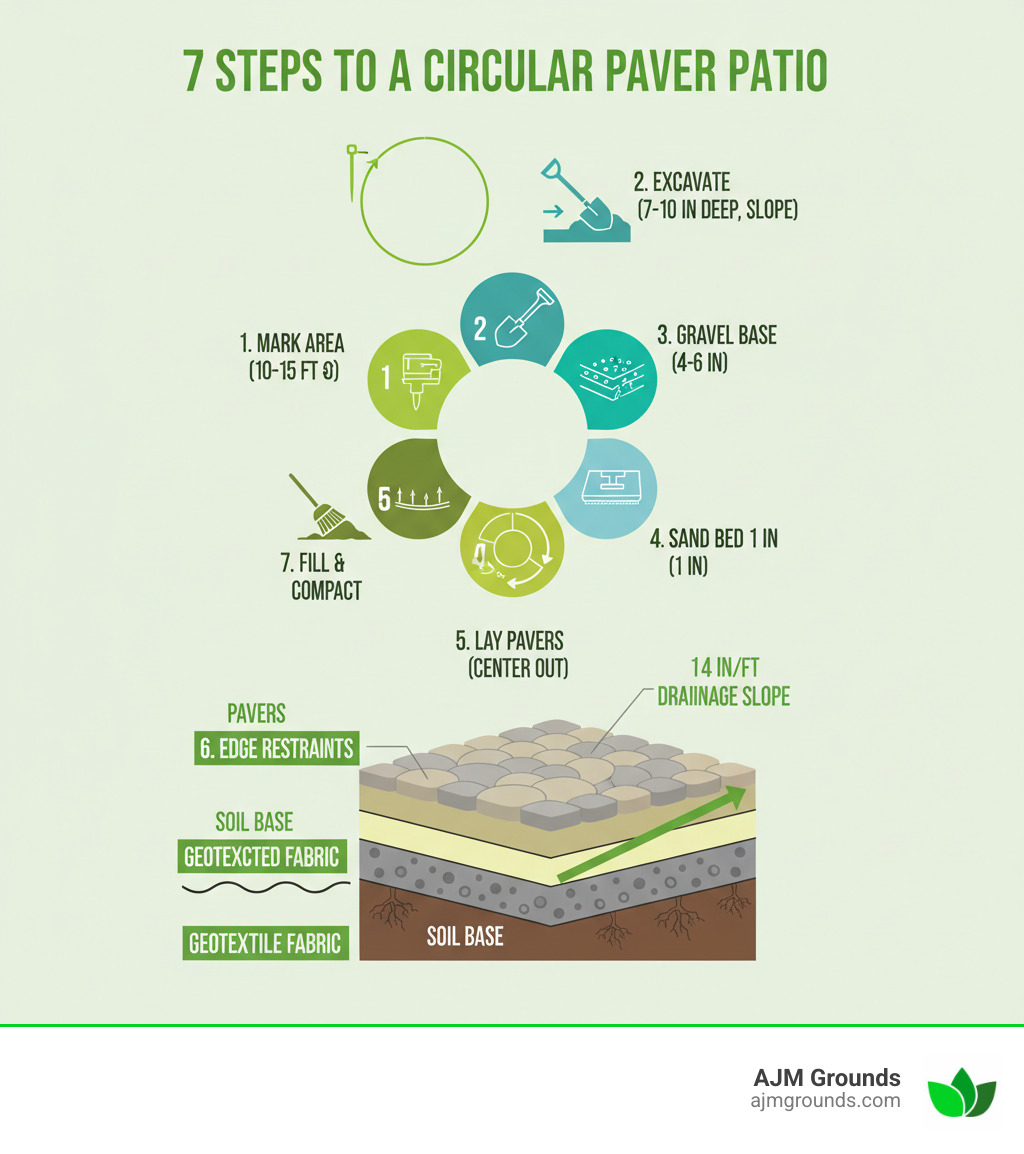
How to install a circular paver patio involves proper planning and seven key steps: marking the area, excavating, installing a gravel base, adding a sand layer, laying pavers from the center, securing edge restraints, and finishing with joint sand. A DIY installation typically takes 2-3 days.
Quick Overview: The 7 Essential Steps
- Plan and mark your circular layout with a center stake and string.
- Excavate 7-10 inches deep, creating a slight slope for drainage.
- Install base material with 4-6 inches of gravel, compacted in layers.
- Add sand bedding (1 inch) and screed it level.
- Lay pavers starting from the center and working outward.
- Install edge restraints around the perimeter.
- Fill joints with polymeric sand and compact the surface.
Circular patios add a unique, soft aesthetic to outdoor spaces, perfect for dining areas or fire pit gatherings. Their main challenge lies in the curved layout and the need to cut edge pavers. Unlike rectangular designs, you must start from the center and work outward in rings to maintain a perfect circle.
Base preparation is everything. Most patio failures stem from an inadequate base, not the pavers. A proper base requires at least 4-6 inches of gravel compacted in 2-inch layers (lifts). Rushing this step leads to settling, uneven surfaces, and drainage issues.
I’m John Caplis, owner of AJM Grounds LLC. My team has installed many custom circular paver patios in Woburn, Massachusetts, and we know how to install a circular paver patio that is built to last for decades.
Learn more about how to install a circular paver patio:
Planning and Preparation: Your Blueprint for a Perfect Circle
Proper planning is what separates a patio that lasts for decades from one that fails after a single New England winter. This stage is where you design your space, choose materials, and gather all your supplies before breaking ground.
Designing Your Space and Choosing Paver Materials
First, determine your patio’s purpose. For a dining area with a table and four chairs, a 10×10 foot space is adequate. For larger groups or more furniture, plan for 15×15 feet or more.
Location is also critical. Observe how sunlight hits your yard at different times and how the circular shape will flow with your existing landscape. A circular patio creates a natural focal point, so position it to complement your home and garden.
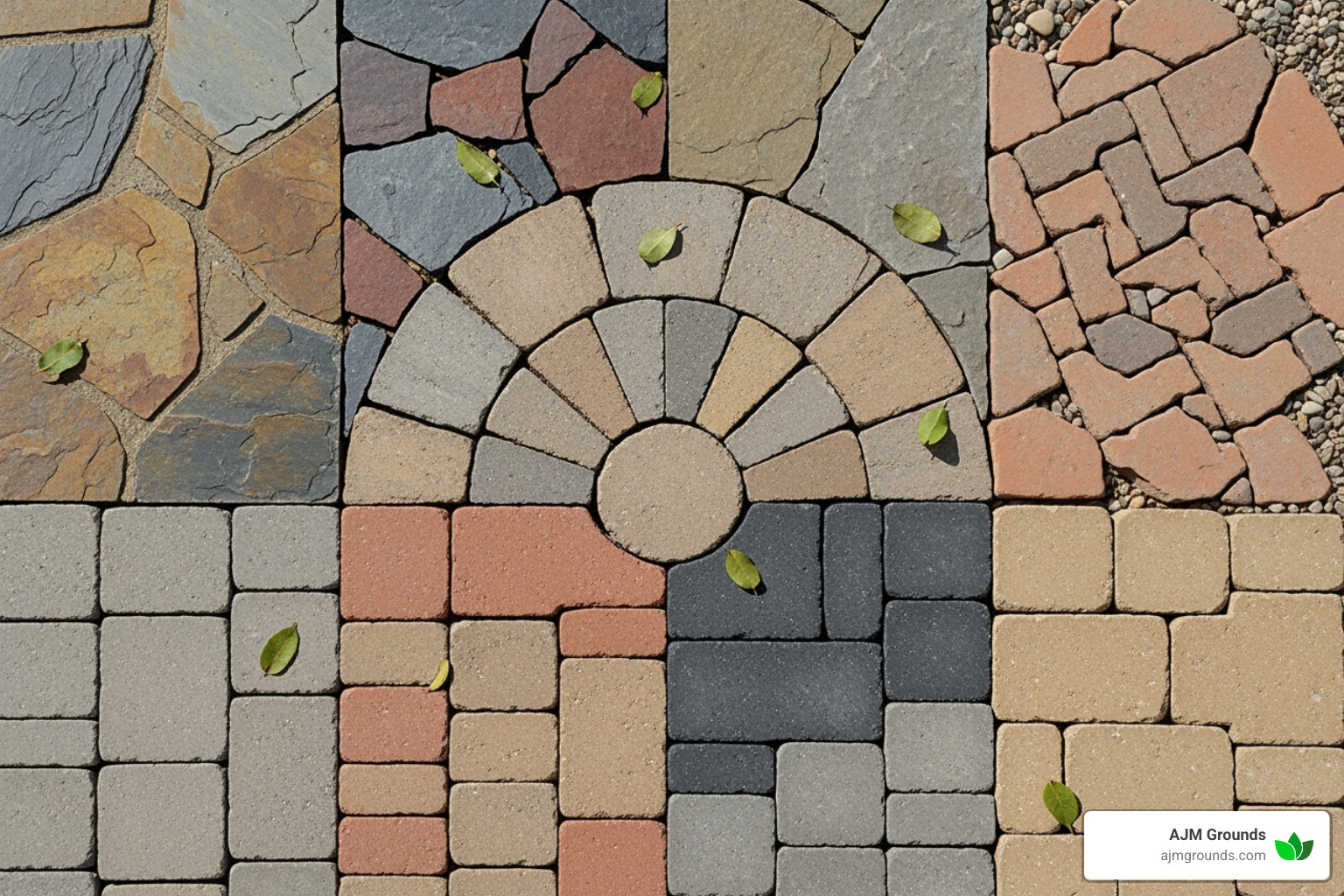
Next, choose your pavers. The material affects your budget, look, and long-term maintenance.
- Concrete pavers are an economical and versatile choice, available in many colors and patterns that hold up well to freeze-thaw cycles. They can fade over time and require sealing to prevent stains.
- Natural stone pavers like granite or bluestone offer a timeless, high-end look with unique color variations. They are extremely durable but cost more, are heavier, and require more skill to cut.
- Clay or brick pavers provide warmth and rustic charm with excellent color retention. They are more brittle than concrete and have a more limited color palette.
Here’s a quick comparison:
| Paver Type | Pros | Cons |
|---|---|---|
| Concrete Pavers | Budget-friendly, versatile colors and patterns, durable, easier to cut and install | Can fade over time, requires sealing, less natural appearance |
| Natural Stone | Stunning appearance, extremely long-lasting, unique character, increases property value | Higher cost, heavier to work with, requires more skill to cut |
| Clay/Brick | Excellent color retention, classic look, good durability | More brittle, limited colors, needs sealing |
Some manufacturers offer circular paver kits with pre-cut pieces, which simplify installation but offer less design flexibility. Whatever you choose, ensure it blends with your home’s style. We’ve created many Beautiful Patio Design Ideas that can provide inspiration.
Essential Tools and Materials for the Job
Having all your tools and materials ready prevents delays.
Tools:
- Shovel, wheelbarrow, and rake
- Tape measure, string line, stakes, and marking paint
- Long and short levels
- Rubber mallet
- Plate compactor (essential for a solid base)
- Masonry saw (wet saw recommended for cuts)
- Screed board and push broom
- Safety gear: gloves, safety glasses, ear protection
Materials:
- Geotextile fabric (recommended to separate soil and gravel)
- Crushed stone base (3/4″ minus gravel or road base)
- Bedding sand (concrete sand)
- Pavers of your choice
- Flexible plastic edge restraints and galvanized spikes
- Polymeric sand for joints
For more details on hardscaping components, see our Hardscaping Services Complete Guide. With your plan and materials ready, you can begin building the foundation.
How to Install a Circular Paver Patio: A Step-by-Step Guide
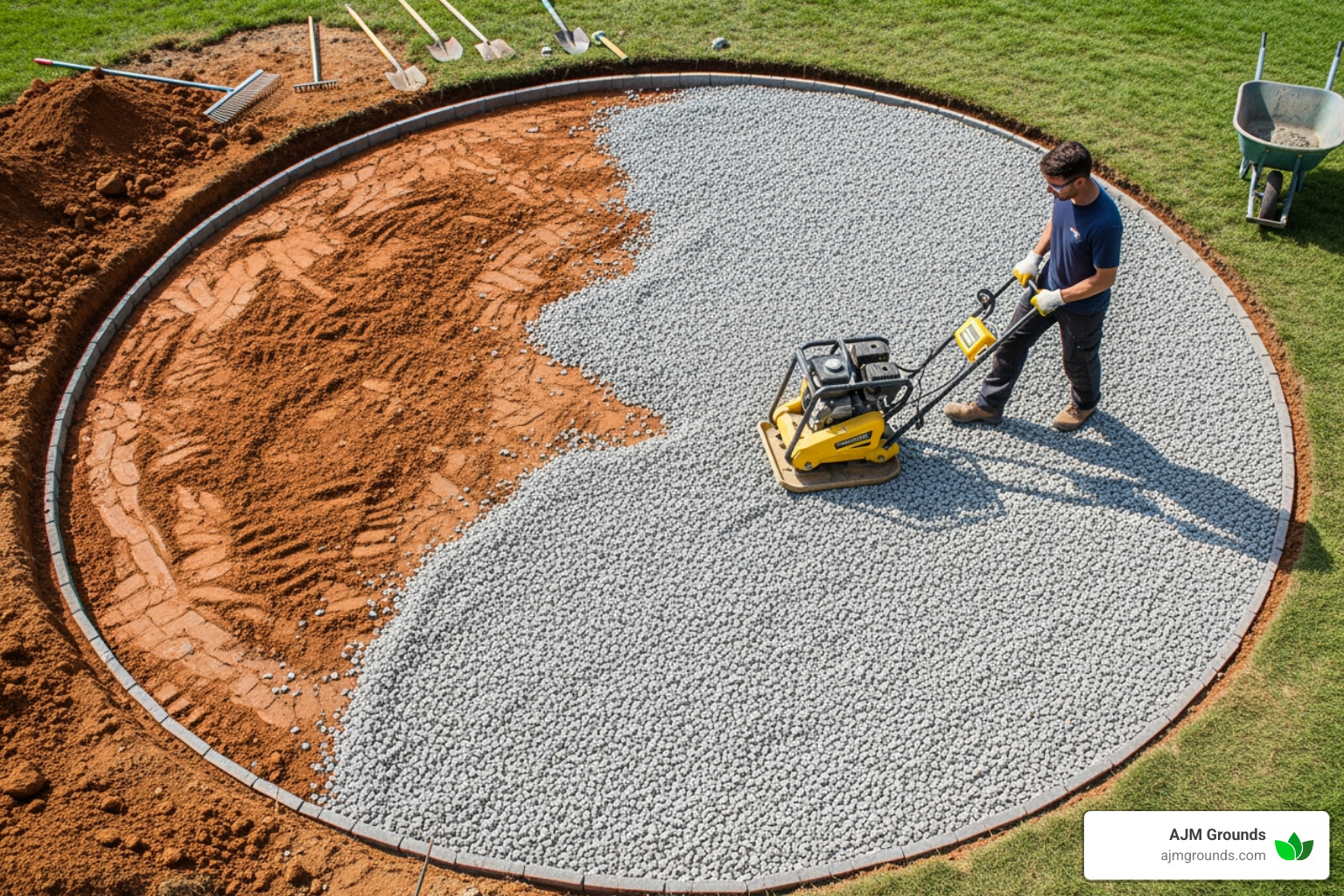
With your plan and materials ready, it’s time to build. Following these steps carefully is crucial for a stable, long-lasting patio. Rushing the foundation is the most common cause of patio failure. For more on base construction, consult industry resources like Paving Expert.
How to Properly Prepare the Ground and Create a Stable Foundation
A solid foundation is non-negotiable. Skimping here will lead to settling, shifting, and drainage problems.
- Mark the Circle: Place a stake at the center of your planned patio. Tie a string to it equal to your desired radius. Walk the perimeter, keeping the string taut, and spray a circle on the ground with marking paint. Mark a second circle 6-8 inches wider to allow room for edge restraints.
- Excavate: Dig 7-10 inches deep within the larger circle. This depth accommodates the base, sand, and pavers. The formula is: Excavation Depth = Base Thickness + Sand Thickness + Paver Thickness.
- Establish Drainage Slope: Create a slope of 1/4 inch per foot (a 1:60 ratio) away from any structures to ensure water runs off. Use string lines and a line level to set this grade across the excavated area.
- Lay Geotextile Fabric: Place this permeable fabric over the excavated soil. It prevents soil from mixing with your gravel base, improving stability and drainage, which is vital in New England’s freeze-thaw climate.
- Install the Gravel Base: Add 4-6 inches of compacted base material (e.g., 3/4″ minus gravel). Compact the base in 2-inch lifts. Spread a 2-inch layer, compact it thoroughly with a plate compactor, and repeat until you reach the desired thickness. This multi-layer process is critical for a solid foundation.
- Screed the Sand Bed: Spread a 1-inch layer of bedding sand over the compacted gravel. Use parallel pipes or conduit as guides and pull a straight board (screed) across them to create a smooth, consistently thick layer. Do not compact the sand bed; it needs to be loose for setting the pavers.
Our Step by Step Laying Pavers guide offers more visuals on these initial steps.
The Best Method for Laying Pavers to Create a Perfect Circular Shape
Laying a circular pattern requires precision, but the result is stunning.
The golden rule is to start from the center stone and work outwards. Place your center stone first, ensuring it’s perfectly level. All other pavers will radiate from this point.
Continue by working outwards in concentric rings. Lay the first ring around the center, then the next, and so on. This method keeps the pattern and shape consistent. As you place each paver, tap it gently with a rubber mallet to set it into the sand and level it with its neighbors.
Maintain consistent joint spacing of about 1/2 to 5/8 inch (approx. 15mm) between pavers. This space is necessary for the polymeric sand to lock the pavers together. Use a long level constantly to check for levelness and prevent “lippage” (uneven paver heights), which is a tripping hazard. Also, ensure you are maintaining the drainage slope across the paver surface.
The most time-consuming part is cutting pavers with a masonry saw to fit the circular edge. Mark each perimeter paver to match the curve and use a wet saw for a precise cut. Always wear proper safety gear. These cuts define the final look of your circle.
Our team at AJM Grounds excels at crafting Custom Stone Patios with intricate circular patterns throughout Woburn, Winchester, and surrounding areas.
Finishing Touches, Common Mistakes, and Expert Advice
The final steps lock your work in place and provide a professional finish. This is also where you can avoid common pitfalls that could compromise your new patio.
How to Install Edge Restraints and Add Finishing Touches
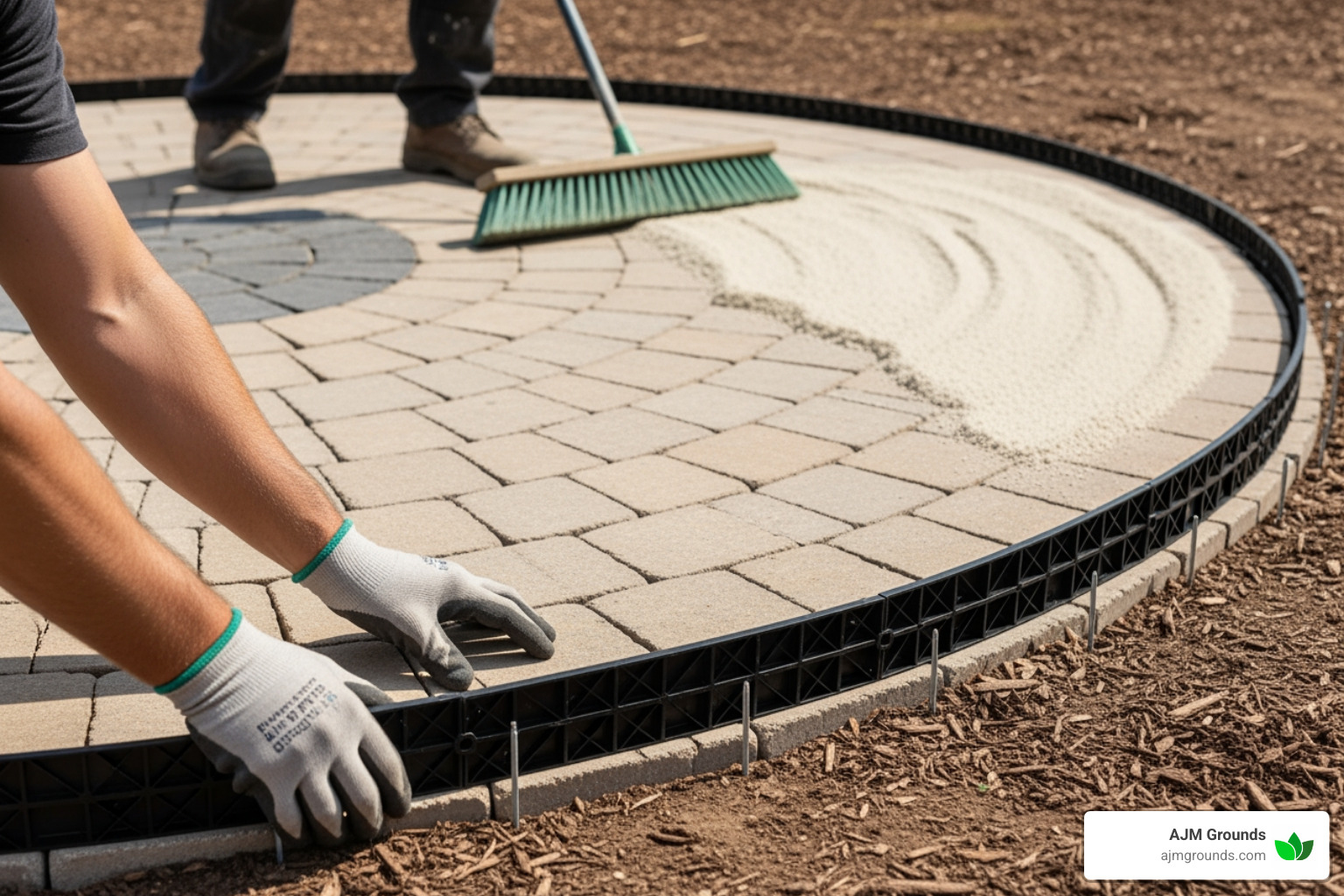
- Install Edge Restraints: Place flexible plastic edging snugly against the perimeter pavers. This is essential to prevent the pavers from spreading.
- Secure the Edging: Drive 8-inch galvanized spikes through the restraint and into the compacted base every 6-12 inches.
- Fill the Joints: Sweep polymeric sand generously into all the joints. This special sand contains polymers that harden with water, locking pavers together and preventing weeds.
- Activate the Sand: Use a hose on a light mist setting to gently wet the sand. Avoid a strong stream that could wash the sand out. The sand will begin to harden in a few hours and fully cure in 24-48 hours.
- Final Compaction: Run a plate compactor with a protective pad over the entire surface to settle the pavers. If any joints look low, add more sand and mist again.
For professional results, explore our Patio Installation services.
Common Mistakes to Avoid When Installing a Circular Paver Patio
Learning from common errors can save you time and money.
- Improper Base Preparation: The #1 cause of patio failure. Do not skimp on excavation depth or compacting the base in 2-inch lifts.
- Forgetting the Drainage Slope: A flat patio will pool water. The 1/4 inch per foot slope is not optional.
- Uneven Paver Heights (Lippage): This creates a tripping hazard. Check for levelness constantly as you work.
- Insecure Edge Restraints: Without enough spikes, your patio’s perimeter will creep outward over time.
- Not Starting from the Center: A circular patio must be built from the center out to avoid an “egg” shape.
The biggest challenge versus square patios is cutting curves. A circular design requires many precise cuts with a masonry saw, which is time-consuming and requires skill.
When to call a professional is an important consideration. While a circular patio can be a DIY project, it is physically demanding. For complex designs, sloped terrain, or integrated features like fire pits, professional expertise from a team like AJM Grounds can ensure a flawless result. We serve Woburn, Bedford, Billerica, Burlington, Lexington, Reading, Stoneham, Wilmington, and Winchester, Massachusetts.
Successfully installing a circular paver patio comes down to planning and precision.
Find expert paver patio contractors near you to discuss your project with our experienced team.
