

Why Installing a Block Retaining Wall Matters for Your Property
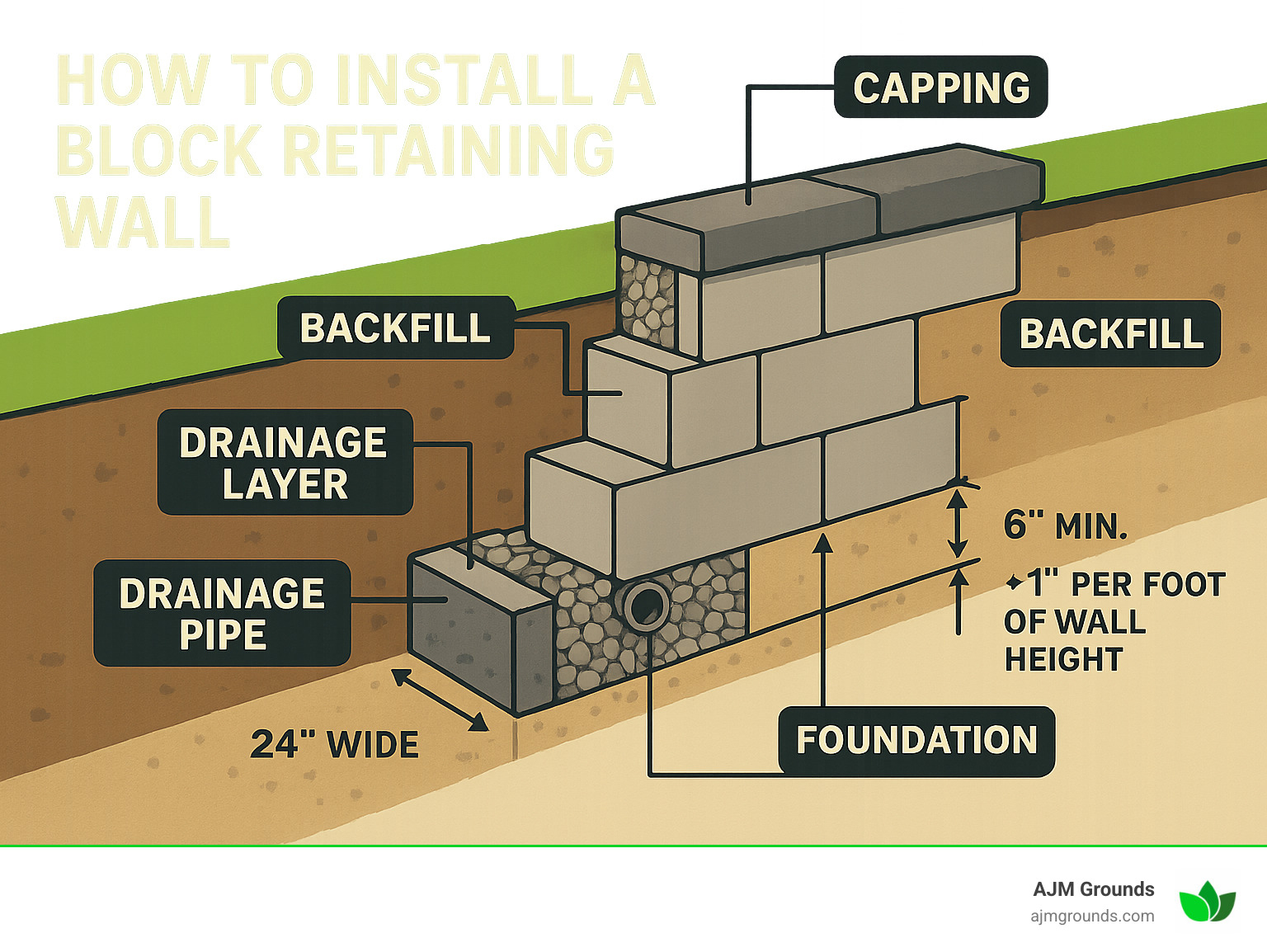
How to install a block retaining wall properly is essential for both functionality and aesthetics in your landscape. For those looking for a quick overview, here are the basic steps:
- Plan and layout your wall location with stakes and string
- Dig a trench (24″ wide and 6″ deep plus 1″ per foot of wall height)
- Add and compact 6″ of crushed gravel base
- Install the first course of blocks, checking for level
- Add drainage pipe behind the first course
- Stack additional courses with proper offset (staggered joints)
- Backfill with gravel behind the wall in 6-8″ lifts
- Cap the wall with adhesive and capstones
A well-built retaining wall does more than just hold back soil—it transforms a sloped yard into usable space, prevents erosion, and adds visual interest to your property. Whether you’re dealing with a steep slope or simply want to create defined garden beds, a properly installed block retaining wall provides both structural support and aesthetic appeal.
Retaining walls face unique challenges: they must withstand tremendous lateral soil pressure and manage water drainage effectively. Without proper installation, walls can bulge, lean, or completely fail over time.
I’m John Caplis, owner of AJM Grounds LLC, and I’ve installed countless block retaining walls throughout Woburn and Greater Boston, mastering the techniques to ensure they remain structurally sound and visually appealing for years to come.
Similar topics to how to install a block retaining wall:
– backyard retaining wall ideas
– concrete retaining wall builders
– retaining walls ideas
Block Retaining Wall Basics & Pre-Planning
Before you grab your shovel and start stacking blocks, let’s take a moment to understand what makes a retaining wall successful. I’ve built hundreds of these walls throughout Woburn and Greater Boston, and proper planning prevents most headaches down the road.
Types of Block Retaining Walls
When considering how to install a block retaining wall, you’ll need to decide which type fits your needs. Gravity walls are the simplest option—they use their own weight and a slight backward lean to hold back soil. These work great for walls under 4 feet tall in residential settings.
For taller projects or walls bearing heavy loads (like a driveway above), you’ll need reinforced walls. These incorporate geogrid—a synthetic mesh material that extends into the soil behind the wall—creating a reinforced zone that dramatically increases strength and stability.
You might also consider free-standing walls, which use similar installation techniques but don’t retain soil. They’re perfect for creating garden borders or defining outdoor spaces without managing elevation changes.
Understanding Soil Pressure and Water Management
The real challenge in retaining wall construction isn’t stacking the blocks—it’s managing the invisible forces working against your wall.
Soil is heavier than most people realize, especially when wet. It exerts tremendous lateral pressure that increases with both wall height and moisture content. This is why walls need a slight backward lean (called “batter”) to counteract this pressure.
But the true enemy of every retaining wall is water. As one contractor with 26 years of experience told me, “Hydrostatic pressure from water buildup is the leading cause of retaining wall failure.” When water saturates soil behind a wall, pressure can double or triple, causing bulging or complete collapse.
This is why proper drainage isn’t just important—it’s absolutely essential. The science behind soil pressure confirms this approach is necessary for long-term stability.
Permits and Regulations
Before breaking ground, check your local building codes:
Height restrictions typically require permits for walls over 36-48 inches tall. Engineering requirements often kick in for taller walls, requiring professional plans. And always verify property lines to ensure your wall doesn’t accidentally encroach on neighboring properties.
Here in the Greater Boston area, regulations vary significantly between towns like Bedford, Billerica, and Burlington. We’re familiar with these local requirements and can help steer the permitting process.
Safety First: Call Before You Dig
Always call 811 at least a few days before digging. This free service marks underground utilities to prevent dangerous and costly accidents. I’ve seen projects delayed for weeks because someone hit a gas line or fiber optic cable—don’t let this happen to you!
When working, protect yourself with proper safety gear: work gloves, safety glasses, steel-toe boots, back support for lifting, hearing protection when using power equipment, and a dust mask when cutting blocks.
Project Layout and Planning
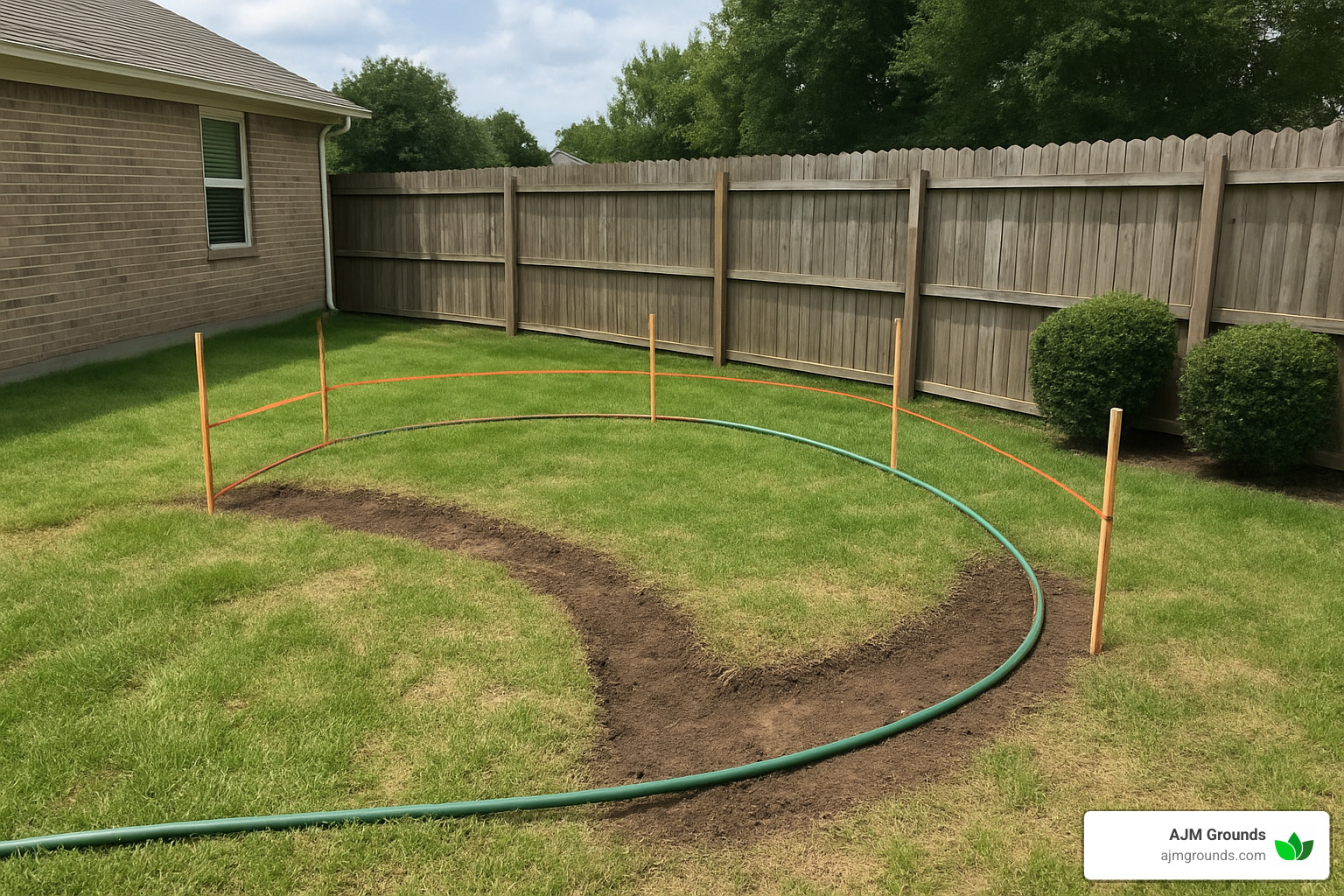
Start by using stakes and string to mark your wall’s location. For curved sections, a garden hose works wonderfully to visualize the path. Take photos of your layout from different angles—this helps spot potential issues before you start digging.
Consider drainage paths carefully. Drain pipes should vent to daylight (the exposed end of a pipe) every 50 feet. Water needs somewhere to go!
For very tall slopes, consider building multiple tiered walls instead of one tall wall. The general rule is that the upper wall should be set back from the lower wall by at least twice the height of the lower wall.
How to Install a Block Retaining Wall (Step-by-Step)
Now that you understand the basics, let’s dive into the step-by-step process of how to install a block retaining wall. This guide will walk you through each phase of construction, turning what might seem overwhelming into manageable steps.
How to Install a Block Retaining Wall: Base & Trench
The foundation of your wall is critical to its long-term stability. Think of it like building a house—without a solid foundation, everything above is at risk.
1. Mark Your Layout
Start by creating a clear roadmap for your wall. Drive stakes into the ground and run mason’s string between them to mark the front edge of your wall. For curved sections, a garden hose works perfectly to visualize smooth, flowing lines.
2. Dig the Trench
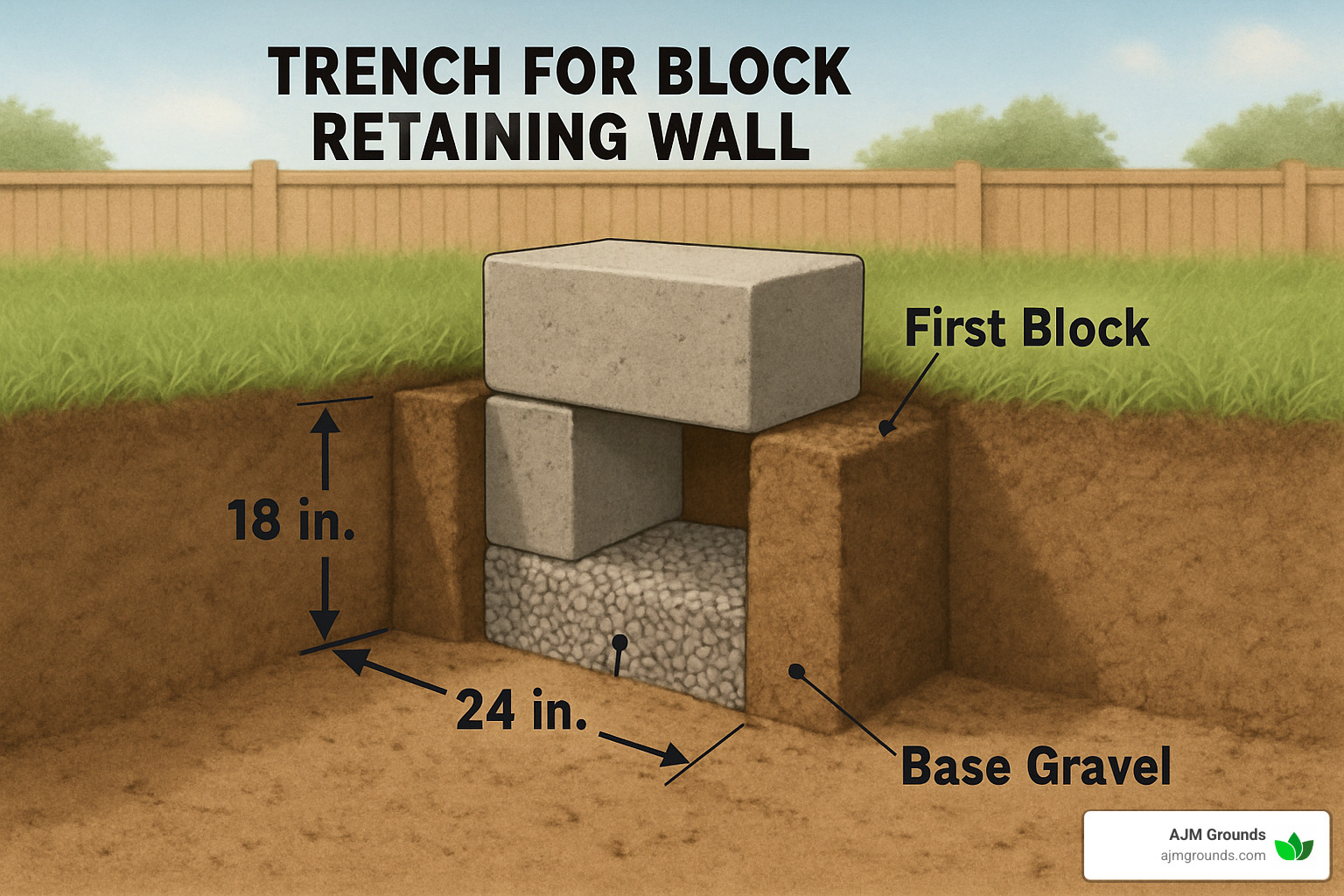
For walls under 4 feet tall, dig a trench about 18 inches wide. Taller walls need more stability, so increase to 24 inches wide. For depth, use this formula: 6 inches (for base material) + 1 inch per foot of wall height + half the height of your first block.
So if you’re building a 3-foot wall with 8-inch blocks, your trench should be 13 inches deep (6″ + 3″ + 4″). This prevents frost heave and settling that can ruin your wall’s appearance and function.
3. Compact the Trench Bottom
Before adding any materials, compact the native soil at the bottom of your trench. A plate compactor works best, but a hand tamper will do for smaller projects. Make at least two passes to ensure proper compaction.
4. Add and Compact Base Material
Add 6 inches of 3/4″ crushed gravel across the entire trench. Rake the gravel level, then compact it in thin layers (2-3 inches at a time) using your plate compactor. Check for level both lengthwise and front-to-back as you go.
5. Fine-Tune the Base
Use a straight 2×4 and level to screed the surface of the gravel, creating a perfectly flat base. Any irregularities in your base will be magnified as the wall rises, so take your time here.
How to Install a Block Retaining Wall: Building the Courses
With your foundation set, it’s time for the satisfying part—watching your wall take shape, one course at a time.
1. Install the First Course
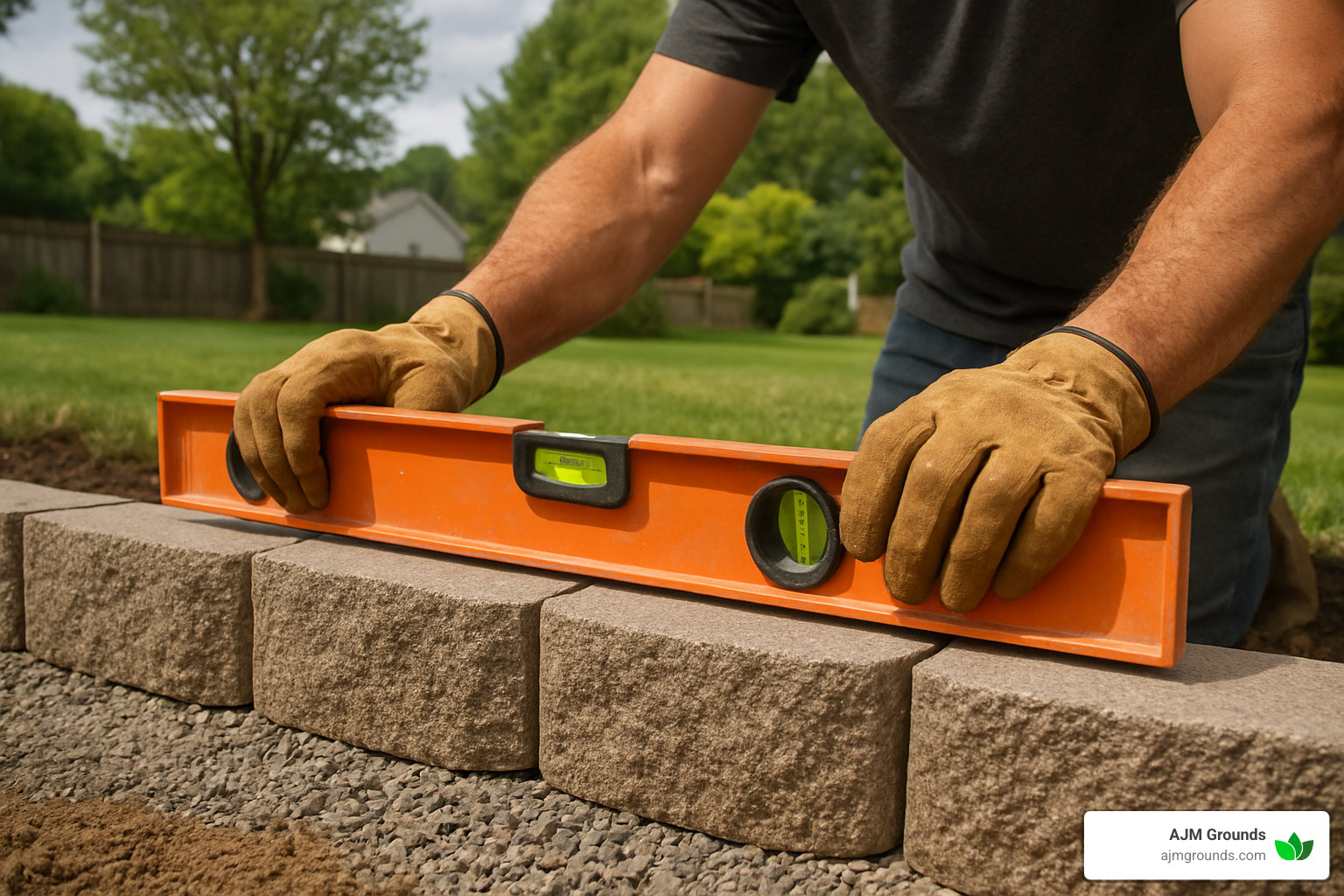
Start at the lowest point of your wall (if on a slope) and place your first block. Check it for level front-to-back and side-to-side, making adjustments with a rubber mallet. Continue placing blocks side by side, checking each one with a level.
2. Install Drainage System
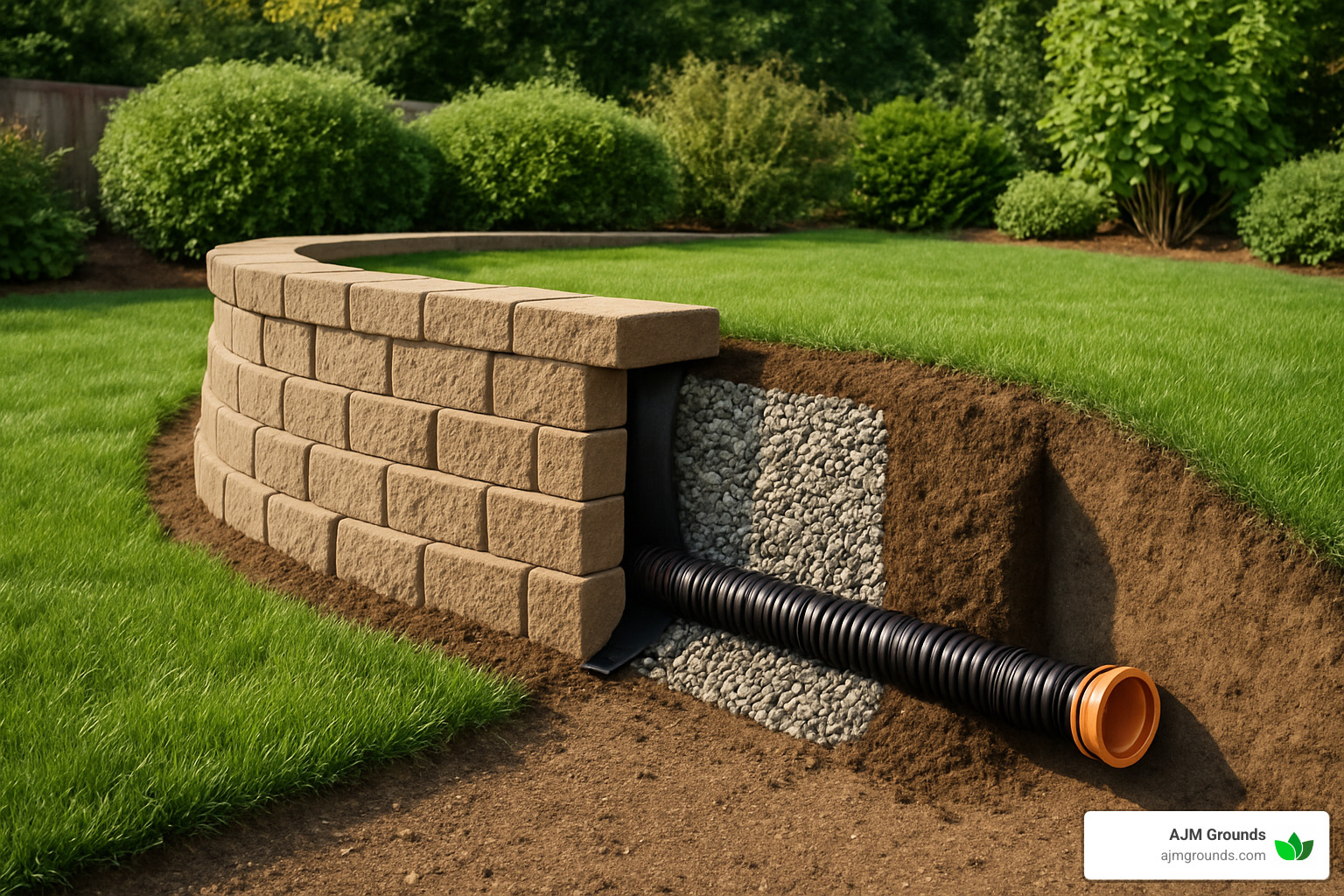
Place a 4-inch perforated drainage pipe behind the first course, positioned at the lowest point and sloping at least 1/2 inch per 10 feet. Wrap the pipe in a filter sock or landscape fabric to prevent soil from clogging it over time.
Make sure to extend the pipe to daylight (where water can freely exit) or connect to an existing drainage system.
3. Backfill Behind First Course
Fill the hollow cores of the blocks with 3/4″ crushed gravel, then add 12 inches of the same gravel behind the blocks. This creates a drainage zone that helps water move toward your drainage pipe.
4. Install Additional Courses
Place the second course blocks in a running bond pattern (like bricks in a wall) so that the vertical seams are staggered. Offset these seams by at least 1/4 of the block length for maximum strength.
5. Maintain Proper Setback
Most retaining wall systems have a built-in setback that creates a slight backward lean—this is intentional and important! This “batter” is crucial for counteracting soil pressure and preventing your wall from leaning forward over time.
For more detailed information on proper installation techniques, check out resources like Retaining Wall Construction and retaining wall base installation.
Pro Techniques, Finishing Touches & Maintenance
You’ve mastered the basics of how to install a block retaining wall, but it’s those professional touches that transform a good wall into a great one. Let’s explore some expert techniques that will lift your project.
Handling Curves and Corners
Creating beautiful curves and crisp corners requires special know-how. When building curved walls for clients in Woburn and surrounding areas, I pay careful attention to block placement:
For curved sections, inside curves cause blocks to touch at the front and fan out at the back, while outside curves do the opposite. You’ll likely need to cut some blocks to maintain consistent spacing, especially on tighter curves.
Corners deserve extra attention too. If your block system offers dedicated corner units, use them! They create clean, professional-looking transitions. Always alternate the orientation of corner blocks with each course to create that essential running bond pattern.
Working with Slopes
Boston’s hilly terrain often means building walls on slopes. You have two primary approaches here:
With a stepped base approach, your foundation follows the natural slope in a series of level steps. Each step should be at least as long as your block, and you’ll always want to start at the lowest point.
Alternatively, a stepped top keeps your base level throughout while allowing the top of the wall to follow the slope in a series of steps. This often creates a more dramatic visual effect and requires you to cap each section individually.
Geogrid Reinforcement
For walls exceeding 4 feet or those bearing significant loads (like driveways), geogrid reinforcement isn’t optional—it’s essential. This synthetic mesh material creates a reinforced soil mass that works with your wall to resist pressure.
Install geogrid sheets at intervals specified by your manufacturer or engineer (typically every 1-2 courses). Cut the grid to the designed length—usually 60-70% of your wall’s height—and lay it flat on the course with no wrinkles.
Capping the Wall
The cap course isn’t just decorative—it’s the finishing touch that protects and completes your wall. Start by thoroughly cleaning the top course to remove any debris. Apply a high-quality construction adhesive in a zigzag pattern. Place your cap blocks with staggered joints from the course below for maximum strength.
Connection Systems Comparison
Different block systems use different connection methods, each with its own advantages:
| Connection Type | Advantages | Considerations |
|---|---|---|
| Pin System | Precise setback control, Strong connection | Requires exact alignment |
| Lip/Flange System | Easy installation, Self-aligning | Limited setback options |
| Adhesive Connection | Works with any block, Flexible | Weather-dependent application |
Seasonal Maintenance
New England’s distinct seasons mean your wall needs different attention throughout the year:
In spring, check for any winter damage and clear drainage outlets of debris. Summer is perfect for monitoring plant growth near the wall. Come fall, be diligent about clearing drainage paths of leaves and debris. During winter, remove snow from the top of your wall to prevent damage from freeze-thaw cycles.
Frequently Asked Questions about How to Install a Block Retaining Wall
Do I need a permit for a wall under 4 ft?
One of the most common questions I hear from homeowners is about permits. While it’s generally true that walls under 4 feet don’t require permits, the reality is a bit more nuanced.
In our Greater Boston communities around Woburn, regulations can vary significantly from town to town. Some municipalities care more about where your wall sits (especially near property lines) than its height. Others actually measure the total height including the buried portion, not just what shows above ground.
The bottom line: it’s always worth a quick call to your local building department before breaking ground. At AJM Grounds, we’ve steered permitting in Lexington, Reading, Winchester, and throughout our service area, so we’re happy to guide you through this process.
What backfill material compacts best?
The material you can’t see is often what determines whether your wall stands the test of time. For backfill, not all materials are created equal.
3/4″ crushed stone or gravel is your best friend for the drainage zone directly behind the wall (that critical 12-inch area) and for filling hollow block cores. It drains beautifully and compacts to provide solid support.
For the area beyond the drainage zone, granular soil with good sandy or gravelly composition works well. These materials create a stable mass that won’t shift dramatically with moisture changes.
What should you avoid? Clay soils are problematic because they expand when wet and shrink when dry—exactly what you don’t want behind a wall. Organic soils break down over time, creating voids. And despite what you might think, pea gravel is actually a poor choice because its rounded shape prevents proper compaction.
How much does a block retaining wall cost?
Based on internet data (not AJM Grounds specific pricing), expect to pay between $20–$60 per square foot for a professionally installed block retaining wall. High-end installations with premium materials or challenging site conditions can reach $80+ per square foot.
Several factors influence where your project falls in that range:
Wall dimensions matter significantly—taller walls require deeper foundations and possibly reinforcement, driving up costs. The type of block you choose makes a big difference too, with decorative options commanding premium prices over standard blocks.
Your property itself plays a role as well. Difficult access means more labor hours, while challenging soil conditions might require additional excavation and preparation work.
How deep should the first row of blocks be buried?
The buried portion of your wall (what we call the “embedment”) is crucial for preventing the wall from sliding forward under pressure. Think of it as the wall’s anchor.
For walls under 3 feet tall, bury at least half the height of the block. So if you’re using 8-inch blocks, at least 4 inches should be below grade.
When your wall reaches the 3-4 foot range, we recommend burying a full block height. This provides the stability needed for these medium-height walls.
For anything over 4 feet tall, you’ll likely need engineered specifications, but typically plan on burying at least a full block, sometimes more depending on soil conditions and loads.
Conclusion
Building a block retaining wall is truly a blend of technical know-how and creative vision. When you understand how to install a block retaining wall properly, you’re not just piling blocks—you’re creating a structure that will beautify your landscape while solving drainage and erosion problems for years to come.
Throughout this guide, we’ve walked through the essential steps to create a wall that stands the test of time. Proper planning is the foundation of success. Take time to consider your wall’s location, height, and drainage needs before you ever pick up a shovel. Check those local regulations too—nothing worse than building a beautiful wall only to have to tear it down because of permit issues!
The base preparation might seem tedious, but it’s absolutely critical. I’ve seen many DIY walls fail simply because someone rushed through this step. That perfectly level, well-compacted foundation is what will keep your wall standing straight years from now when your neighbor’s DIY attempt is already leaning.
As you build, keep checking for level and alignment with every course. It’s much easier to make small adjustments as you go than to try fixing problems later. And never skimp on proper drainage—those perforated pipes and gravel backfill aren’t optional features, they’re essential components that protect your investment.
I’ve noticed that many homeowners make the same mistakes when tackling retaining wall projects. They underestimate the importance of drainage, use rounded pea gravel instead of angular crushed stone, forget to compact the base and backfill properly, build walls too tall without reinforcement, or get sloppy with level checking. Avoiding these pitfalls will save you significant headaches down the road.
At AJM Grounds, we’ve installed countless retaining walls throughout Woburn and surrounding communities like Bedford, Billerica, Burlington, and Lexington. What makes me proudest isn’t just that our walls remain structurally sound years later—it’s seeing how they’ve transformed properties, created usable outdoor spaces, and solved drainage issues that had plagued homeowners for years.
For more information about our professional retaining wall services, visit our retaining wall construction page or reach out to schedule a personalized consultation.
