

What Does a Retaining Wall Project Cost?
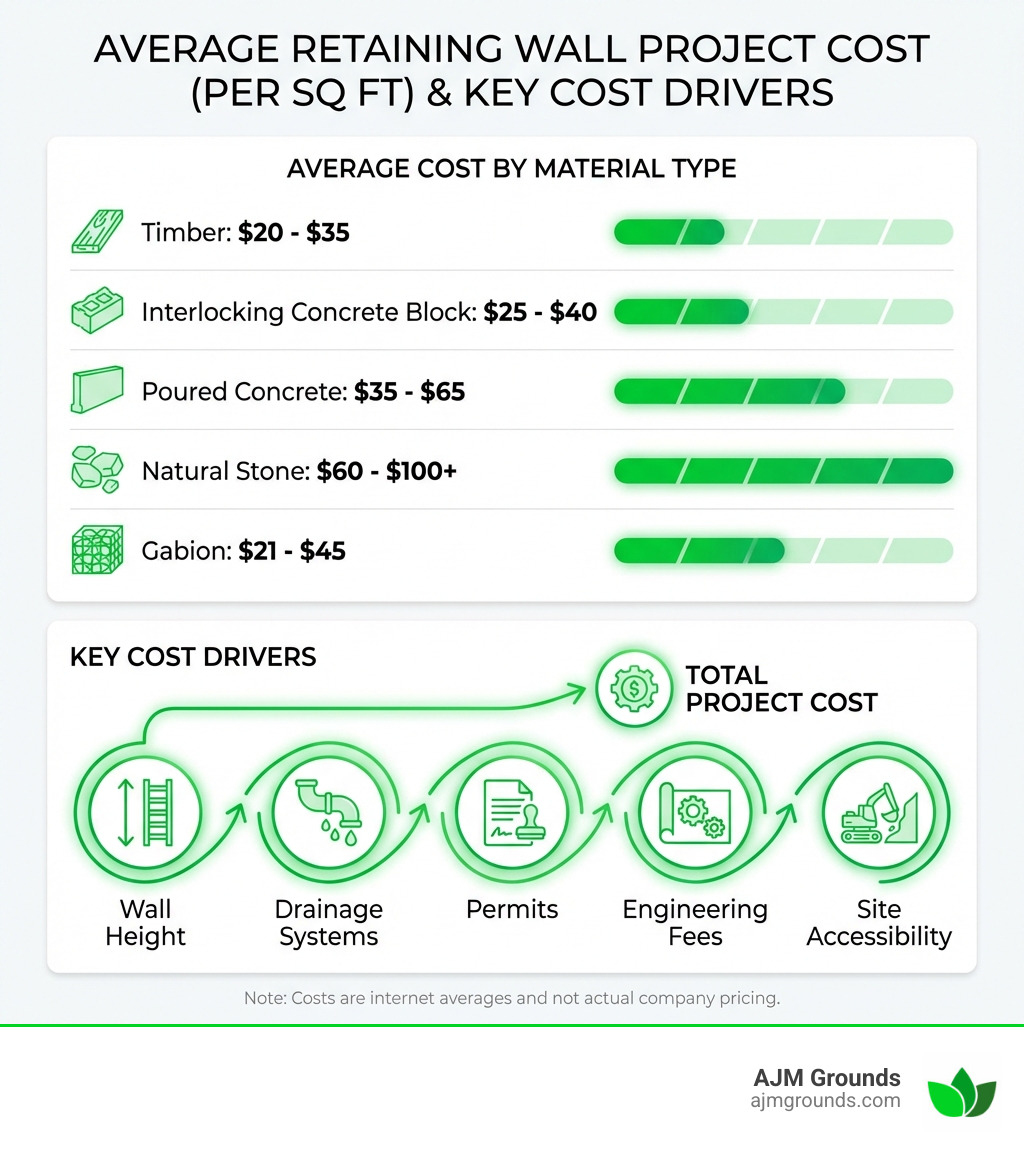
Retaining wall project cost typically ranges from $20 to $150+ per square foot, depending on your materials, wall height, site conditions, and local permit requirements. Here’s a quick breakdown to help you budget:
| Material | Avg. Cost Per Sq Ft | Estimated Lifespan |
|---|---|---|
| Timber | $20 – $35 | 15-20 years |
| Interlocking Concrete Block | $25 – $40 | 50-100 years |
| Poured Concrete | $35 – $65 | 50-100+ years |
| Natural Stone | $60 – $100+ | 100+ years |
| Gabion | $21 – $45 | 50-75 years |
Quick answer: Most homeowners pay between $3,200 and $9,200 for a professionally installed retaining wall, with a national average around $6,000. A simple 100 sq ft wall can start at $2,500, while larger or more complex projects can easily exceed $12,000.
These are average costs based on internet research and do not reflect actual AJM Grounds pricing.
Sloped yards look beautiful — until the soil starts sliding, water pools against your foundation, or your landscaping slowly washes away. A retaining wall solves all of that. But before you commit, you need a clear picture of what you’re actually spending.
The truth is, retaining wall costs vary more than most homeowners expect. The material you choose is just one piece of the puzzle. Height, drainage, permits, site access, and labor all add up fast — and skipping any one of them can lead to a wall that fails within a few years.
I’m John Caplis, owner of AJM Grounds LLC, and I’ve spent years helping homeowners in Woburn, MA plan and install hardscaping projects — including retaining walls that hold up season after season. Understanding retaining wall project cost before you get quotes is one of the best ways to avoid budget surprises and get the most out of your investment.
Primary Factors Influencing Your Retaining Wall Project Cost
When we look at a backyard in Lexington or a sloped driveway in Winchester, we aren’t just looking at the length of the wall. Several structural and environmental factors dictate the final price. A wall isn’t just a stack of stones; it is a functional engineering feat designed to hold back thousands of pounds of earth.

Wall Height and Engineering
The height of your wall is perhaps the biggest cost driver. As a wall gets taller, the pressure behind it increases exponentially. In many parts of Massachusetts, including Woburn and Stoneham, any wall exceeding 4 feet in height typically requires a structural engineer’s approval and a specific building permit. Engineering plans alone can cost between $500 and $2,000. Taller walls also require deeper foundations and often need geogrid reinforcement—a synthetic mesh that stabilizes the soil behind the wall—which adds $5 to $10 per square foot.
Soil Type and Site Conditions
The dirt in your yard matters. Sandy soil drains well and is easier to work with, while heavy clay soil retains water and expands, putting immense pressure on the structure. If your soil is poor, we may need to excavate more of it and bring in “select fill” or additional crushed stone, which can cost $15 to $50 per yard. Furthermore, site accessibility plays a huge role. If we can get a skid-steer or excavator directly to the wall site, the job goes faster. If we have to move every block by hand through a narrow gate in a Reading backyard, labor costs can jump by 20% to 30%.
To ensure your project meets industry safety requirements, we follow Scientific research on masonry standards and wall safety provided by the National Concrete Masonry Association. You can also find More info about retaining wall construction to see how these factors play out in real-world builds.
Material Comparison Table
| Material Type | Estimated Cost (Internet Avg) | Lifespan | Maintenance |
|---|---|---|---|
| Timber/Railroad Ties | $20 – $35/sq ft | 15-25 Years | High (Rot/Insects) |
| Concrete Blocks | $25 – $110/sq ft | 50-100 Years | Low |
| Natural Stone | $35 – $150+/sq ft | 100+ Years | Low to Medium |
| Poured Concrete | $35 – $150/sq ft | 50-100+ Years | Low |
Note: Pricing ranges are based on general internet research and do not reflect AJM Grounds specific rates.
Material Selection and Retaining Wall Project Cost
The “look” of your wall often starts with the material, but the material also determines the longevity and total retaining wall project cost.
- Timber and Railroad Ties: These are often the most budget-friendly upfront, costing roughly $20 to $35 per square foot. However, they have the shortest lifespan (15–20 years) as they eventually rot or succumb to termites. They are great for small garden borders but less ideal for major structural needs.
- Interlocking Concrete Blocks: Also known as segmental retaining walls, these are incredibly popular in Bedford and Burlington. They are durable, come in various colors, and are designed to “give” slightly with the freeze-thaw cycles we experience in Massachusetts. Learn More info about concrete block wall installation here.
- Natural Stone: For that classic New England aesthetic, nothing beats natural stone. Whether it’s a dry-stack fieldstone wall or a mortared granite structure, these walls can last over a century. They are labor-intensive, often pushing costs toward the $80 to $150 per square foot range. Check out More info about natural stone retaining walls.
- Poured Concrete: This is the heavyweight champion of strength. It’s perfect for driveways or areas with extreme soil pressure. While the finish is modern and clean, it requires extensive formwork and footings, which increases the labor cost.
- Gabion Baskets: These are wire cages filled with rock. They are excellent for drainage and offer a unique industrial look. They are often more affordable than traditional stone masonry, ranging from $21 to $45 per square foot.
Hidden Expenses: Drainage, Permits, and Engineering
The “hidden” costs are usually what cause a retaining wall project cost to spiral out of control if they aren’t planned for.
Hydrostatic Pressure: The Wall Killer Water is the number one reason retaining walls fail. When rain saturates the soil behind the wall, it creates hydrostatic pressure. Without proper drainage, that pressure will eventually push the wall over or cause it to lean. We install drainage systems—usually consisting of a perforated “weeping tile” pipe and at least 12 inches of clean crushed stone backfill—to channel water away. Proper drainage systems typically add $10 to $20 per linear foot but can double the life of your wall.
Permits and Regulations In towns like Woburn and Wilmington, local building codes are strict for a reason. If a wall collapses, it can damage property or cause injury. Permits for these projects typically range from $50 to $450, though some complex projects involving engineering reviews can see fees climb higher. Skipping a permit might save a few hundred dollars now, but it could cost thousands in fines or force you to tear the wall down later. For help with existing structures, see More info about retaining wall repairs.
We strictly adhere to the Mason Contractors Association of America (MCAA) professional standards to ensure every structure we build is safe and compliant with local Massachusetts codes.
Labor and Site Preparation Requirements
Labor usually accounts for 40% to 60% of your total retaining wall project cost. Before the first block is even set, a lot of work happens underground.
- Excavation: We have to dig a trench for the wall’s foundation. Depending on the height, this trench might be several feet deep. Excavation costs can run $50 to $200 per linear foot depending on the soil (rocky soil or ledge in Lexington can be a real challenge!).
- Foundation/Base Prep: A wall is only as good as its base. We use a 6-inch compacted gravel base to prevent the wall from settling or shifting. You can read More info about paver base for retaining walls to understand why this step is non-negotiable.
- Land Grading and Soil Disposal: If we dig up 20 yards of dirt, it has to go somewhere. Soil disposal and site grading to ensure water flows away from the wall are essential steps that require heavy machinery and dump trucks.
- Delivery Fees: Transporting several tons of stone or concrete blocks isn’t free. Expect delivery fees to range from $30 to $100 per truckload.
Maximizing Value and Planning Your Investment
A retaining wall isn’t just an expense; it’s an investment that offers a return on investment (ROI) of roughly 60% to 80% for primary residences. By creating usable flat space in a sloped yard, you effectively increase your property’s square footage.
Terracing for Better Value
If you have a very steep slope in Winchester or Billerica, building one massive 8-foot wall is incredibly expensive because of the engineering requirements. A smarter, more cost-effective strategy is “terracing.” By building two or three smaller walls (under 4 feet each) with flat “steps” in between, you can often avoid the need for expensive structural engineering and create beautiful planting beds. Explore More info about backyard retaining wall ideas and More info about retaining walls for slopes for inspiration on tiered designs.
DIY vs. Professional Installation Considerations
We get asked all the time: “Can I just do this myself over the weekend?”
For a small decorative garden wall (under 2 feet tall) using lightweight landscape blocks, a DIY approach is a great way to save money. You can find More info about installing a small retaining wall to help you get started on those minor projects.
However, for anything structural or over 3 feet tall, we strongly recommend professional installation. Here’s why:
- Safety and Liability: A collapsing wall is a massive liability. Professionals carry insurance and understand soil mechanics.
- Equipment: Renting a plate compactor, an excavator, and a laser level can cost hundreds of dollars a day.
- Physical Labor: Moving 80-lb blocks all day is back-breaking work.
- Structural Integrity: If a DIY wall fails after three years because the base wasn’t compacted correctly, you’ll end up paying a professional twice as much to tear it out and start over.
Estimating Your Total Retaining Wall Project Cost
When you are browsing the internet for a retaining wall project cost, you will see a lot of “averages.” It is important to remember that these are just starting points. We always recommend adding a 10% to 15% contingency fund to your budget for “surprises”—like hitting a giant boulder underground or needing extra drainage stone.
Based on general internet research, here are the wide cost ranges you might encounter for a professional installation (these are not AJM Grounds’ specific prices, but industry averages):
- Wood/Timber Walls: $20 – $75 per sq ft (The high end includes high-grade cedar or complex designs).
- Concrete Block Walls: $25 – $110 per sq ft (Varies by block style and reinforcement needs).
- Natural Stone Walls: $35 – $150+ per sq ft (Depends on the type of stone and if it is dry-stacked or mortared).
That material prices fluctuate based on fuel costs and availability. For a deeper dive into current trends, see More info about the 2025 retaining walls guide.
Essential Questions to Ask Your Contractor
Before you sign a contract, ask these five questions to ensure your budget stays on track:
- Does the quote include all-inclusive drainage (pipe, gravel, and fabric)?
- Who is responsible for obtaining the building permits?
- How will you handle site access and protect my existing lawn?
- Is soil disposal and final grading included in the price?
- What kind of warranty do you provide on the structural integrity of the wall?
Conclusion: Building a Lasting Foundation in Woburn
At AJM Grounds, we know that a retaining wall is more than just a pile of rocks—it’s the foundation of your outdoor living space. Whether you’re in Bedford, Lexington, or right here in Woburn, our team focuses on the technical details that ensure your wall stands the test of time. We take pride in our attention to detail and personalized service, ensuring that your retaining wall project cost translates into real, long-term value for your home.
Don’t let your yard wash away or your budget slide out of control. If you’re ready to stabilize your landscape with a professional touch, we’re here to help. For More info about professional retaining wall installation, reach out to us today for a consultation. Let’s build something that lasts.
