

Why Building Stone Walls Transforms Your Property
Building stone wall structures can add both rustic charm and lasting value to your Woburn property. Whether you’re creating a garden retainer, marking a boundary, or adding architectural interest, understanding the fundamentals is key to a successful project.
Project Overview: What’s Involved in Building a Stone Wall?
- Skill Level: This is a difficult and labor-intensive project requiring technical expertise.
- Cost Range: $250-$800 per 10 feet of wall (internet averages, not AJM Grounds pricing).
- Time Required: 2-7 days for most residential projects.
- Key Principles: A proper wall requires a deep foundation, careful stone placement to stagger joints, and an understanding of drainage.
- Professional Guidance: For dry-stack walls over 3 feet, engineering is often required for safety and stability.
Stone walls are a classic feature of our local landscape. These structures require patience, a strong back, and adherence to important construction principles.
As John Caplis, owner of AJM Grounds LLC, I’ve helped countless Woburn homeowners improve their properties through professional hardscaping. My team specializes in building stone wall structures that combine traditional craftsmanship with modern engineering to ensure your investment lasts for generations.
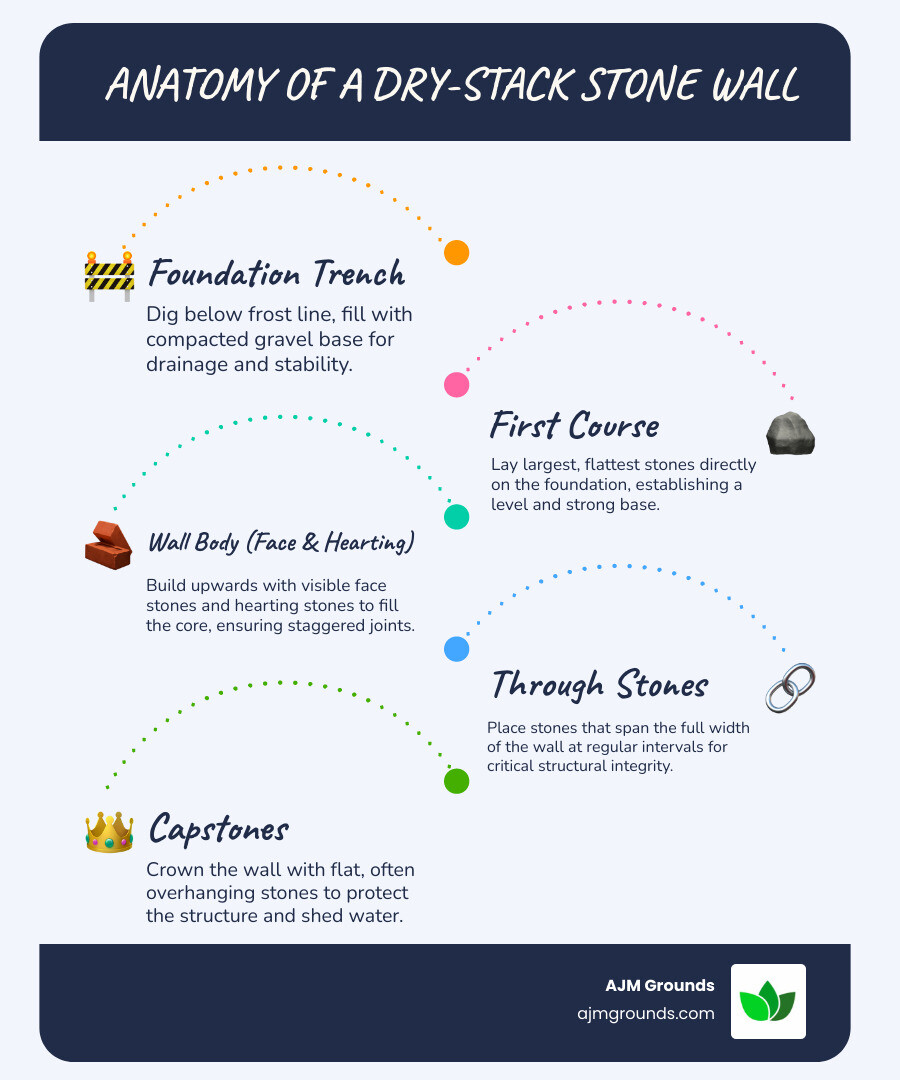
Building stone wall terms made easy:
The Complete Guide to Building a Stone Wall
Planning Your Project: Permits, Tools, and Materials
Careful planning is the bedrock of a successful building stone wall project. This phase involves assessing your site, understanding local regulations, and selecting the right materials.
Site Assessment, Permits, and Safety
A professional assessment looks at soil type, water drainage, and terrain slope, which dictates the wall’s design, foundation depth, and drainage needs. It’s also crucial to check with your local building department in Woburn or surrounding towns like Lexington and Winchester for permit requirements, as walls over a certain height (often 3-4 feet) require them. Before any digging, calling 8-1-1 is mandatory to locate underground utility lines. Safety is paramount in this labor-intensive work; professionals use hard-toe boots, eye protection, and gloves to prevent injury.
Professional Tools and Materials
Building a durable stone wall requires specialized tools, including shovels, wheelbarrows, levels, mason’s lines, and hammers and chisels for shaping stone. For a truly stable foundation, a plate compactor is essential.
The stone itself defines the wall’s character.
- Fieldstone: Natural, irregularly shaped stones offer a rustic look that blends beautifully with the local landscape. Their variation requires skill to fit but creates a unique and strong wall.
- Palletized Stone: These quarried stones are more uniform, which can simplify stacking. However, they may lack the character and size variation needed for the most stable structures.
For an authentic look, many of our clients in Bedford and Billerica prefer local fieldstone. Estimating quantity is also key; a general rule is that one ton of stone will build about 10 cubic feet of wall. It’s always wise to have a surplus to allow for selection and shaping. For more on the principles of quality construction, explore our guide to hardscape construction.
Preparing the Foundation for Building a Stone Wall
The foundation is the most critical part of a stone wall. A weak base will compromise the entire structure.
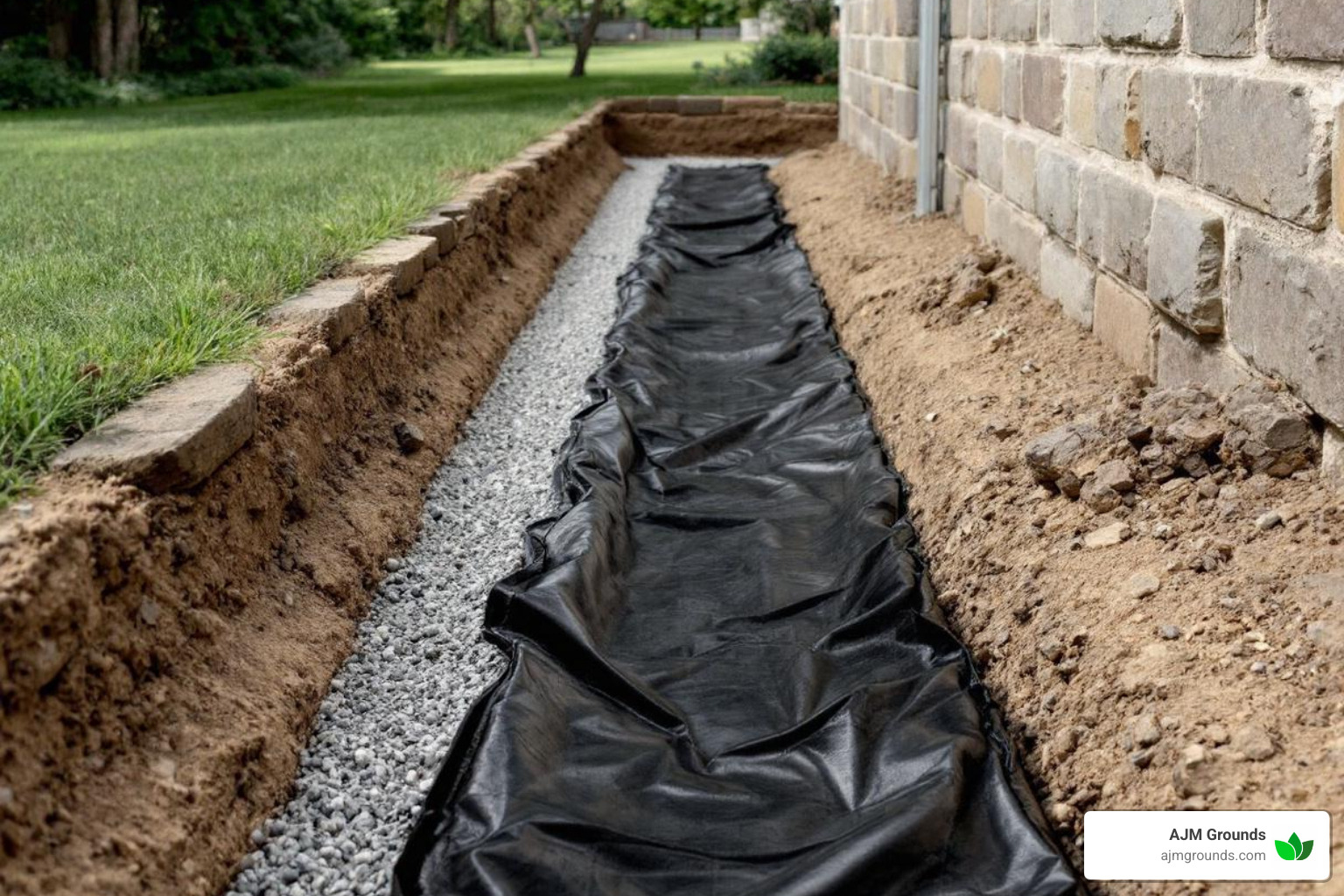
A Stable, Well-Drained Base
A proper foundation starts with a trench dug below the frost line to prevent heaving from freeze-thaw cycles. The trench is then lined and filled with layers of compacted gravel to create a stable base and ensure proper drainage. For retaining walls, especially those in areas with poor drainage or near gardens, managing water is vital. A professional installation may include a perforated drain pipe to channel water away and prevent hydrostatic pressure, a primary cause of wall failure. This is especially important for retaining walls for gardens.
The first course of stones—the largest and flattest—is then carefully set into this base. Each stone must be perfectly level, as this course dictates the integrity of the entire wall.
Building Upwards: Staggering Joints and Shaping Stones
With a solid foundation, the wall is built upwards, course by course. This is where skill and artistry combine.
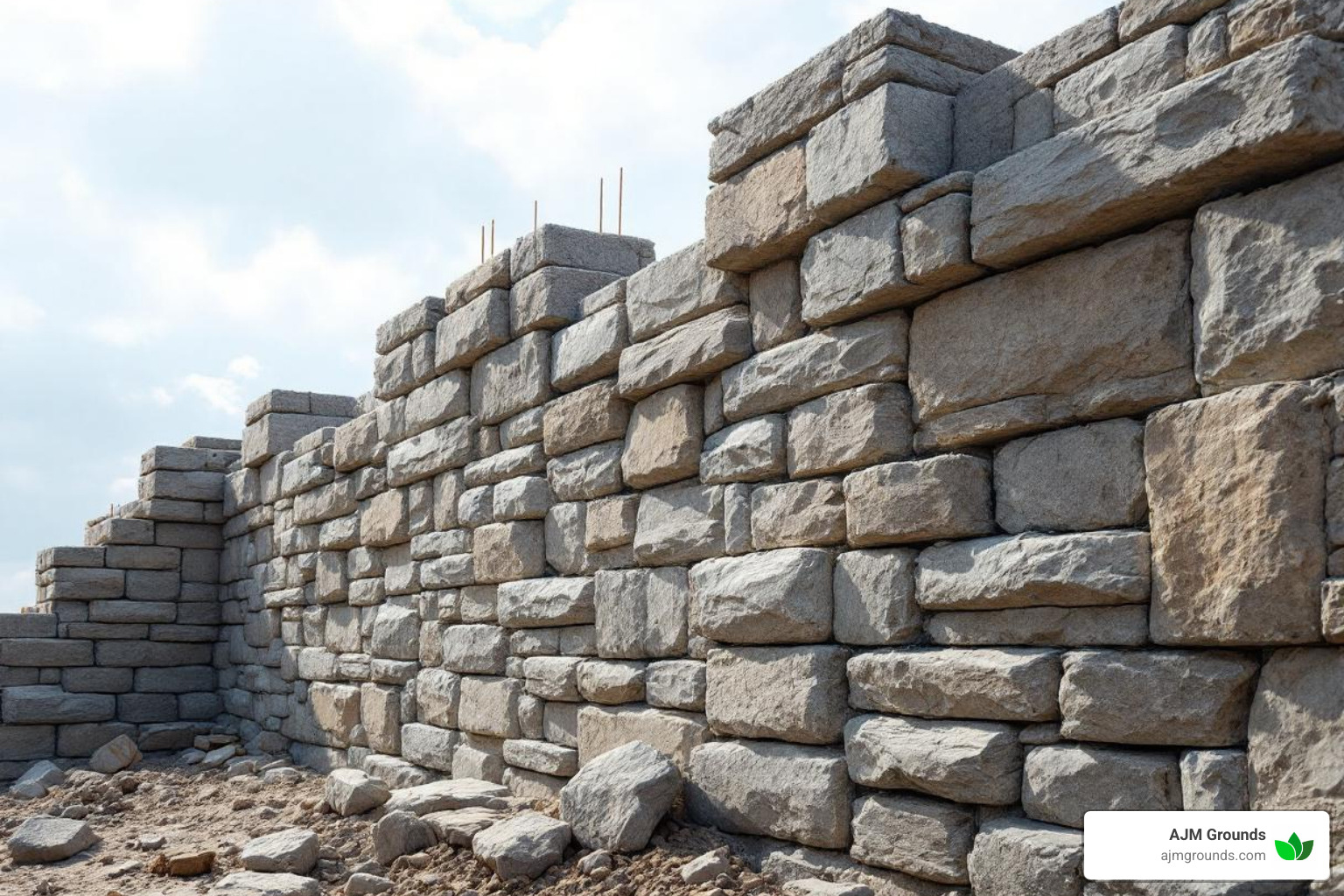
Ensuring Structural Integrity
The key to a strong wall is interlocking the stones. Vertical seams are a major weakness, so each stone must bridge the joint between two stones below it. This staggering distributes weight and ties the structure together into a cohesive unit.
A solid wall is more than just its visible faces. The internal core is tightly packed with smaller “hearting” stones to add mass and prevent the larger face stones from shifting. While natural stones are beautiful, they sometimes need to be shaped with a hammer and chisel to achieve a perfect fit. This process requires experience to read the stone’s grain and make clean breaks. For those interested in the craft, you can Learn more about professional techniques.
Common Challenges, Maintenance, and Enhancing Your Wall
Overcoming Common Building a Stone Wall Challenges
Even with careful planning, building stone wall projects can present challenges. Professionals in areas like Burlington and Wilmington know how to anticipate and address them.
- Uneven Terrain: On a slope, the foundation must be “stepped”—built as a series of level sections that follow the hill’s contour. This prevents the wall from sliding and ensures stability.
- Poor Drainage: In areas with heavy water flow, standard drainage may not be enough. A professional might install a more robust system with wider gravel backfill or additional weep holes to relieve pressure.
- Rebuilding vs. New Construction: Rebuilding an old wall is often more complex than starting fresh. It involves carefully dismantling the structure, sorting the stone for reuse, and assessing the old foundation, which frequently needs to be completely rebuilt to modern standards to correct the original failure. If you have a damaged wall, it’s best to seek More info about hardscape repair near me.
Professional Engineering for Taller Walls
As walls get taller or retain more soil, their design requires advanced structural considerations to ensure safety and longevity.
- Structural Support: Professionals build walls with a slight inward lean, or “batter,” to counteract the pressure of the soil behind them. For taller retaining walls, long “tie-back” stones are embedded deep into the hillside to anchor the structure. In some cases, reinforcement materials like geogrid mesh are layered within the wall for additional strength.
- Finishing with Capstones: The top course of a wall is finished with flat capstones. These are not just for looks; they should overhang the wall slightly to direct rainwater away from the face, protecting the joints below from erosion. For a secure finish, especially on sitting walls, capstones are often set with a strong masonry adhesive. Our team has extensive experience with installing cap stone on retaining wall projects.
Maintaining and Landscaping Around Your New Stone Wall
A well-built stone wall is a lasting investment. Proper care and thoughtful landscaping will ensure it remains a beautiful feature for decades.
Long-Term Care and Improvements
We recommend an annual inspection to check for any shifting or bulging. Small issues, like a loose stone, should be addressed promptly to prevent larger problems. While dry-stack walls are incredibly durable, significant movement could indicate a deeper foundation or drainage issue that requires professional assessment.
A stone wall also provides a stunning backdrop for plants.
- Complementary Plants: Cascading plants like creeping phlox or thyme look beautiful spilling over the edges.
- Landscape Lighting: Highlighting the wall’s texture with carefully placed lighting can create a dramatic effect at night. Our team specializes in Hardscape lighting design to showcase your new feature.
AJM Grounds Expertise: Your Partner in Hardscaping
Building stone wall projects are a cornerstone of our services at AJM Grounds. We bring attention to detail and personalized service to every project in Woburn, Lexington, Reading, and our other service areas. For professional design and installation of landscape retaining walls that are both beautiful and structurally sound, contact our experts at AJM Grounds today.
