

Understanding Lawn Fertilization Costs
When it comes to keeping your lawn looking its best, fertilization is one of those investments that truly pays off in curb appeal. The average cost of lawn fertilization service typically falls between $72 and $377 per application, with most homeowners paying around $224 nationally. But what exactly are you getting for your money?
I’ve found that many of my clients are surprised by how much the size of their property affects their bottom line. Let me break it down for you:
| Lawn Size | Average Cost Per Application | Annual Cost (4-6 applications) |
|---|---|---|
| Small (under 5,000 sq ft) | $50-$150 | $200-$600 |
| Medium (5,000-10,000 sq ft) | $65-$200 | $260-$800 |
| Large (1/4 acre) | $100-$300 | $400-$1,200 |
| Very Large (1/2 acre) | $200-$500 | $800-$2,000 |
| Estate (1 acre+) | $500-$1,500 | $2,000-$6,000 |
Professional fertilization services typically charge between $0.02 and $0.08 per square foot for basic treatments. When you add complementary services like weed control or aeration, that figure can climb to around $0.40 per square foot. The good news? Larger lawns often qualify for a lower per-square-foot rate, even though the total bill is higher.
Several key factors will influence what you’ll ultimately pay. Lawn size is the most obvious, but don’t overlook fertilizer type – organic options generally cost 30-50% more than synthetic alternatives, though many families feel the premium is worth it for environmental reasons and pet safety. Your application frequency matters too, with most healthy lawns requiring 4-6 treatments spread throughout the growing season.
It might surprise you to learn that labor costs represent a whopping 80-90% of your total price. This makes sense when you consider the expertise and equipment required to properly apply fertilizer at the right rates. Finally, your location plays a significant role – prices in the Northeast often differ substantially from those in the South or Midwest due to regional labor costs and growing season length.
I’m John Caplis, owner of AJM Grounds LLC. After more than ten years of providing professional lawn fertilization throughout Woburn, MA, I’ve helped hundreds of homeowners understand the average cost of lawn fertilization service while developing maintenance plans that deliver gorgeous results without breaking the bank.
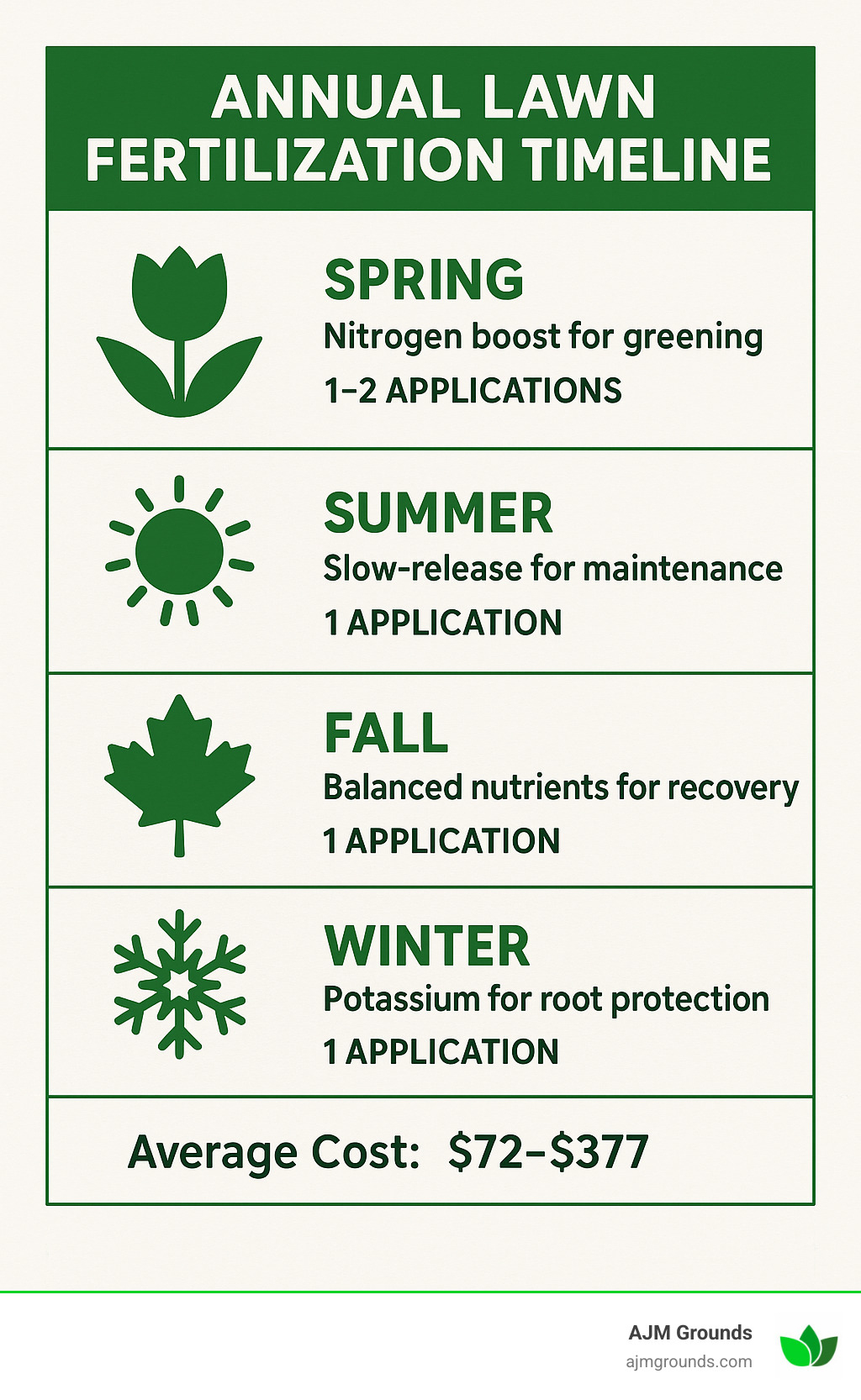
Please note that the prices listed above are average costs based on internet data and not actual costs for AJM Grounds services.
Why Fertilizing Matters & How Often You Really Need It
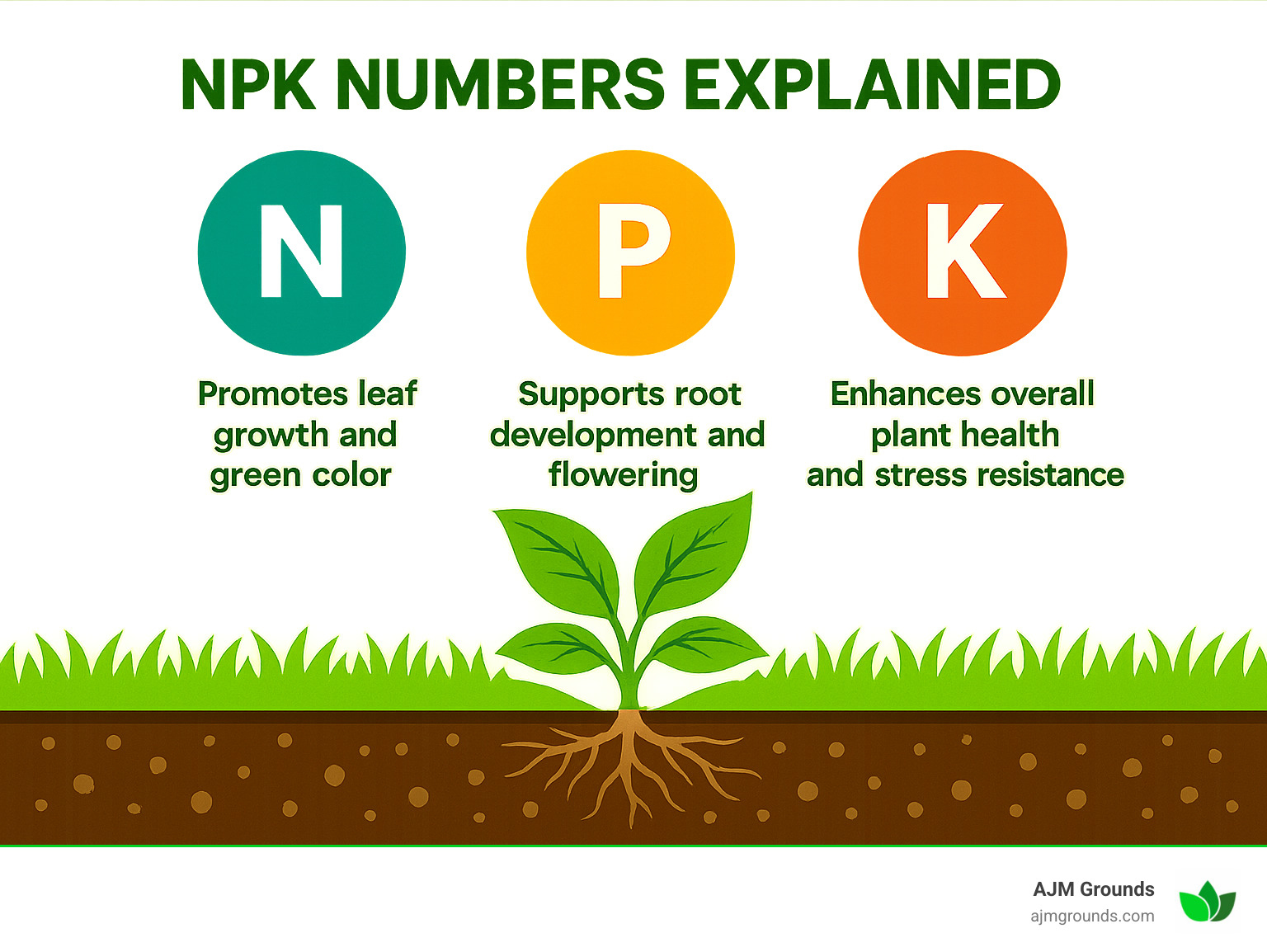
Think of your lawn as a hungry teenager – it’s constantly consuming nutrients from the soil to fuel its growth. Over time, these nutrients become depleted, especially here in New England where our soils tend to be naturally acidic and often lack key minerals. Without replenishment, your lawn will eventually show signs of malnutrition.
Good fertilization isn’t just about a prettier lawn – it’s about creating a healthier ecosystem right in your yard. When done right, fertilizing gives your grass:
Deeper, stronger root systems that can access water even during dry spells. Thicker, more resilient turf that stands up to foot traffic and play. Better resistance to drought, disease, and pests that might otherwise take over. Plus, healthy grass has an improved ability to crowd out weeds naturally – meaning fewer chemicals needed over time. And yes, that vibrant green color that makes neighbors slow down when driving past doesn’t hurt either!
“Fertilize your lawn correctly, and you’ll step on green, lush, thick grass every morning,” notes lawn care expert Melanie Joseph. “But timing and frequency are everything.”
The Right Schedule for New England Lawns
Here in Massachusetts and surrounding areas, cool-season grasses like Kentucky bluegrass, perennial ryegrass, and fescues dominate our landscapes. These grasses have different nutritional needs than southern varieties, and understanding this local difference is key to success.
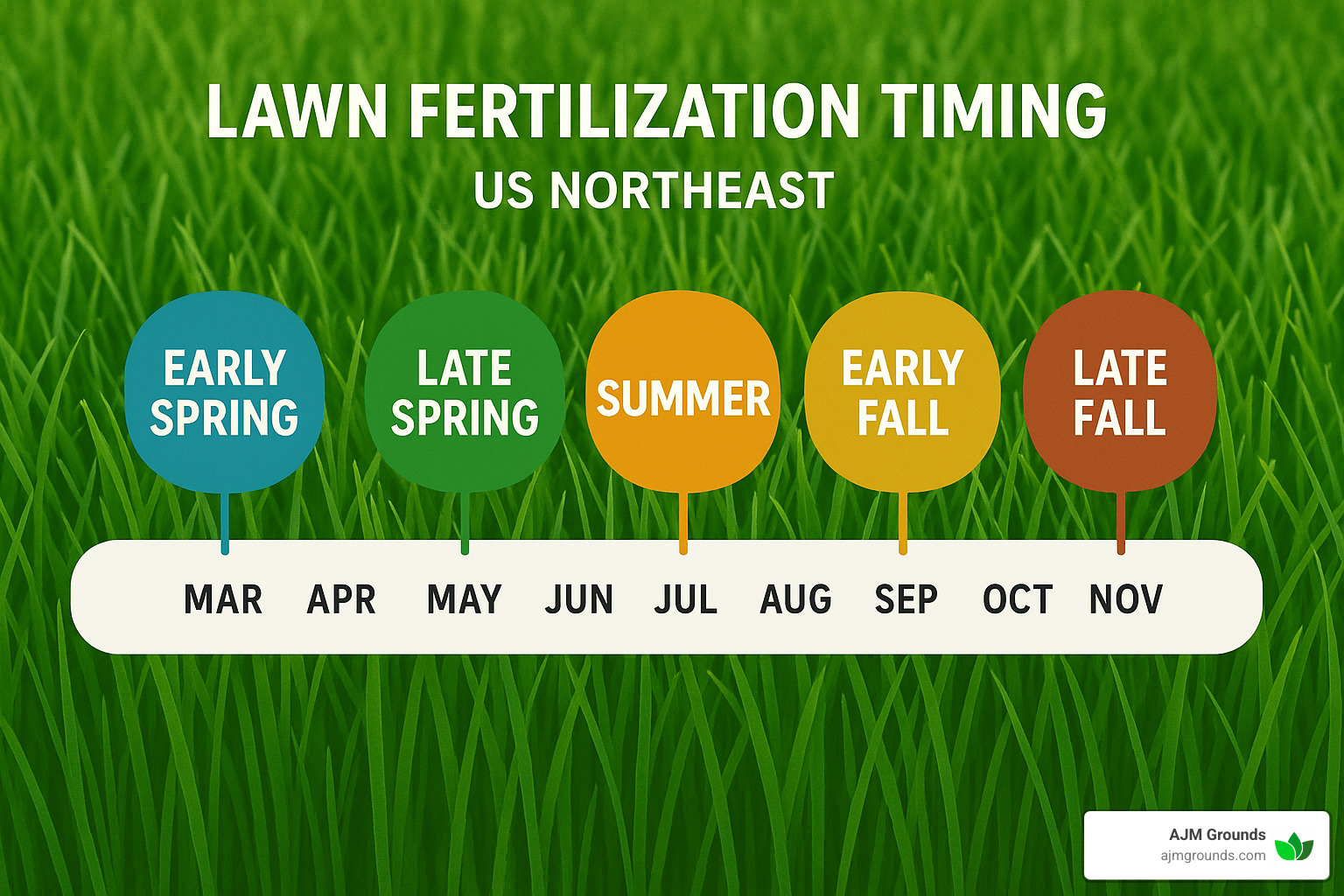
For our New England lawns, we typically recommend 4-5 applications per year:
- Early Spring (March-April): A gentle wake-up call with low-nitrogen, pre-emergent application to block crabgrass while not pushing excessive top growth.
- Late Spring (May-June): Balanced fertilizer with targeted broadleaf weed control to strengthen grass during its prime growing season.
- Summer (July-August): Light, stress-relief application (often organic) during heat when grass is focused on survival rather than growth.
- Early Fall (September): This is actually your lawn’s favorite meal of the year – the primary feeding with higher nitrogen to promote recovery and root development.
- Late Fall (November): The winterizer application strengthens roots before dormancy, essentially storing energy for next spring’s growth.
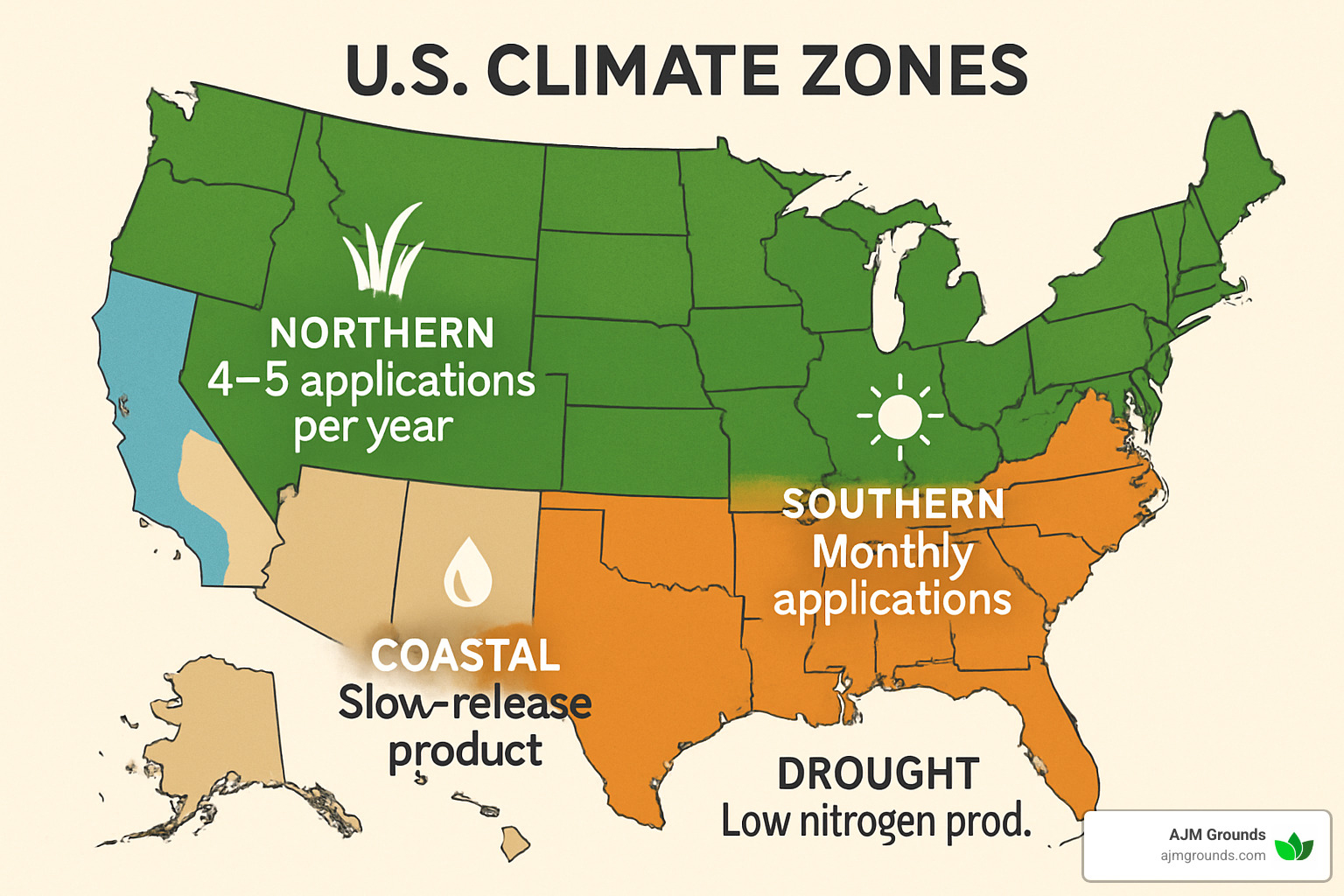
This schedule is quite different from what you’d see in Georgia or Florida, where warm-season grasses might need 6-10 applications annually but take a nutrition break during winter months.
The Risk of Over-Fertilizing
One mistake I see repeatedly is homeowners thinking “if some is good, more must be better” when it comes to fertilizer. This well-intentioned approach can actually harm your lawn by burning grass through excess nitrogen, creating weak, disease-prone growth that flops over instead of standing tall, contributing to thatch buildup that blocks water absorption, and causing environmental runoff that pollutes local waterways.
According to scientific research on nutrient leaching, over-fertilized lawns can release up to 50% of nitrogen and phosphorus into groundwater and nearby water bodies. This environmental impact is why professional application with calibrated equipment makes such a difference in both lawn health and being a good neighbor to our local ecosystems.
The average cost of lawn fertilization service might seem like an extra expense, but when you consider the potential damage from improper application – both to your lawn and the environment – professional service often pays for itself in better results and peace of mind.
Average Cost of Lawn Fertilization Service in 2024-2025
Let’s talk real numbers about what you can expect to pay for professional lawn fertilization these days. (Just a friendly reminder that these figures represent average costs from internet research, not actual pricing from AJM Grounds.)
The average cost of lawn fertilization service across the country sits at around $224 per application, though most homeowners find themselves paying somewhere between $72 and $377. When you commit to a full annual program with 4-6 applications, you’re typically looking at a yearly investment of $250 to $1,000. Of course, if you’ve got a sprawling property, that figure could stretch to $2,000-$6,000.
Why such a wide range? It’s not just about square footage. Professional lawn care involves several cost components:
Labor makes up a whopping 80-90% of what you’re paying. This includes trained technicians who know exactly how much product to apply, the proper equipment to spread it evenly, and the insurance that protects everyone involved. Here in Massachusetts, we tend to see costs running about 10-15% higher than the national average, thanks to our higher labor rates and operational expenses.
For a typical suburban lawn, expect to pay between $50 and $150 per application. Breaking it down by square footage, basic fertilization runs about $0.02 to $0.08 per square foot. When companies bundle in extras like weed control or grub prevention, that per-square-foot cost might climb to around $0.40.
Larger properties naturally cost more. A full acre (that’s 43,560 square feet) typically starts around $500 per application but can easily reach $1,200 or more if your property has tricky terrain, lots of obstacles, or limited access points.
Average cost of lawn fertilization service by lawn size
The average cost of lawn fertilization service is directly tied to how much grass you’ve got, though there are some economies of scale at play. Here’s the breakdown by lawn size:
For small lawns under 5,000 square feet, expect to pay $50-$150 per application. Worth noting: most companies have minimum service charges between $40-$80, so tiny lawns might not see proportional savings.
Medium lawns between 5,000-10,000 square feet (typical for many Woburn homes) generally run $65-$200 per visit.
Quarter-acre properties (about 10,900 square feet) typically cost $100-$300 per application. At this size, professionals can work more efficiently.
Half-acre lawns (21,780 square feet) usually fall in the $200-$500 range. The equipment efficiency starts to offset the larger area.
One-acre or larger properties (43,560+ square feet) generally start at $500 and can exceed $1,200 per application, often requiring specialized equipment.
To put this in local perspective, a typical quarter-acre lawn in Bedford or Lexington might cost $300-$400 per application, while a half-acre property in Wilmington or Reading might run $350-$550.
Average cost of lawn fertilization service by fertilizer type
The products used make a big difference in both your results and your bill. Here’s how different fertilizer types affect the average cost of lawn fertilization service:
Synthetic Fertilizers typically cost $25-$80 per treatment. They’re made from petroleum by-products and deliver fast results, usually within 7-14 days. They contain higher nitrogen concentrations and cost less than organic options, though they may leach from the soil more quickly.
Organic Fertilizers generally run $50-$150 per treatment—about 30-50% more than synthetic options. They release nutrients more slowly (over 14-30 days) and are made from natural materials like bone meal, seaweed, and compost. While more expensive, they build soil health over time and are safer for children, pets, and the environment.
The application method also impacts cost. Liquid fertilizers ($10-$30 per 1,000 square feet) offer faster absorption and more even distribution, making them excellent for targeted feeding—though they carry a higher risk of burn if misapplied. Granular fertilizers ($8-$25 per 1,000 square feet) provide slower, steadier release with lower burn risk, though distribution may be less even.
There’s also a significant difference between fast-release products ($104-$321 per application), which green up your lawn within days but only last 3-4 weeks, and slow-release options ($162-$470 per application), which feed gradually over 6-8 weeks, use nutrients more efficiently, and better support long-term lawn health.
At AJM Grounds, we’ve found that a balanced approach works best for New England lawns. We typically use a strategic combination of synthetic and organic materials throughout the season, maximizing results while minimizing environmental impact. Our years of experience serving Woburn and surrounding communities have shown that this thoughtful approach delivers the best value—beautiful lawns that last.
7 Price Drivers That Make or Break Your Quote
When you’re comparing lawn fertilization quotes, you might wonder why there’s such a range in pricing. As someone who’s been in the industry for years, I can tell you it’s not random—several key factors determine what you’ll pay. Let’s explore the seven elements that most impact your fertilization costs.
1. Lawn Size and Complexity
While square footage is the starting point for any estimate, your lawn’s unique characteristics play a huge role in pricing.
Think about your property for a moment—do you have numerous trees creating awkward spaces to steer? Steep slopes that require careful handling? Those obstacles and terrain challenges can increase your cost by 20-30% compared to a simple, flat rectangular yard of the same size.
I’ve seen quarter-acre properties with winding layouts, mature trees, and multiple garden beds cost significantly more than simpler yards because they require more time and precision to fertilize properly.
2. Fertilizer Quality and Formulation
Not all fertilizers deliver the same results, and quality definitely affects pricing.
Professional-grade products often contain premium ingredients not available in consumer products. These formulations typically cost more but provide superior results with fewer applications. Many professionals also offer custom blends based on soil test results that address your lawn’s specific deficiencies—these specialized mixes naturally come at a premium price point.
The technology behind the fertilizer matters too. Products with controlled-release technology use sophisticated coatings that regulate nutrient release based on moisture and temperature, ensuring your lawn receives steady nutrition rather than feast-or-famine feeding.
3. Application Frequency
How often your lawn needs fertilization directly impacts your annual costs:
A basic program with 3-4 applications per year typically costs $150-$600 annually, while a comprehensive program with 5-6 applications might run $250-$900. For lawns needing intensive restoration, 6+ applications could push costs to $300-$1,200+ per year.
The good news? Many companies (including ours at AJM Grounds) offer 10-25% discounts for annual package commitments versus one-off applications. This brings down the per-application cost significantly.
4. Geographic Location and Local Market
Where you live affects pricing in ways you might not expect. Here in Massachusetts, professional service labor rates typically run $40-$80 per hour—higher than many other regions of the country.
Local competition plays a role too. Areas with more service providers often have more competitive pricing, though this doesn’t always translate to better value. And interestingly, service pricing tends to correlate with local property values—what you’ll pay in Lexington often differs from pricing in Lowell, even for identical services.
State regulations can also impact costs. Some states have implemented stricter fertilizer application laws to protect waterways, requiring additional training and licensing for professionals—costs that are ultimately reflected in service pricing.
5. Minimum Service Fees
Ever wonder why even a tiny lawn doesn’t get a tiny price? Most professionals establish minimum charges regardless of lawn size.
These minimum service fees (typically $40-$80) cover the fixed costs of sending a crew to your property—including travel time, equipment setup, and preparation. Even for a postage-stamp lawn, these basics costs don’t change much.
As a homeowner with a small property, you might find better value by bundling services rather than purchasing fertilization alone, as you’ll be paying that minimum trip charge regardless.
6. Equipment Type and Technology
The equipment used to apply your fertilizer affects both quality and cost:
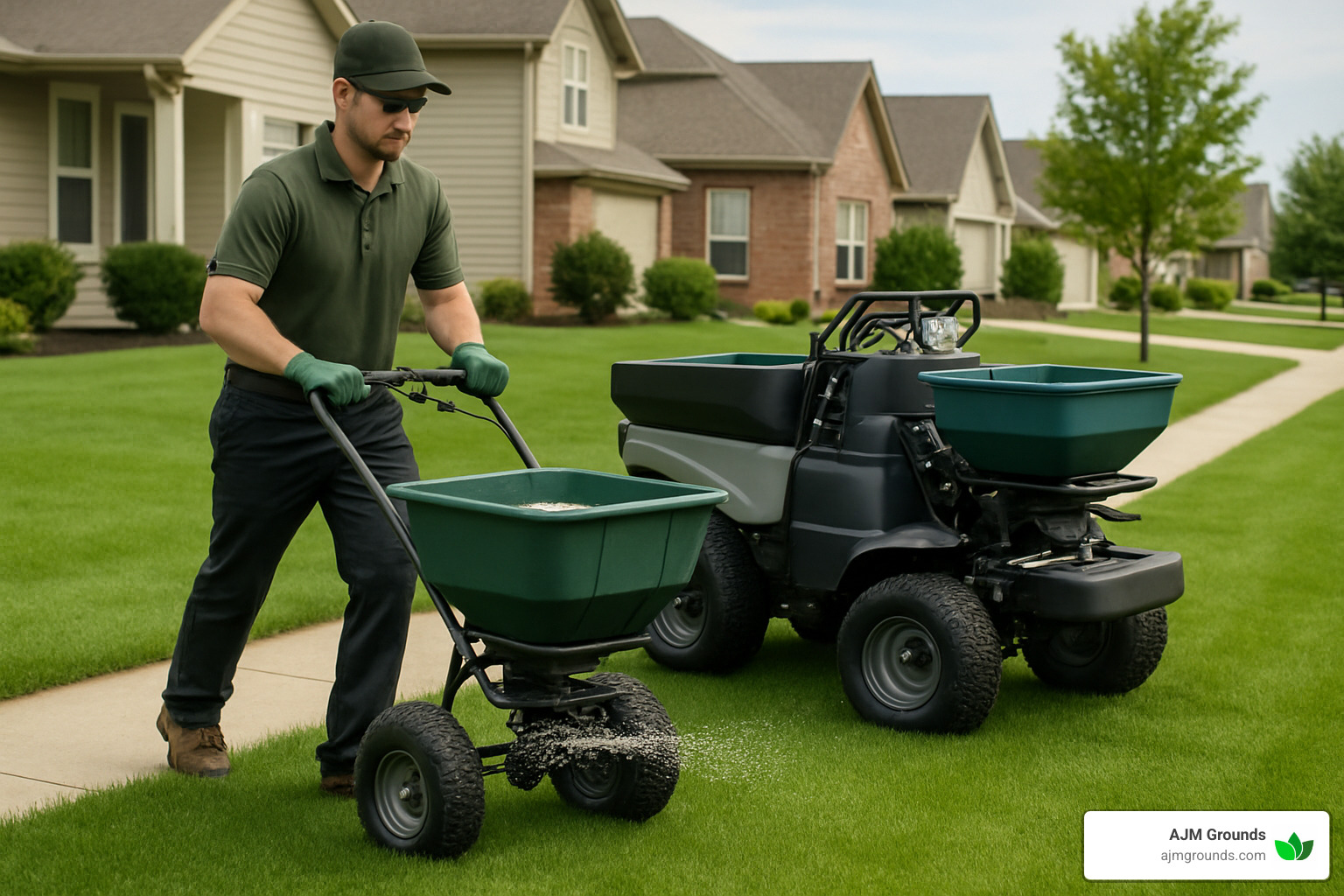
Basic push spreaders cost less to operate but provide less precise application. Professional broadcast spreaders offer more consistent coverage, while ride-on applicators become necessary for larger properties. Some companies even use GPS-guided systems that ensure perfect coverage without gaps or overlaps—premium technology that comes with premium pricing.
Better equipment typically means better results, but it also means higher overhead costs for the service provider.
7. Labor and Expertise
Perhaps the most significant factor in pricing is the expertise level of the team applying your fertilizer:
Licensed applicators with state certifications command higher wages but bring valuable knowledge to your lawn care. Well-trained staff apply product more effectively and efficiently, which can actually save money in the long run by reducing waste and preventing damage.
At AJM Grounds, we invest heavily in training our team because we know that expertise isn’t just about credentials—it’s about understanding the specific challenges of New England lawns and knowing exactly how to address them.
Regional & Climate Impact
Living in New England brings unique challenges for lawn care that directly impact fertilization needs and costs.
Our shorter growing season means we need to concentrate applications in a 7-8 month window, rather than spreading them throughout the year as southern states do. Our naturally acidic soils often require supplemental lime applications—an additional cost that homeowners in other regions might not face.
Even within Massachusetts, needs vary significantly. Coastal properties near Boston face different challenges than those in more inland communities like Woburn or Burlington. After harsh winters, our spring applications need to address substantial recovery needs, with higher nitrogen levels to jumpstart growth.
This regional variation explains why fertilization programs that work in Florida or Texas simply won’t succeed here—and why local expertise is so valuable when choosing a lawn care provider.
Fertilizer Formulation Deep-Dive
Understanding different fertilizer types helps explain why prices vary so widely:
Granular Fertilizers ($130-$350 per application) are the workhorses of the industry. These dry pellets spread via broadcast spreader release nutrients over 4-6 weeks, providing steady feeding with lower burn risk. They’re ideal for most residential lawns and work well in various weather conditions.
Liquid Fertilizers ($150-$554 per application) deliver faster results, often showing improvement within 24-48 hours. They’re excellent for quickly correcting deficiencies but require more precise application equipment and have a higher risk of burn if misapplied. They’re also more weather-dependent, as heavy rain shortly after application can reduce effectiveness.
Weed-and-Feed Products ($175-$450 per application) combine fertilizer with selective herbicides to tackle multiple issues in one visit. While convenient, they require precise timing to be effective against target weeds and may face environmental restrictions in some areas.
For shady, damp areas, Moss Control Formulations ($200-$500 per application) include iron sulfate or other moss-killing ingredients alongside nutrients. These specialized products address both nutrition and moss elimination but come at a higher price point.
Slow-Release Technologies ($162-$470 per application) represent the premium end of fertilizers. These polymer-coated granules release nutrients gradually over 8-12 weeks, providing more efficient feeding with less environmental impact. While more expensive upfront, they often require fewer applications annually.
DIY vs. Professional: What It Really Costs & Why Quality Varies
That age-old question many homeowners wrestle with: should I fertilize my lawn myself or hire a pro? Let’s break down what each option really costs and why the results often look so different.
DIY Fertilization Costs
If you’re considering the DIY route, here’s what you’re looking at for a typical suburban lawn of 5,000-10,000 square feet:
First, you’ll need some equipment. A decent broadcast spreader runs between $30-$70, though premium models can cost $100-$150. If you have a tiny lawn, you might get by with a handheld spreader for $15-$30. For liquid applications, expect to spend $20-$100 on a sprayer. And if you’re doing things right, add $10-$30 for a soil test kit.
As for the actual fertilizer, materials typically cost about $1-$2 per 1,000 square feet per application. A bag of synthetic fertilizer covering 5,000-10,000 square feet costs $15-$40, while organic options run $25-$60 but usually cover only 2,500-5,000 square feet. Specialty products like weed and feed formulations will set you back $30-$50 per bag.
Running the annual numbers for four applications, you’re looking at roughly:
– Small lawn (under 5,000 sq ft): $38-$107 (plus equipment)
– Medium lawn (5,000-10,000 sq ft): $80-$200 (plus equipment)
– Large lawn (quarter acre): $120-$320 (plus equipment)
That’s about half what you’d pay a professional, at least for materials. But there’s more to the story.
Professional Service Costs
For comparison, the average cost of lawn fertilization service from professionals ranges quite widely:
- Single application: $103-$343 (with a national average of $289)
- Annual program (4-6 applications): $250-$1,000
- Per square foot pricing: $0.02-$0.08 for basic fertilization
“When I first started AJM Grounds, clients were often surprised by the difference between DIY and professional costs,” shares John Caplis. “But then I explain that labor, equipment, and expertise make up 80-90% of what they’re paying for.”
That higher price tag includes trained technicians, commercial-grade equipment, proper timing based on weather patterns, and often a satisfaction guarantee. Plus, you’re buying back your weekends – no more spending hours pushing a spreader across your lawn or storing chemicals in your garage.
Quality Differences Explained
Ever wonder why professional lawns often look noticeably better than DIY efforts? Several factors create this quality gap:
Professional applications are simply more precise. Commercial spreaders are calibrated regularly and designed for even distribution, while many homeowners struggle with striping or missed spots.
The products themselves are different too. Many commercial-grade fertilizers aren’t available to the general public, containing better slow-release technologies and more refined nutrient profiles.
Professionals also time applications strategically. They monitor soil temperatures, moisture levels, and growth patterns to apply fertilizer when your grass can best use it. Many DIYers apply too early in spring or too late in fall, reducing effectiveness.
In Massachusetts, there’s another important distinction: professional applicators must be licensed by the state. This ensures they’ve received proper training on application rates, environmental safeguards, and safety protocols – knowledge that protects both your lawn and local waterways.
For more details about our professional approach, visit our Lawn Fertilizing Service page.
Pros & Cons Quick-Glance
DIY Fertilization
Pros: Lower direct costs (about 50% savings on materials), complete control over products, flexible timing, personal satisfaction, and no service appointments to schedule.
Cons: Equipment investment, time commitment (2-4 hours per application), storage headaches, learning curve, risk of lawn damage from improper application, limited product access, no guarantees, and potential environmental issues.
Professional Fertilization
Pros: Expert application, access to commercial-grade products, precise application with calibrated equipment, customized programs, major time savings, service guarantees, professional lawn evaluations, reduced risk of damage, and no chemical storage.
Cons: Higher direct cost, scheduling coordination, less control over exact products, quality variations between companies, and possibly paying for bundled services you don’t need.
“The question isn’t really whether you can fertilize your lawn yourself – of course you can,” says lawn care veteran Mike Thompson. “The real question is whether your time, the potential for mistakes, and the limited access to professional products make the savings worthwhile.”
The prices noted here are average internet estimates, not actual AJM Grounds rates. Your specific lawn’s needs may vary significantly based on size, condition, and location in the Woburn area.
Add-On Services That Inflate (or Justify) the Bill
When you’re considering professional lawn fertilization, you’ll likely encounter a menu of complementary services that can either make you wince at the total or nod appreciatively at the comprehensive approach. These add-ons aren’t just profit centers for lawn care companies – they’re often the difference between good results and spectacular ones.
Core Aeration ($75-$200)
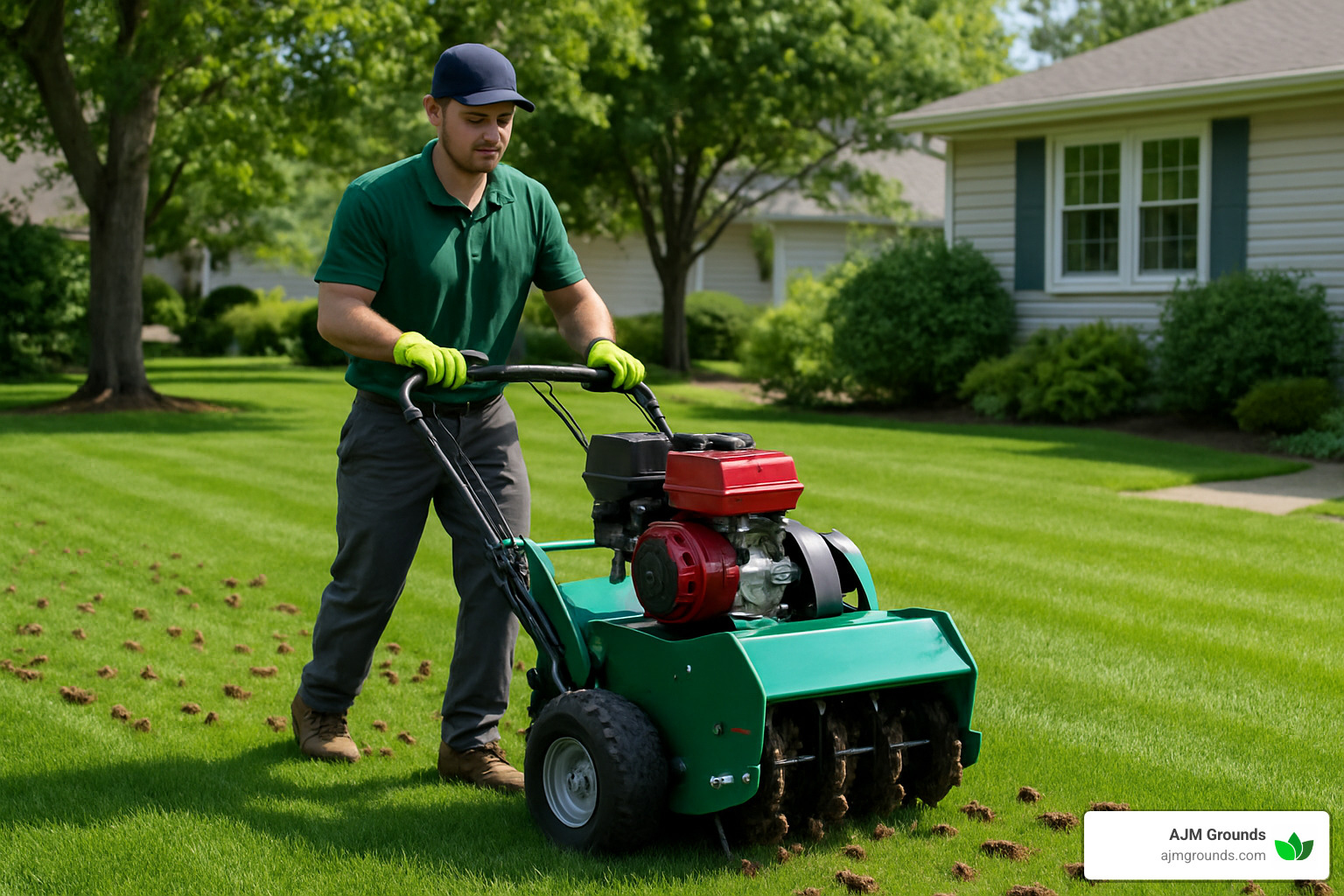
Think of aeration as giving your lawn a chance to breathe. After years of foot traffic, mowing, and just living its lawn life, your soil becomes compacted – like trying to grow grass in a parking lot.
“Aerate your lawn before you fertilize to break up soil compaction,” advises lawn care expert Cory Ferrer. “This creates pathways for roots to absorb nutrients, air, and water.”
Core aeration pulls small plugs of soil from your lawn, creating thousands of tiny openings that allow fertilizer to reach deeper into the root zone instead of washing away. For $75-$200 (depending on lawn size), this service dramatically improves how effectively your grass uses fertilizer. In New England’s heavy clay soils, aeration isn’t just helpful – it’s often essential for healthy root development.
Dethatching ($180-$400)
That spongy layer between your grass and soil might feel nice underfoot, but when thatch exceeds ½ inch, it becomes a barrier that blocks fertilizer, water, and air from reaching roots. Dethatching physically removes this layer, allowing your lawn to breathe again.
At $180-$400 for a typical lawn, dethatching costs more than aeration but can be absolutely necessary for lawns with severe thatch buildup. The difference in fertilizer effectiveness before and after dethatching can be night and day – especially in established lawns that haven’t been maintained regularly over the years.
When I visit Woburn properties with bouncy, spongy lawns that aren’t responding to fertilizer, dethatching is often my first recommendation before investing in more nutrients that won’t reach their target.
Overseeding ($300-$1,350)
Even the best-maintained lawns thin out over time. Overseeding introduces fresh, often improved grass varieties into your existing lawn, creating thicker turf that uses fertilizer more efficiently and naturally crowds out weeds.
Pricing varies widely from $300 for basic overseeding of a small lawn to $1,350 for larger properties using premium seed blends. When paired with fertilization, the results can transform a mediocre lawn into a showcase property within one growing season. The denser your turf, the more efficiently it uses nutrients and the fewer weeds you’ll battle.
Grub Control ($50-$125)
Nothing defeats the purpose of fertilization faster than having grubs munch through your grass roots from below. These beetle larvae can devastate even perfectly fertilized lawns by severing the very roots that absorb those nutrients.
Preventive grub control applications cost between $50-$125 depending on lawn size and product used. While this might seem like an unnecessary expense, consider it insurance – repairing grub damage can cost thousands, while prevention costs relatively little. Throughout Middlesex County, Japanese beetles and European chafers make grub control a wise investment for most homeowners.
Lime & pH Correction ($70-$150)
New England soils are notoriously acidic – often too acidic for grass to properly use fertilizer. You can apply premium fertilizer all day long, but if your soil pH is too low, your grass can’t access those nutrients.
Lime applications cost $70-$150 and gradually raise soil pH to the sweet spot where grass thrives and fertilizer works most effectively. In my experience working with Woburn lawns, nearly 80% of properties benefit from periodic lime applications every 1-3 years. It’s like open uping nutrients that were already in your soil but unavailable to your grass.
Bundled Service Discounts
Smart homeowners take advantage of package pricing, which typically offers savings of 10-25% compared to purchasing services individually. Most companies, including AJM Grounds, offer several options:
Annual fertilization programs save 10-15% over individual applications and ensure your lawn receives timely care throughout the growing season. Complete care packages that combine fertilization with aeration, grub control, and lime applications often save 20-25% while addressing all major lawn needs systematically.
The real value in bundled services isn’t just the direct cost savings – it’s the improved results that come from a coordinated approach where each service improves the effectiveness of the others.
For more insights into how these services work together to create exceptional results, visit our page on 5 Compelling Reasons to Hire a Professional Lawn Fertilizing Company.
The prices noted here are average costs based on internet data and not actual costs for AJM Grounds. Your specific property may require more or less investment depending on size, condition, and goals.
Smart Ways to Save on Fertilization Without Sacrificing Curb Appeal
Let’s face it – we all want that magazine-worthy lawn without the premium price tag. The good news is that you don’t have to choose between a beautiful yard and your budget. With some strategic planning, you can significantly reduce your lawn care costs while still maintaining that lush, green carpet your neighbors will envy.
1. Commit to Annual Programs
One of the smartest money-saving moves is signing up for a complete annual program rather than scheduling individual applications.
Most lawn care companies, including local services in Woburn and surrounding areas, offer substantial discounts for annual commitments. While single applications might set you back $100-$150 each, annual packages typically drop to $75-$120 per application – translating to savings of 20-25%. Some companies even offer additional 5-10% discounts if you prepay for the entire season.
Beyond just saving money, annual programs ensure your lawn receives the right treatments at the optimal times throughout the growing season, creating a more cohesive approach to lawn health.
2. Schedule During Off-Peak Times
Just like many industries, lawn care has its busy and slow seasons. Taking advantage of this can pad your wallet nicely.
Early spring (March) and late fall (November) often come with promotional pricing as companies look to fill their schedules. Mid-summer applications sometimes feature hot-weather discounts when demand naturally dips. And if you’re really planning ahead, end-of-season promotions can lock in better rates for the following year.
As one industry veteran puts it, “Hiring a pro at the end of fall may save on labor costs due to seasonal slowdowns. Companies are often more willing to negotiate when their schedules aren’t packed.”
3. Measure Your Lawn Accurately
This simple step can save you serious money. Many homeowners unknowingly overpay by overestimating their lawn size.
Instead of guessing, use digital tools like Google Earth’s area finder or the Map Developers Area Finder to get precise measurements. Be sure to exclude non-lawn areas like driveways, houses, and garden beds when calculating your square footage.
Providing accurate measurements when requesting quotes ensures you’re not paying to fertilize your driveway or patio! For properties with varying needs, consider dividing your yard into priority zones, focusing professional services on high-visibility areas while handling less prominent sections yourself.
4. Organize Neighborhood Group Service
There’s strength (and savings) in numbers! Coordinating with neighbors for group service can lead to discounts of 10-15% per household.
Companies save on travel time and setup when servicing multiple adjacent properties, allowing them to pass those savings to you. In communities throughout Middlesex County, neighborly coordination has become increasingly popular for reducing lawn care costs.
Don’t forget to ask about referral programs too – many companies offer $25-$50 credits for each new customer you refer, which can significantly offset your own costs.
5. Prioritize Soil Testing Before Fertilizing
A simple soil test costing just $10-$30 could save you hundreds in unnecessary fertilizer applications.
Testing identifies specific nutrient deficiencies and soil pH issues that might be preventing your lawn from thriving. Without this information, you might be applying (and paying for) nutrients your lawn doesn’t even need, or applying them when soil conditions won’t allow proper absorption.
Many professional lawn care companies include soil testing with their initial consultation or as part of annual programs. This small investment helps create a targeted approach rather than taking expensive shots in the dark.
6. Focus on Core Applications
If you’re on a tight budget, not all fertilizer applications are created equal. Knowing which ones deliver the biggest bang for your buck is crucial.
The early fall (September) application is widely considered the most important for New England lawns, as cool-season grasses actively develop their root systems during this period. The late spring (May-June) application is next in line, helping control weeds while feeding your lawn during a key growth period.
During severe drought or budget constraints, summer applications can sometimes be skipped or handled DIY. As one turf expert explains, “If you can only fertilize once a year, do it in early fall when cool-season grasses are most receptive to feeding.”
7. Improve Soil Health Naturally
Complementing professional services with good lawn practices can reduce your dependency on purchased fertilizers.
Leave grass clippings on your lawn after mowing – they can provide up to 25% of your lawn’s nitrogen needs for free. Apply compost as a top dressing (¼-½ inch layer in spring or fall) to improve soil structure and add nutrients. Maintain proper mowing height (3-3.5 inches for most New England lawns) to encourage stronger root development. And water deeply but infrequently to train grass roots to grow deeper.
These practices improve your soil’s biology, enhancing nutrient cycling and creating a more self-sustaining lawn that requires fewer inputs over time – a win for both your wallet and the environment.
By implementing these strategies, homeowners throughout Woburn, Winchester, and surrounding communities have successfully reduced their average cost of lawn fertilization service while still enjoying beautiful, healthy lawns. The key is working smarter, not necessarily spending more.
Frequently Asked Questions About Lawn Fertilization Costs
How many times a year should I fertilize?
The magic number for most New England lawns is 4-5 applications per year. But like most things in lawn care, there’s no one-size-fits-all answer.
If you’re maintaining a lawn in Massachusetts or surrounding areas, your cool-season grasses typically need fewer applications than southern warm-season varieties. The grass in your Woburn yard has different needs than your cousin’s lawn in Florida!
Your soil type matters too—sandy soils tend to lose nutrients faster and might need more frequent feeding. And that backyard where the kids play soccer all summer? High-traffic areas benefit from additional nutrition to recover from wear and tear.
On a tight budget? Even 2-3 strategic applications can make a remarkable difference. If you can only fertilize twice a year, focus on early fall (September) and late spring (May-June). These two applications will give you the most bang for your buck, supporting your lawn during its key growth periods.
Is organic fertilizer worth the higher price?
When you see organic fertilizer costing 30-50% more than synthetic options, you might wonder if it’s worth the premium. For many homeowners in Woburn and surrounding communities, the answer is yes—and here’s why.
Safety is a major factor, especially for families with children and pets who spend time rolling around in the grass. Organic fertilizers pose significantly lower risks to your two-legged and four-legged family members.
Your soil health gets a boost too. While synthetic fertilizers feed the grass directly, organic options feed the soil ecosystem, improving its structure and microbial activity over time. Think of it as the difference between taking vitamins and eating a balanced diet—both provide nutrients, but one builds lasting health.
Organic options release nutrients more slowly, reducing the chance of burning your grass or contributing to water pollution through runoff. This slower release often means more consistent growth rather than the quick surge and plateau you might see with synthetics.
As lawn care expert Tara Dudley puts it, “Consider organic fertilizers, especially if pets and children use the lawn space.”
For most of our clients in Winchester, Woburn, and nearby towns, the additional $25-$70 per application feels justified by these benefits. At AJM Grounds, we often recommend a hybrid approach—organic for certain seasonal applications and synthetic for others—giving you the best of both worlds while keeping costs reasonable.
Can rain right after application wash money down the drain?
The relationship between rain and fertilizer is complicated—like that friend who’s helpful in small doses but overwhelming when they show up unannounced.
A gentle shower after application can be beneficial, especially for granular fertilizers that need moisture to start breaking down. It’s nature’s way of watering in your investment.
But a heavy downpour? That’s problematic. Significant rainfall within 24 hours of application can wash away fertilizer before your lawn has a chance to absorb it—literally sending your money down the storm drain while potentially contributing to water pollution.
For optimal results, timing matters:
– Apply fertilizer when soil is moist but not saturated (typically 2 days after rain)
– Allow 24-48 hours of dry weather after application for proper absorption
– Reschedule if heavy rain is forecast within 24 hours
Most professional services, including AJM Grounds, monitor weather forecasts carefully and adjust schedules to protect your investment. It’s one of those behind-the-scenes benefits of professional service that homeowners don’t always consider.
How much does DIY fertilization really save?
The DIY route seems like an obvious money-saver at first glance. Materials for a typical quarter-acre lawn might cost you $120-$320 annually, compared to $400-$800 for professional service. That potential $280-$480 difference looks attractive!
But as with most DIY projects, the full picture includes more than just material costs:
Equipment investment starts at $50 for a basic spreader but can reach $200+ for quality equipment. Unlike professionals who spread this cost across hundreds of properties, your spreader serves just one lawn.
Your time investment adds up quickly—2-4 hours per application when you include preparation, application, and cleanup. That’s potentially 8-20 hours of your year dedicated to fertilizing.
There’s also a learning curve. Even with the best intentions, DIY applications often result in streaking, burning, or missed spots while you develop proper technique. These mistakes can require expensive corrections.
You’ll need storage space for equipment and products, some of which have special handling requirements. And if you’re using liquid applications, you’ll need appropriate protective gear.
Finally, consider the results comparison. Professional applications typically provide more consistent coverage and use commercial-grade products often unavailable to consumers.
The question becomes not just “How much will I save?” but “Is the savings worth the trade-offs?” For some homeowners, particularly those who enjoy yard work, the answer might be yes. For others, the convenience and reliability of professional service justify the higher cost.
Do lawn size discounts really make a difference?
Yes, there’s definitely an economy of scale when it comes to the average cost of lawn fertilization service. The per-square-foot price typically decreases as your lawn size increases:
Small lawns under 5,000 square feet might cost $0.03-$0.08 per square foot, while medium lawns (5,000-10,000 square feet) drop to around $0.02-$0.05. When you get to quarter-acre properties and beyond, that rate can fall to $0.01-$0.04 per square foot.
However, there’s a catch for very small lawns. Most companies have minimum service charges—typically $40-$80—regardless of size. If you have a tiny urban yard, you might actually pay a higher per-square-foot rate than your neighbor with the medium-sized lawn.
Conversely, very large properties sometimes face additional charges for equipment changes or access challenges. That sprawling estate might require special ride-on equipment or take significantly longer to treat due to obstacles or terrain.
The sweet spot for maximum value often lands in the medium to large lawn category—big enough to benefit from volume pricing but not so large that complexity factors kick in.
How soon will I see results from professional fertilization?
Patience isn’t just a virtue in lawn care—it’s a necessity. But how long should you actually wait to see results?
With synthetic fertilizers, you’ll typically notice greening within 5-7 days as the quick-release nitrogen gets to work. Organic options take longer—usually 2-3 weeks—as they need time to break down in the soil before plants can access the nutrients.
Seasonal timing affects results too. Spring applications typically show faster visible response than fall treatments, which focus more on root development than dramatic top growth.
Weather conditions play a huge role. Warm, moist conditions accelerate the response, while cool or dry periods can delay visible results. This is why professional timing is so valuable—applications scheduled during optimal conditions simply work better.
The current health of your lawn matters too. A stressed lawn might take longer to show improvement as it recovers from underlying issues before putting energy into new growth.
If you’ve included complementary services like aeration before fertilization, you’ll often see faster results as the nutrients can more easily reach the root zone.
Most of our clients notice improvement within 7-14 days after a professional application. With a comprehensive program, you’ll typically see dramatic improvement after 2-3 months of regular care—changing from “just a yard” to a lawn your neighbors envy.
The best lawn care results aren’t about instant gratification but consistent care that builds over time. The patience pays off in a resilient, beautiful lawn that improves your property’s curb appeal and your enjoyment of outdoor living.
Conclusion
The average cost of lawn fertilization service gives homeowners a wide range to consider—typically $72 to $377 per application. For most properties requiring year-round care, annual programs run between $250 and $1,000, though larger properties might see costs climb to $2,000-$6,000. These numbers provide a helpful starting point, but your actual investment will depend on your specific lawn size, its current condition, and the level of service you choose.
For our neighbors in Woburn, Bedford, Lexington, and surrounding Massachusetts communities, professional fertilization delivers something DIY approaches often miss: peace of mind. Yes, the upfront cost exceeds the DIY route, but the expertise, time savings, and consistently superior results often make professional service the better value over time.
I’ve seen countless lawns transform over my years in this business. The most satisfying projects are often those where homeowners who’ve struggled with patchy, weed-prone lawns finally see what their property can become with proper care. That first moment when they step outside to find a lush, vibrant lawn that makes neighbors take notice—that’s what makes this work rewarding.
At AJM Grounds, we take a different approach than the big national companies. We understand that cookie-cutter solutions rarely work for New England lawns. Instead, we develop customized fertilization programs that account for your property’s unique characteristics, the specific challenges of your microclimate, and your budget considerations. Our attention to detail and personalized approach allow us to deliver exceptional results while respecting your investment.
Whether you’re looking for a comprehensive annual program with all the bells and whistles, or you just need a few strategic applications to address specific issues, professional fertilization remains one of the smartest investments you can make in your property’s appearance and value. The return on investment goes beyond curb appeal—a healthy lawn reduces erosion, filters rainwater, cools your property, and creates an outdoor space your family can truly enjoy.
For more information about how we can tailor our lawn fertilization services to your specific needs in Woburn and surrounding communities, visit our Lawn Fertilizing Service page.
Please note: Prices noted throughout this article are average internet estimates based on industry research, not actual AJM Grounds rates. For a personalized quote reflecting your specific property needs, please contact us directly.
